
POTASSIUM TELLURITE
Synonym(s):Dipotassium tellurite;Potassium tellurate;Potassium tellurium oxide
- CAS NO.:7790-58-1
- Empirical Formula: H3KO3Te
- Molecular Weight: 217.72
- MDL number: MFCD00011379
- EINECS: 232-213-1
- SAFETY DATA SHEET (SDS)
- Update Date: 2026-05-28 04:43:31
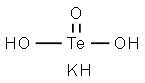
What is POTASSIUM TELLURITE?
Chemical properties
Granular, white powder. Hygroscopic; decomposes at 460–470C. Soluble in water.
The Uses of POTASSIUM TELLURITE
Potassium tellurite along with agar may be used as a component of a selective medium for growth of bacteria.
The Uses of POTASSIUM TELLURITE
In 1:50,000 solution for detecting presence of living pathogenic bacteria in sera and vaccines, such organisms forming characteristic black reduction Compounds.
Definition
ChEBI: A potassium salt consisting of potassium and tellurite ions in a 2:1 ratio.
General Description
Potassium tellurite is a hygroscopic granular white powder. It decomposes at 460-470oC.
Safety Profile
A poison by an unspecified route. Human systemic effects by ingestion: sleep dsturbance, anorexia, nausea. When heated to decomposition it emits toxic fumes of K2O and Te. See also TELLURIUM compounds.
Properties of POTASSIUM TELLURITE
| Melting point: | decomposes at 460–470℃ [HAW93] |
| storage temp. | 2-8°C |
| solubility | very soluble in H2O |
| form | white hygroscopic crystals |
| color | white hygroscopic crystals, crystalline |
| Water Solubility | g/100g H2O: 8.8 (0°C), 27.5 (20°C), 50.4 (30°C) [LAN05] |
| CAS DataBase Reference | 7790-58-1(CAS DataBase Reference) |
| EPA Substance Registry System | Telluric acid (H2TeO3), potassium salt (1:2) (7790-58-1) |
Safety information for POTASSIUM TELLURITE
| Signal word | Danger |
| Pictogram(s) |
 Skull and Crossbones Acute Toxicity GHS06 |
| GHS Hazard Statements |
H301:Acute toxicity,oral H315:Skin corrosion/irritation H319:Serious eye damage/eye irritation |
| Precautionary Statement Codes |
P264:Wash hands thoroughly after handling. P264:Wash skin thouroughly after handling. P270:Do not eat, drink or smoke when using this product. P280:Wear protective gloves/protective clothing/eye protection/face protection. P301+P310:IF SWALLOWED: Immediately call a POISON CENTER or doctor/physician. P302+P352:IF ON SKIN: wash with plenty of soap and water. P305+P351+P338:IF IN EYES: Rinse cautiously with water for several minutes. Remove contact lenses, if present and easy to do. Continuerinsing. |
Computed Descriptors for POTASSIUM TELLURITE
New Products
2-(2-Chlorophenyl)glycine Propiolic Acid 1-(3-Hydroxy-4-methoxyphenyl)-2-nitroethene (±)-amino(2-fluorophenyl)acetic acid trans-3-Benzyloxy-4-methoxy-beta-nitrostyrene 1-Pentadecanol 4-(4-Αminophenyl)-3-Morpholinone 3-Morpholino-1-(4-(2-oxopiperidin-1-yl) phenyl)-5,6-dihyropyridin-2-(1H)-one 1-(4-Aminophenyl)-3-morpholino-5,6-dihydropyridin-2(1H)-one N-cyanoacetylurethane 1H-IndazoleRelated products of tetrahydrofuran

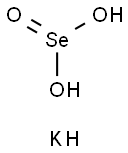
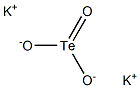


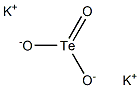
You may like
-
 Potassium Tellurite Anhydrous extrapure CAS 7790-58-1View Details
7790-58-1 -
Potassium tellurite CAS 7790-58-1View Details
7790-58-1 -
Potassium tellurite CAS 7790-58-1View Details
7790-58-1 -
471-25-0 Propiolic Acid 98+View Details
471-25-0 -
84145-28-8 98+View Details
84145-28-8 -
2-(2-Chlorophenyl)glycine 88744-36-9 98+View Details
88744-36-9 -
40216-83-9 trans-4-Hydroxy-L-proline methyl ester hydrochloride 98+View Details
40216-83-9 -
1-(3-Hydroxy-4-methoxyphenyl)-2-nitroethene 98+View Details
39816-35-8
Statement: All products displayed on this website are only used for non medical purposes such as industrial applications or scientific research, and cannot be used for clinical diagnosis or treatment of humans or animals. They are not medicinal or edible.