
POLY(VINYL FORMAL)
Synonym(s):Polyvinylformal
- CAS NO.:26876-25-5
- Empirical Formula: C3H6O2
- Molecular Weight: 74.07854
- MDL number: MFCD00084463
- SAFETY DATA SHEET (SDS)
- Update Date: 2026-06-24 18:39:39
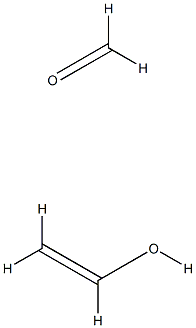
What is POLY(VINYL FORMAL)?
Preparation
Poly(vinyl formal) is generally prepared directly from poly(vinyl acetate)
without isolation ofthe intermediate poly(vinyl alcohol). In a typical process,
poly(vinyl acetate) is dissolved in acetic acid and then formalin and a small
quantity of sulphuric acid (catalyst) are added. The mixture is heated at 70°C for 24 hours. Water is then added to the product with rapid agitation and the
poly(vinyl formal) is precipitated as granules, which are washed with alkali
and dried.
As the formal content increases there is a
progressive increase in softening point, impact strength and hardness. The
materials, being amorphous, are soluble in solvents of similar solubility
parameter, such as dichloroethylene and dioxan; as the acetate content
increases, the polymers become more soluble in ketones, esters and glycol
ethers.
The principal use of poly(vinyl formal) is in the electrical insulation of
magnet wire. For this purpose, polymers with low hydroxyl content (5-6%)
and low acetate content (10-13%) are used in admixture with a resol phenolic
resin. On heating at about 175°C, cross-linking occurs; this reaction probably
involves the formation of ether links by condensation of methylol groups in
the resol and hydroxyl groups in the poly(vinyl formal). These coatings are
extremely tough; of particular significance is the fact that they are able to
withstand high-speed winding operations.
Properties of POLY(VINYL FORMAL)
| Density | 1.23 g/mL at 25 °C(lit.) |
| refractive index | n |
| form | powder |
| EPA Substance Registry System | Formaldehyde, polymer with ethenol (26876-25-5) |
Safety information for POLY(VINYL FORMAL)
Computed Descriptors for POLY(VINYL FORMAL)
New Products
2-Bromo-4-hydroxypyridine Dibenzoyl-L-tartaric acid Anhydrous (Resolution Reagent) Dibenzo[b,f][1,4]thiazepin-11(10H)-one 1,2,3,9-Tetrahydro-9-Methyl-4H-Carbazole-4-One Cis-Tosylate 1-(4-methoxyphenyl)-4-(4-Nitrophenyl)Piperazine (IT-1) 2'-Fluoroacetophenone 1-aminocyclobutanecarbonitrile hydrochloride AMINO-O-TOLYL-ACETIC ACID N-Methyl-2-amino-2-methylpropionamide 4-(FMOC-AMINO)-TETRAHYDROPYRAN-4-CARBOXYLIC ACID 1-Aminocyclobutanecarboxylic Acid Hydrochloride METHANOL-D1(OD) TERTIARY BUTANOL-D9 N-ETHYL-D5-AMINE HYDROCHLORIDE BENZOIC ACID-D CHLOROFORM-D TOLUENE-D3 2-(2-Bromophenyl)ethanol Boc-D-Glu(OMe)-OMe 2,5 Dibromopyridine Ethyl 4-hydroxy-3-oxobutanoate Dimethyl (2S)-2-((tert-butoxycarbonyl)amino)-4-(cyanomethyl)pentanedioate 1-(3-Chlorophenyl)piperazine hydrochlorideRelated products of tetrahydrofuran








You may like
-
 98071-16-0 1-Aminocyclobutanecarboxylic Acid Hydrochloride 98+View Details
98071-16-0 -
106914-07-2 N-Methyl-2-amino-2-methylpropionamide 98+View Details
106914-07-2 -
129592-98-9 98+View Details
129592-98-9 -
4-(FMOC-AMINO)-TETRAHYDROPYRAN-4-CARBOXYLIC ACID 98+View Details
285996-72-7 -
1-aminocyclobutanecarbonitrile hydrochloride 845821-84-3 98+View Details
845821-84-3 -
98071-16-0 1-Aminocyclobutanecarboxylic Acid Hydrochloride 98+View Details
98071-16-0 -
 ADC-151View Details
27176-87-0 -
 Nickel Acetate | Eastmen Chemicals - Manufacturer, Supplier, Exporter metallic saltsView Details