
POLY(HEXAMETHYLENE DIISOCYANATE)
Synonym(s):1,6-Diisocyanatohexane homopolymer;1,6-Diisocyanatohexane polymer;HMDI homopolymer
- CAS NO.:28182-81-2
- Empirical Formula: (C8H12N2O2)x
- Molecular Weight: 168.19
- MDL number: MFCD00197906
- EINECS: 931-274-8
- SAFETY DATA SHEET (SDS)
- Update Date: 2026-05-28 06:05:44
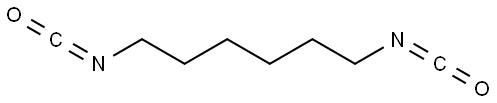
What is POLY(HEXAMETHYLENE DIISOCYANATE)?
Chemical properties
Hexamethylene diisocyanate is a colorless liquid. Sharp, irritating odor.
The Uses of POLY(HEXAMETHYLENE DIISOCYANATE)
PolyHDI can be used as a compatibilizer to increase the complex viscosity of poly(3-hydroxybutyrate-co-3-hydroxyvalerate) (PHBV)/poly(lactic acid) biopolymer based blends. It can be used as a hardener that can be mixed with polyol resins to form polyurethane coatings with a wide range of applications like self-cleaning.
General Description
Poly(hexamethylene diisocyanate) (PolyHDI) is an aliphatic compound belonging to the class of isocyanates. It is generally prepared by reacting hexamethylene diamine with phosgene.
Potential Exposure
Used to make other chemicals, coat ings, and polyurethane. It is also used as a hardener in automobile and airplane paints.
Shipping
UN2281 Hexamethylene diisocyanate, Hazard Class: 6.1; Labels: 6.1-Poisonous materials.
Incompatibilities
May form explosive mixture with air. Isocyanates are highly flammable and reactive with many compounds, even with themselves. Incompatible with oxi dizers (chlorates, nitrates, peroxides, permanganates, per chlorates, chlorine, bromine, fluorine, etc.); contact may cause fires or explosions. Reaction with moist air, water or alcohols may form amines and insoluble polyureas and react exothermically, releasing toxic, corrosive or flamma ble gases, including carbon dioxide; and, at the same time, may generate a violent release of heat increasing the con centration of fumes in the air. Incompatible with amines, aldehydes, alkali metals, ammonia, carboxylic acids, capro lactum, alkaline materials, glycols, ketones, mercaptans, hydrides, organotin catalysts, phenols, strong acids, strong bases, strong reducing agents such as hydrides, urethanes, ureas. Elevated temperatures or contact with acids, bases, tertiary amines, and acyl-chlorides may cause explosive polymerization. Attacks some plastics, rubber and coatings. Contact with metals may evolve flammable hydrogen gas. May accumulate static electrical charges, and may cause ignition of its vapors. Temperatures above 200℃ can cause polymerization. Attacks copper.
Properties of POLY(HEXAMETHYLENE DIISOCYANATE)
| Density | 1.12 g/mL at 25 °C |
| vapor pressure | 0.002-0.003Pa at 20-25℃ |
| refractive index | n |
| Flash point: | >230 °F |
| EPA Substance Registry System | Hexamethylene diisocyanate homopolymer (28182-81-2) |
Safety information for POLY(HEXAMETHYLENE DIISOCYANATE)
| Signal word | Danger |
| Pictogram(s) |
 Skull and Crossbones Acute Toxicity GHS06 |
| GHS Hazard Statements |
H317:Sensitisation, Skin H331:Acute toxicity,inhalation H335:Specific target organ toxicity, single exposure;Respiratory tract irritation |
| Precautionary Statement Codes |
P261:Avoid breathing dust/fume/gas/mist/vapours/spray. P271:Use only outdoors or in a well-ventilated area. P272:Contaminated work clothing should not be allowed out of the workplace. P280:Wear protective gloves/protective clothing/eye protection/face protection. P302+P352:IF ON SKIN: wash with plenty of soap and water. |
Computed Descriptors for POLY(HEXAMETHYLENE DIISOCYANATE)
New Products
Dibenzoyl-L-tartaric acid Anhydrous (Resolution Reagent) Cis-Tosylate Dibenzo[b,f][1,4]thiazepin-11(10H)-one 1,2,3,9-Tetrahydro-9-Methyl-4H-Carbazole-4-One 1-(4-methoxyphenyl)-4-(4-Nitrophenyl)Piperazine (IT-1) BOC Piperazine 1-Benzhydrylazetane-3-carbonitrile 8-oxa-1,3-diazaspiro[4.5]decane-2,4-dione (±)-amino(2-fluorophenyl)acetic acid 2-(2-Chlorophenyl)glycine AMINO-(3-CHLORO-PHENYL)-ACETIC ACID 2'-Fluoroacetophenone METHANOL-D1(OD) TERTIARY BUTANOL-D9 N-ETHYL-D5-AMINE HYDROCHLORIDE BENZOIC ACID-D CHLOROFORM-D TOLUENE-D3 Trans,trans muconic acid HC Blue-16 4-Amino-2-chloro-6,7-dimethoxyquinazoline Ethyl 4,5-bis(2-methoxyethoxy)-2-nitrobenzoate 2,3-Dimethoxypyridine 1-(3-Chlorophenyl)piperazine hydrochlorideRelated products of tetrahydrofuran

You may like
-
 Poly(hexamethylene diisocyanate) CAS 28182-81-2View Details
28182-81-2 -
 Product IntroductionView Details
 -
 Product InrtroductionView Details
 -
 DGO24View Details
 -
 DGO25View Details
 -
 DGO29View Details
 -
 DGO32View Details
 -
 DGO36View Details