
Platelet Activating Factor-16
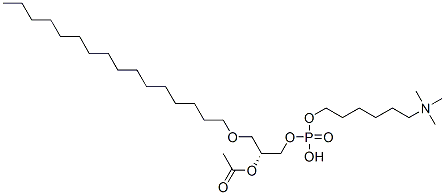
Synonym(s):Platelet activating factor;1-O-hexadecyl-2-acetyl-sn-glycero-3-phosphocholine;1-O-Palmityl-2-acetyl-sn-glycero-3-phosphocholine monohydrate;2-Acetyl-1-hexadecyl-sn-glycero-3-phosphocholine;3-sn-Phosphatidylcholine, 1-hexadecyl-2-acetyl
- CAS NO.:74389-68-7
- Empirical Formula: C26H54NO7P
- Molecular Weight: 523.68
- MDL number: MFCD00043214
- SAFETY DATA SHEET (SDS)
- Update Date: 2026-07-27 17:00:41
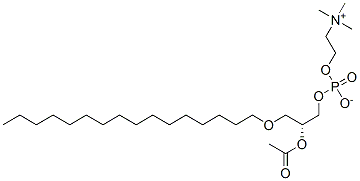
What is Platelet Activating Factor-16?
The Uses of Platelet Activating Factor-16
PAF (C16) (cas# 74389-68-7) is a blood platelet-activating factor, used to study human airway smooth muscle cell line.
The Uses of Platelet Activating Factor-16
C16-02:0 PC or 1-O-hexadecyl-2-acetyl-sn-glycero-3-phosphocholine may be used as a substrate in enzymatic lipoprotein-associated phospholipase A2 (Lp-PLA2) activity assay. It may also be used to study its physicochemical properties and its interaction with peptides derived from the C-terminal domains of human apolipoprotein E.
What are the applications of Application
PAF C-16 is a PAF-R, MAP kinase, and MAP kinase kinase activator
Definition
ChEBI: A 2-acetyl-1-alkyl-sn-glycero-3-phosphocholine betaine which has hexadecyl as the alkyl group. PAF is a potent phospholipid activator and mediator of many leukocyte functions, including platelet aggregation, inflammation, and anaphylaxis.
General Description
C16-02:0 PC, also known as 1-O-hexadecyl-2-acetyl-sn-glycero-3-phosphocholine (C16 PAF) (acetyl PAF), is a platelet-activating factor (PAF). Acetyl PAF is present in the body and it contains ether-linked hexadecyl chain at the sn-1 position and an acetyl group at the sn-2 position.
Biological Activity
Endogenous platelet-activating factor (PAF) and ligand for PAF receptors. Produced by inflammatory cells and a potent chemoattractant for polymorphonuclear neutrophils. Induces increased vascular permeability.
Biochem/physiol Actions
Platelet-activating factor (PAF) is a pro-inflammatory agent that exhibits variety of biological and pharmacological effects. It plays a major role in initiation and progression of atherosclerosis. PAF acts as a potential biomarker for coronary artery diseases. It yields LysoPAF (1-O-alkyl-2-hydroxy-sn-glycero-3-phosphocholine) on hydrolysis by platelet-activating factor-acetylhydrolase.
Storage
Store at -20°C
Properties of Platelet Activating Factor-16
| Melting point: | 247 °C |
| storage temp. | -20°C |
| solubility | Soluble in H2O or ethanol |
| form | lyophilized powder |
| color | White to off-white |
| Water Solubility | Soluble to 100 mM in water |
| BRN | 3574588 |
Safety information for Platelet Activating Factor-16
Computed Descriptors for Platelet Activating Factor-16
New Products
2-Bromo-4-hydroxypyridine Dibenzoyl-L-tartaric acid Anhydrous (Resolution Reagent) Dibenzo[b,f][1,4]thiazepin-11(10H)-one 1,2,3,9-Tetrahydro-9-Methyl-4H-Carbazole-4-One Cis-Tosylate 1-(4-methoxyphenyl)-4-(4-Nitrophenyl)Piperazine (IT-1) 1-aminocyclobutanecarbonitrile hydrochloride AMINO-O-TOLYL-ACETIC ACID 1-Aminocyclobutanecarboxylic Acid Hydrochloride AMINO(2-BROMOPHENYL)ACETIC ACID 6-BROMOTETRAZOLO[1,5-A]PYRIDINE 3-Oxocyclobutanecarboxylic acid METHANOL-D1(OD) TERTIARY BUTANOL-D9 N-ETHYL-D5-AMINE HYDROCHLORIDE BENZOIC ACID-D CHLOROFORM-D TOLUENE-D3 2-(2-Bromophenyl)ethanol Boc-D-Glu(OMe)-OMe 2,5 Dibromopyridine Ethyl 4-hydroxy-3-oxobutanoate Dimethyl (2S)-2-((tert-butoxycarbonyl)amino)-4-(cyanomethyl)pentanedioate 1-(3-Chlorophenyl)piperazine hydrochlorideRelated products of tetrahydrofuran

You may like
-
 C16-02:0 PC CAS 74389-68-7View Details
74389-68-7 -
β-Acetyl-γ-O-hexadecyl-L-α-phosphatidylcholine hydrate CAS 74389-68-7View Details
74389-68-7 -
Platelet Activating Factor-16 CAS 74389-68-7View Details
74389-68-7 -
C16-02:0 PC CAS 74389-68-7View Details
74389-68-7 -
254762-66-8 AMINO(2-BROMOPHENYL)ACETIC ACID 98+View Details
254762-66-8 -
254762-66-8 AMINO(2-BROMOPHENYL)ACETIC ACID 98+View Details
254762-66-8 -
23716-23-1 98+View Details
23716-23-1 -
6-BROMOTETRAZOLO[1,5-A]PYRIDINE 98+View Details
5799-75-7