
PD 173074
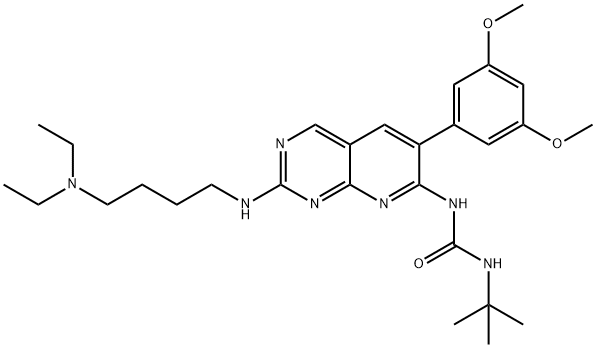
Synonym(s):1- t-Butyl-3-(6-(3,5-dimethoxyphenyl)-2-(4-diethylaminobutylamino)-pyrido[2,3-d]pyrimidin-7-yl)urea, PD173074, VEGFR Tyrosine Kinase Inhibitor XXIII, VEGFR2 Kinase Inhibitor XX;1-t-Butyl-3-(6-(3,5-dimethoxyphenyl)-2-(4-diethylaminobutylamino)-pyrido[2,3-d]pyrimidin-7-yl)urea, PD173074, VEGFR Tyrosine Kinase Inhibitor XXIII, VEGFR2 Kinase Inhibitor XX;FGF/VEGF Receptor Tyrosine Kinase Inhibitor, PD173074 - CAS 219580-11-7 - Calbiochem
- CAS NO.:219580-11-7
- Empirical Formula: C28H41N7O3
- Molecular Weight: 523.67
- MDL number: MFCD08705327
- SAFETY DATA SHEET (SDS)
- Update Date: 2026-07-27 17:00:41
What is PD 173074?
Description
PD173074 (219580-11-7) is an inhibitor of FGFR tyrosine kinase, and to a lesser extent VEGFR1?(IC50?values are 5 nM, 22.5 nM and 100 nM for FGFR1, FGFR3 and VEGFR respectively). Inhibition of FGFR by PD173074 promotes stem cell self renewal.2,3
Chemical properties
Yellow Solid
The Uses of PD 173074
PD 173074 ar signal-related kinase phosphorylation.
The Uses of PD 173074
A selective FGFR1 and
The Uses of PD 173074
PD173074 is a potent FGFR1 inhibitor with IC50 of ~25 nM and also inhibits VEGFR2 with IC50 of 100-200 nM.
What are the applications of Application
PD173074 is Potent inhibitor of FGF and VEGF (Flt/Flk) receptors
Definition
ChEBI: A member of the class of ureas that is 1-tert-butylurea in which one of the hydrogens attached to N3 is substituted by a pyrido[2,3-d]pyrimidin-7-yl group, which is itself substituted at pos tions 2 and 6 by a 4-(diethylamino)butyl]amino group and a 3,5-dimethoxyphenyl group, respectively. It is a FGF/VEGF receptor tyrosine kinase inhibitor.
Biological Activity
Selective FGFR1 and FGFR3 inhibitor (IC 50 values are 5, 21.5, ~100, 17600 and 19800 nM for FGFR3, FGFR1, VEGFR2, PDGFR and c-Src respectively, and > 50000 nM for EGFR, InsR, MEK and PKC). Inhibits VEGF- and FGF-induced angiogenesis in the mouse cornea model of angiogenesis. Inhibits proliferation and differentiation of oligodendrocyte progenitors.
Biochem/physiol Actions
PD 173074 is a fibroblast growth factor receptor 3 (FGFR3) inhibitor: IC50 = 5 nM inhibition of FGFR3 autophosphorylation. PD 173074 arrests the G0/G1 phase of FGFR3-expressing cells. It is 100-fold more selective for FGFR3 than for VEGF receptors, IGF-1 receptors, and MAPKs.
in vitro
pd173074 was found to block h-510 and h-69 sclc proliferation and clonogenic growth in a dose-dependent fashion and prevent fgf-2-induced chemoresistance as well. these effects correlate with the inhibition of both fgfr1 and fgfr2 transphosphorylation. in addition, pd173074 showed a high degree of selectivity for fgfr tyrosine kinase [2].
in vivo
in the h-510 xenograft mouse model, tumor growth was significanlty improved similar to that seen with single-agent cisplatin administration. accordingly, pd173074 treatment resulted in significanlty prolonged median survival when compared with that of control sham-treated animals. more dramatically, pd173074 also induced complete responses lasting >6 months in 50% of in mice h-69 xenografts [2].
Storage
+4°C
References
1 Bansal?et al. (2003),?Specific inhibitor of FGF receptor signaling: FGF-2 mediated effects on proliferation, differentiation and MAPK activation are inhibited by PD173074 in oligodendrocyte-lineage cells; J. Neurosci. Res.,?74?486 2) Kim?et al. (2012),?Regulation of autocrine fibroblast growth factor-2 signaling by perfusion flow in 3D human mesenchymal stem cell constructs; Biotechnol. Prog.,?28?1384 3) Zaragosi?et al. (2006),?Autocrine fibroblast growth factor 2 signaling is critical for self renewal of human multipotent adipose-derived stem cells; Stem Cells,?24?2412
Properties of PD 173074
| Melting point: | 82-85°C |
| Density | 1.163 |
| storage temp. | 2-8°C |
| solubility | DMSO: 21 mg/mL |
| form | solid |
| pka | 10.12±0.43(Predicted) |
| color | yellow |
| Stability: | Stable for 1 year from date of purchase as supplied. Solutions in DMSO may be stored at -20° for up to 3 months. |
Safety information for PD 173074
| Signal word | Warning |
| Pictogram(s) |
 Exclamation Mark Irritant GHS07 |
| GHS Hazard Statements |
H315:Skin corrosion/irritation H319:Serious eye damage/eye irritation H335:Specific target organ toxicity, single exposure;Respiratory tract irritation |
| Precautionary Statement Codes |
P261:Avoid breathing dust/fume/gas/mist/vapours/spray. P271:Use only outdoors or in a well-ventilated area. P280:Wear protective gloves/protective clothing/eye protection/face protection. |
Computed Descriptors for PD 173074
New Products
9-Mesityl-10-methylacridinium perchlorate Sulfapyridine Fmoc-OSu (R)-(-)-2-Amino-1-propanol Cyclobutanone 5-bromo-4-fluoro-2-nitrobenzaldehyde 4 pentyn 1 ol N-Vinylformamide Phenethyl cinnamate Pyrrolo[1,2-a]pyrimidine-6-carboxylic acid, 4,6,7,8-tetrahydro-4-oxo-, sodium salt (1:1), (6S) Ethyl 3-phenylpropanoate β-Bromostyrene Methacrylate-PEG-Methacrylate, Mn:35000 2,4-Dihydroxyacetophenone 2-Chloro 5-Fluoro Pyridine Vasicinone 2-Chloroisonicotinic Acid Tween 80 or Polysorbate 80 5-Bromo-1-Pentyne 1-(2-Methyl-5-nitrophenyl)guanidine Nitrate Methyl trans-4-Aminocyclohexanecarboxylate Hydrochloride 2-Pentyn-1-oL 4-Nitrobenzotrifluoride N-(4-Cyano-3-(trifluoromethyl)phenyl)-2-methyloxirane-2-carboxamideRelated products of tetrahydrofuran
You may like
-
 PD 173074 CAS 219580-11-7View Details
219580-11-7 -
Pd173074 95% CAS 219580-11-7View Details
219580-11-7 -
FGF/VEGF Receptor Tyrosine Kinase Inhibitor, PD173074 CAS 219580-11-7View Details
219580-11-7 -
Fmoc-OSu 98+View Details
82911-69-1 -
1191-95-3 Cyclobutanone 98+View Details
1191-95-3 -
213382-45-7 98+View Details
213382-45-7 -
Fmoc-OSu 98+View Details
82911-69-1 -
(R)-(-)-2-Amino-1-propanol 35320-23-1 98+View Details
35320-23-1