
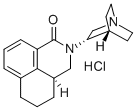
Palonosetron
- CAS NO.:135729-56-5
- Empirical Formula: C19H22N2O
- Molecular Weight: 294.39
- MDL number: MFCD07783848
- SAFETY DATA SHEET (SDS)
- Update Date: 2026-05-20 15:45:26
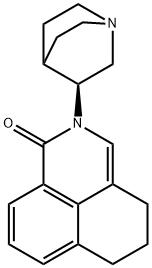
What is Palonosetron?
Absorption
Low oral bioavailability.
Toxicity
A single intravenous dose of palonosetron at 30 mg/kg (947 and 474 times the human dose for rats and mice, respectively, based on body surface area) was lethal to rats and mice. The major signs of toxicity were convulsions, gasping, pallor, cyanosis and collapse.
The Uses of Palonosetron
Palonosetron can be used to Anti-emetic; antinauseant.
Indications
For the prevention of acute and delayed nausea and vomiting associated with initial and repeat courses of moderately emetogenic cancer chemotherapy, as well as prevention of acute nausea and vomiting associated with highly emetogenic cancer chemotherapy. Also used for the prevention of postoperative nausea and vomiting for up to 24 hours post operation.
Background
Palonosetron (INN, trade name Aloxi) is an antagonist of 5-HT3 receptors that is indicated for the prevention and treatment of chemotherapy-induced nausea and vomiting (CINV). It is the most effective of the 5-HT3 antagonists in controlling delayed CINV nausea and vomiting that appear more than 24 hours after the first dose of a course of chemotherapy and is the only drug of its class approved for this use by the U.S. Food and Drug Administration. As of 2008, it is the most recent 5-HT3 antagonist to enter clinical use.
brand name
Aloxi (Helsinn).
Pharmacokinetics
Palonosetron is an antinauseant and antiemetic agent indicated for the prevention of nausea and vomiting associated with moderately-emetogenic cancer chemotherapy and for the prevention of postoperative nausea and vomiting. Palonosetron is a highly specific and selective serotonin 5-HT3 receptor antagonist that is pharmacologically related to other 5-HT3 receptor antagonists, but differs structurally. Palonosetron has a high affinity for 5-HT3 receptors, but has little to no affinity for other receptors. The serontonin 5-HT3 receptors are located on the nerve terminals of the vagus in the periphery, and centrally in the chemoreceptor trigger zone of the area postrema. It is suggested that chemotherapeutic agents release serotonin from the enterochromaffin cells of the small intestine by causing degenerative changes in the GI tract. The serotonin then stimulates the vagal and splanchnic nerve receptors that project to the medullary vomiting center, as well as the 5-HT3 receptors in the area postrema, thus initiating the vomiting reflex, causing nausea and vomiting.
Metabolism
Hepatic (50%), primarily CYP2D6-mediated, although CYP3A4 and CYP1A2 are also involved.
Properties of Palonosetron
| Boiling point: | 511.0±50.0 °C(Predicted) |
| Density | 1.24 |
| pka | 9.77±0.33(Predicted) |
Safety information for Palonosetron
Computed Descriptors for Palonosetron
New Products
2-Benzyl-1,1,3,3-tetramethylisoindoline 2-Bromo-4-hydroxypyridine 1-aminocyclobutanecarbonitrile hydrochloride AMINO(2-BROMOPHENYL)ACETIC ACID 6-BROMOTETRAZOLO[1,5-A]PYRIDINE AMINO-(3-FLUORO-PHENYL)-ACETIC ACID 3-Oxocyclobutanecarboxylic acid 1,3-Diazaspiro[4.5]decane-2,4-dione, 8,8-difluoro- 3-tert-Butyl-5-bromobenzaldehyde Methyl 6-(hydroxymethyl)nicotinate 4-Bromo-3-iodoaniline 2,5 Dibromopyridine 4'-(Methylmercapto)-acetophrnonone Enzyme Breaker for Coal Bed Methane Slickwaterr Shale Oil Guar Gum System Enzyme Breaker Water Well Guar Gum System Enzyme-based Deplugging Agent Water Well Slickwater Enzyme-based Deplugging Agent Shale Oil Slickwater Enzyme Breaker Enzyme Breaker for Slickwater in Gas Wells PET FLAKE WASHING CHEMICALRelated products of tetrahydrofuran
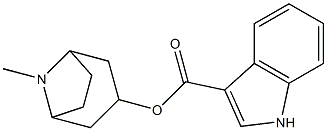
![(S)-N-(1-Azabicyclo[2.2.2]oct-3-yl)-5,6,7,8-tetrahydro-1-naphthalenecarboxamide](https://img.chemicalbook.in/CAS/GIF/135729-78-1.gif)
You may like
-
 7292-74-2 AMINO-(3-FLUORO-PHENYL)-ACETIC ACID 98+View Details
7292-74-2 -
1393823-97-6 98+View Details
1393823-97-6 -
7292-74-2 AMINO-(3-FLUORO-PHENYL)-ACETIC ACID 98+View Details
7292-74-2 -
1393823-97-6 98+View Details
1393823-97-6 -
3-Oxocyclobutanecarboxylic acid 98+View Details
23716-23-1 -
7292-74-2 AMINO-(3-FLUORO-PHENYL)-ACETIC ACID 98+View Details
7292-74-2 -
1393823-97-6 98+View Details
1393823-97-6 -
3-Oxocyclobutanecarboxylic acid 98+View Details
23716-23-1