
p-Chlorobenzoyl peroxide Bis(p-ehlorobenzoyl)peroxide
- CAS NO.:94-17-7
- Empirical Formula: C14H8Cl2O4
- Molecular Weight: 311.12
- MDL number: MFCD00072660
- EINECS: 202-310-3
- SAFETY DATA SHEET (SDS)
- Update Date: 2025-12-31 14:38:37
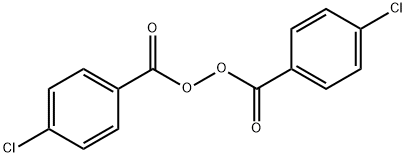
What is p-Chlorobenzoyl peroxide Bis(p-ehlorobenzoyl)peroxide?
Chemical properties
White, odorless powder. Decomposes violently on heating or contamination. Insoluble in water; soluble in organic solvents.
The Uses of p-Chlorobenzoyl peroxide Bis(p-ehlorobenzoyl)peroxide
Curing agent for silicone rubbers.
Definition
A mixture of 50% bis(p-chlorobenzoyl)peroxide in silicone fluid.
General Description
Odorless white solid or paste. Sinks in water.
Reactivity Profile
In pure crystalline form there is danger of explosion upon heating, shock, or friction. Peroxides are good oxidizing agents. Organic compounds can ignite on contact with concentrated peroxides. Strongly reduced material such as sulfides, nitrides, and hydrides may react explosively with peroxides. There are few chemical classes that do not at least produce heat when mixed with peroxides. Many produce explosions or generate gases (toxic and nontoxic). Generally, dilute solutions of peroxides (<70%) are safe, but the presence of a catalyst (often a transition metal such as cobalt, iron, manganese, nickel, or vanadium) as an impurity may even then cause rapid decomposition, a buildup of heat, and even an explosion.
Hazard
Dangerous fire and explosion risk, explodes when heated to 38C, strong oxidizer, will ignite on contact with organic materials. Store in dark, cool locality. Toxic.
Health Hazard
Irritates eyes and (on prolonged contact) skin. Ingestion causes irritation of mouth and stomach.
Safety Profile
Moderately toxic byintraperitoneal route. Probably an irritant to skin andmucous membranes. Dangerous fire hazard; a powerfuloxidizer. Store in a cool place away from fire hazards,sparks, open flames, and out of the direct rays of the sun.Dangerous e
Carcinogenicity
The only other data available for this organic peroxide show that it had no effects on tumor cells when injected intraperitoneally at 125mg/kg in the chest wall of mice .
Properties of p-Chlorobenzoyl peroxide Bis(p-ehlorobenzoyl)peroxide
| Melting point: | 137-138 °C |
| Boiling point: | 427.4±55.0 °C(Predicted) |
| Density | 1.4614 (estimate) |
| color | A white, granular material |
| EPA Substance Registry System | Peroxide, bis(4-chlorobenzoyl) (94-17-7) |
Safety information for p-Chlorobenzoyl peroxide Bis(p-ehlorobenzoyl)peroxide
Computed Descriptors for p-Chlorobenzoyl peroxide Bis(p-ehlorobenzoyl)peroxide
New Products
3-AMINO-3-(2-FLUORO-PHENYL)-PROPIONIC ACID Pentadecanoic acid Hendecanoic acid 2-AMINO-3-METHYLQUINOLINE HYDROCHLORIDE 3-Hydroxypropionitrile DL-3-Amino-3-(2-methoxyphenyl)propionic acid 5-Bromo-2-Fluoropyridine 2,3-Diamino-5-Chloropyridine 2-Amino-3-Hydroxypyridine 2,6-Diamino Pyridine 4-Amino-2-Chloropyridine 2-Hydroxy-4-Picoline 4-(4-(Dimethylamino)-1-(4-fluorophenyl)-1-hydroxybutyl)-3-(hydroxymethyl)benzonitrile 4-Bromo-3-(ethoxymethyl)benzoic acid 2,4-Dichloro-5-methoxyaniline 4,6-Dichloro-2-(propylthio)pyrimidin-5-amine N2-Isobutyryl-2'-O-methylguanosine 2-chloro-5-methylpyridin-4-amine 4-Bromobenzaldehyde 2-Chloro-6-nitro benzothiazole 2-Amino-4-phenyl-thiazole 4-Chloro-2-methyl quinoline 2-(Chloromethyl) quinazolin-4(3H)-one 5-Phenyl-[1,3,4]-thiadiazol-2-amineYou may like
-
 Bis-(4-chlorobenzoyl)-peroxide 98%View Details
 -
 2-Bromo-4-nitropyridine-N-oxide 52092-43-0 98%View Details
52092-43-0 -
18979-61-8 98%View Details
18979-61-8 -
4, 4'-Ditolylamine (or) 4,4-Dimethyl Diphenylamine 620-93-9 98%View Details
620-93-9 -
2-Bromo-5-Chloropyridine 98%View Details
40473-01-6 -
2-Picolinic acid N-oxide 824-40-8 98%View Details
824-40-8 -
2-(2,4-Diaminophenoxy)ethanol Dihydrochloride 98%View Details
66422-95-5 -
 Eperisone Hydrochloride APIView Details
56839-43-1