
OLEIC ACID, FROM TALL OIL FATTY ACIDS
- Empirical Formula: C18H34O2
- Molecular Weight: 282.46136
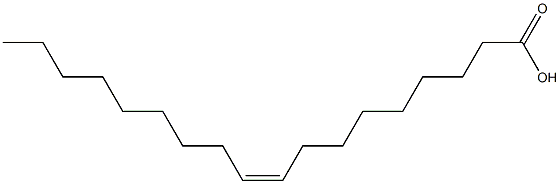
What is OLEIC ACID, FROM TALL OIL FATTY ACIDS?
Description
Tall oil (“tall” is Swedish for “pine”) is basically the sap of the
pine tree. The tall oil of commerce, however, is a by-product
derived from the waste liquors of the pinewood pulp mills in the
kraft or sulfate process of paper manufacture. It consists mainly
of a mixture of fatty and resin (or rosin) acids, and varies in
composition and properties depending upon the source of the wood
and the processing methods used. The resin acids and fatty acids
(tall oil) are removed from the wood and converted to soaps by
the highly alkaline pulping chemicals. Crude tall oil, recovered
when the skimmings are acidified, is separated through distillation
into resin and fatty acid fractions. A large portion of the resin acids
is used in the paper industry, and most of the fatty acids in the
paint and detergent industries.
Crude tall oil is composed of two major fractions, tall oil resin
acids and tall oil fatty acids, and a minor fraction consisting of a
mixture of unsaponifiable or “neutral” substances. The bulk of the
resin acids, comprising about 42 percent of tall oil, consists of
diterpenoid monocarboxylic derivatives of alkylated hydrophenanthrenes
of the abietic and pimaric acid types. A typical analysis
of tall oil resin shows an abietic acid content of 34 percent; dehydroabietic
acid, 24 percent; palustdc acid, 9 percent; isopimadc
acid, 6 percent; dihydroabietic acid, 5 percent; pimaric acid,
5 percent; and neoabietic acid, 5 percent.
The fatty acid fraction constitutes about 51 percent of the tall oil.
Oleic and linoleic acids, in approximately equal percentages, comprise
about 80 percent of this fraction, and cis-5,9,12-octadecatrienoic
acid accounts for about 10 percent. The remaining
10 percent consists of small amounts of various acids including
myristic, palmitic, stearic, palmitoleic, linolenic, and a number of saturated and mono-, di-, and triunsaturated acids, ranging from C17
(straight and branched chain) to C20 (straight chain). The locations
of the double bonds in the octadecatrienoic and eicosatrienoic acids
of tall oil differ from those of the seed fats. The characteristic compounds
of the former are cis-5,9,12-octadecatrienoic and cis-5,11,14-
eicosatrienoic acid.
The unsaponifiable fraction accounts for about 7 percent of tall oil.
It consists mainly of hydrocarbons, sterols, including α- and
(β-sitosterol and stigmasterol, and some of the higher alcohols. Sitosterol,
identified by several workers as largely p-sitosterol, makes up
from 70 to 75 percent of this fraction. This sterol has been of medical
interest because of its reported anti-cholesterolemic properties.
Tall oil fractions, e.g., distilled tall oils and tall oil light ends
ranging in color from pale to dark, are available on the market
under a number of trade names; composition and properties vary
depending on conditions of manufacture.
Tall oil can also be used as a defoaming agent in the manufacture
of paper and paperboard intended for use in packaging, transporting,
or holding food and as a substance generally recognized as
safe for use as a component of adhesives. Constituents or fractions
of tall oil, e.g., oleic and linoleic acids, tall oil rosin and dark tall
oil rosin, tall oil pitch, and tall oil soaps, may be used in foods,
as defined in these regulations, or in the manufacture of articles
or components of articles intended for use in producing, manufacturing,
packing, processing, preparing, treating, packaging, transporting,
or holding food.
Safety information for OLEIC ACID, FROM TALL OIL FATTY ACIDS
New Products
2-Amino-5-bromo- benzoic acid Dibenzoyl-L-tartaric acid Anhydrous (Resolution Reagent) 1,2,3,9-Tetrahydro-9-Methyl-4H-Carbazole-4-One Cis-Tosylate Dibenzo[b,f][1,4]thiazepin-11(10H)-one BOC Piperazine N-Methyl-2-amino-2-methylpropionamide 4-(FMOC-AMINO)-TETRAHYDROPYRAN-4-CARBOXYLIC ACID 1-Aminocyclobutanecarboxylic Acid Hydrochloride 3-Oxocyclobutanecarboxylic acid AMINO(2-BROMOPHENYL)ACETIC ACID 6-BROMOTETRAZOLO[1,5-A]PYRIDINE 4-Amino-2-chloro-6,7-dimethoxyquinazoline 2,3-Dimethoxypyridine 2,6-bis(bromomethyl)pyridine tert-Butyl 4-mercaptopiperidine-1-carboxylate 4'-(Methylmercapto)-acetophrnonone 1-Benzhydrylazetidin-3-ol-Hcl 1-(3-Chlorophenyl)piperazine hydrochloride Enzyme Breaker for Coal Bed Methane Slickwaterr Gas Well Guar Gum Enzyme Breaker Enzyme Breaker for Conventional Slickwater Fracturing Conventional Fracturing Guar Gum Enzyme Breaker Coalbed Methane Guar Gum Enzyme BreakerYou may like
-
 254762-66-8 AMINO(2-BROMOPHENYL)ACETIC ACID 98+View Details
254762-66-8 -
254762-66-8 AMINO(2-BROMOPHENYL)ACETIC ACID 98+View Details
254762-66-8 -
23716-23-1 98+View Details
23716-23-1 -
6-BROMOTETRAZOLO[1,5-A]PYRIDINE 98+View Details
5799-75-7 -
254762-66-8 AMINO(2-BROMOPHENYL)ACETIC ACID 98+View Details
254762-66-8 -
23716-23-1 98+View Details
23716-23-1 -
6-BROMOTETRAZOLO[1,5-A]PYRIDINE 98+View Details
5799-75-7 -
1778-09-2 4'-(Methylmercapto)-acetophrnonone 98%View Details
1778-09-2