
OCTYL ISOBUTYRATE
- CAS NO.:109-15-9
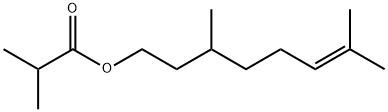
- Empirical Formula: C12H24O2
- Molecular Weight: 200.32
- MDL number: MFCD00048933
- EINECS: 203-651-0
- SAFETY DATA SHEET (SDS)
- Update Date: 2026-06-24 18:39:39
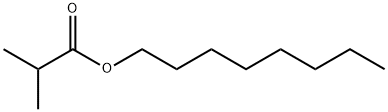
What is OCTYL ISOBUTYRATE?
Description
Octyl isobutyrate has a fruity, fatty fragrance with a soft and humid undertone reminiscent of parsley and fern root with a sweet flavor suggestive of grape. May be prepared by esterification of n-octanol with isobutyric acid.
Chemical properties
Octyl isobutyrate has a fruity, fatty fragrance with a soft and humid undertone reminiscent of parsley and fern root. It has a sweet flavor suggestive of grape.
Occurrence
Reported found among the volatile components of hop. Also reported found in grapefruit juice and babaco fruit (Carica pentagona Heilborn).
The Uses of OCTYL ISOBUTYRATE
Octyl isobutyrate is used in imitation Pistacio, Grape, Melon, Peach, Citrus complexes, fruit blends, wine and Liqueur flavors, ect. The concentration is normally about 2 to 4 ppm in the finished product.
Preparation
Esterification of n-octanol with isobutyric acid.
Definition
ChEBI: Octyl 2-methyl-propionyl is a carboxylic ester.
Aroma threshold values
Detection: 6 ppb
Taste threshold values
Taste characteristics at 30 ppm: creamy, waxy, fruity, earthy and fatty.
Metabolism
Isobutyrates are hydrolysed to materials that are either normally in the diet or readily converted to such materials (Fassett, 1963a). Isobutyric acid occurs normally in the metabolism of valine, being converted to a propionyl group and entering into the glycogenic process (Fassett, 1963b). π-Octanol is largely oxidized in vivo; about 10% is excreted conjugated with glucuronic acid in rabbits. Isomeric octanols may be more highly conjugated; they may also be oxidized to the ketone or may be excreted unchanged (Williams, 1959).
Properties of OCTYL ISOBUTYRATE
| Melting point: | -56°C (estimate) |
| Boiling point: | 245 °C(lit.) |
| Density | 0.856 g/mL at 25 °C(lit.) |
| refractive index | n |
| FEMA | 2808 | OCTYL ISOBUTYRATE |
| Flash point: | 206 °F |
| color | A colourless liquid. |
| Odor | at 100.00 %. oily green waxy soapy clean fruity creamy |
| JECFA Number | 192 |
| EPA Substance Registry System | Propanoic acid, 2-methyl-, octyl ester (109-15-9) |
Safety information for OCTYL ISOBUTYRATE
Computed Descriptors for OCTYL ISOBUTYRATE
New Products
9-Mesityl-10-methylacridinium perchlorate Sulfapyridine Fmoc-OSu (R)-(-)-2-Amino-1-propanol Cyclobutanone 5-bromo-4-fluoro-2-nitrobenzaldehyde 4 pentyn 1 ol N-Vinylformamide Phenethyl cinnamate Pyrrolo[1,2-a]pyrimidine-6-carboxylic acid, 4,6,7,8-tetrahydro-4-oxo-, sodium salt (1:1), (6S) Ethyl 3-phenylpropanoate β-Bromostyrene Methacrylate-PEG-Methacrylate, Mn:35000 2,4-Dihydroxyacetophenone 2-Chloro 5-Fluoro Pyridine Vasicinone 2-Chloroisonicotinic Acid Tween 80 or Polysorbate 80 5-Bromo-1-Pentyne 1-(2-Methyl-5-nitrophenyl)guanidine Nitrate Methyl trans-4-Aminocyclohexanecarboxylate Hydrochloride 2-Pentyn-1-oL 4-Nitrobenzotrifluoride N-(4-Cyano-3-(trifluoromethyl)phenyl)-2-methyloxirane-2-carboxamideRelated products of tetrahydrofuran
You may like
-
 Octyl Isobutyrate (109-15-9), Packaging Size: 25 kgView Details
109-15-9 -
 1191-95-3 Cyclobutanone 98+View Details
1191-95-3 -
Fmoc-OSu 98+View Details
82911-69-1 -
(R)-(-)-2-Amino-1-propanol 35320-23-1 98+View Details
35320-23-1 -
1191-95-3 Cyclobutanone 98+View Details
1191-95-3 -
213382-45-7 98+View Details
213382-45-7 -
Fmoc-OSu 98+View Details
82911-69-1 -
(R)-(-)-2-Amino-1-propanol 35320-23-1 98+View Details
35320-23-1