
Oclacitinib Maleate(PF-03394197)
- CAS NO.:1208319-27-0
- Empirical Formula: C19H27N5O6S
- Molecular Weight: 453.51
- MDL number: MFCD30533388
- EINECS: 200-001-8
- Update Date: 2026-08-06 14:26:04
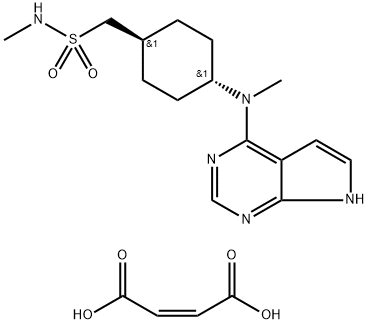
What is Oclacitinib Maleate(PF-03394197)?
Description
APOQUEL (oclacitinib maleate) was the first selective Janus kinase (JAK) inhibitor to be developed for dogs. It was recently approved for the control of pruritus associated with allergic dermatitis and control of atopic dermatitis in dogs at least 12 months of age. In recent years, there has been a significant evolution in understanding regarding the pathophysiology of allergic and atopic diseases. The molecular mechanisms involved in stimulating the itch response have been elaborated (Marsella et al., 2012), and it is now understood that cytokines play a key role in initiating the neuronal itch stimulation which triggers pruritic behavior (scratching, rubbing, chewing, etc.) in dogs. This leads to the establishment of a vicious cycle of itch that exacerbates skin lesions and amplifies defects in the skin barrier function in clinically affected dogs. This progress provided the opportunity to develop new treatments (Marsella et al., 2012). Specifically, Janus kinases play a central role in cytokine signaling and are involved in signal transduction of many pro-inflammatory, pro-allergic, and pruritogenic cytokines including IL-2, IL-4, IL-6, IL-13, and IL-31 that are implicated in allergic conditions (Ong & Leung, 2006; Carmi-Levy et al., 2011).
The Uses of Oclacitinib Maleate(PF-03394197)
Oclacitinib is labeled to treat atopic dermatitis and itchiness (pruritus) caused by allergies in dogs, though it has also been used to reduce the itchiness and dermatitis caused by flea infestations. It is considered to be highly effective in dogs, and has been established as safe for at least short-term use. Its efficacy equals that of prednisolone at first, though oclacitinib has been found to be more effective in the short term in terms of itchiness and dermatitis, long term safety is unknown. It has been found to have a faster onset and cause less gastrointestinal issues than cyclosporine. While safe in the short term, oclacitinib's long-term safety is unknown. While some say it is best only for acute flares of itchiness, others claim that it is also useful in chronic atopic dermatitis.
Pharmacokinetics
The pharmacokinetics of oclacitinib maleate was evaluated in four separate studies. The absolute bioavailability study used a crossover design with 10 dogs. The effect of food on bioavailability was investigated in a crossover study with 18 dogs. The breed effect on pharmacokinetics was assessed in a crossover study in beagles and mongrels dogs. Dose proportionality and multiple dose pharmacokinetics were evaluated in a parallel design study with eight dogs per group. In all four studies, serial blood samples for plasma were collected. Oclacitinib maleate was rapidly and well absorbed following oral administration, with a time to peak plasma concentration of<1 h and an absolute bioavailability of 89%. The prandial state of dogs did not significantly affect the rate or extent of absorption of oclacitinib maleate when dosed orally, as demonstrated by the lack of significant differences in pharmacokinetic parameters between the oral fasted and oral fed treatment groups. The pharmacokinetics of oclacitinib in laboratory populations of beagles and mixed breed dogs also appeared similar. Following oral administration, the exposure of oclacitinib maleate increased dose proportionally from 0.6 to 3.0 mg/kg. Additionally, across the pharmacokinetic studies, there were no apparent differences in oclacitinib pharmacokinetics attributable to sex
Side Effects
There are several caveats to the use of Oclacitinib maleate. This medication is meant to control the symptoms of itching. For many patients, ending itching also ends scratching and chewing. Ending scratching and chewing ends infections and a vicious cycle can finally be broken. The problem is that while oclacitinb maleate can control itching, it does may not control the disease that is causing the itching. If there is an infection present, it will continue to be present; it simply will not be itchy. It is important not to let skin disease persist simply because the dog is comfortable. The disease must be controlled as well. The oclacitinib maleate label contains a caution against use in patients with cancer. While oclacitinib maleate does not cause cancer, there is question about whether it can interfere with natural protective mechanisms that help control cancer. If a patient is known to have cancer or known to have an undefined growth on its body or if there is any reason to suspect a patient might be harboring cancer, it is important to discuss this caution with one's veterinarian before use of this medication. Oclacitinib maleate appears to promote or support Demodex skin mites. It should not be used to control itching associated with Demodectic Mange.
Properties of Oclacitinib Maleate(PF-03394197)
| Melting point: | 135 - 137°C |
| storage temp. | -20°C, Inert atmosphere |
| solubility | DMSO (Slightly), Methanol (Slightly, Sonicated) |
| form | Solid |
| color | White to Off-White |
Safety information for Oclacitinib Maleate(PF-03394197)
Computed Descriptors for Oclacitinib Maleate(PF-03394197)
| InChIKey | VQIGDTLRBSNOBV-VQIYXBGXNA-N |
| SMILES | C(/C(=O)O)=C/C(=O)O.N([C@@H]1CC[C@@H](CS(=O)(=O)NC)CC1)(C1N=CN=C2NC=CC=12)C |&1:9,12,r| |
New Products
2-Benzyl-1,1,3,3-tetramethylisoindoline 2-Bromo-4-hydroxypyridine 1-aminocyclobutanecarbonitrile hydrochloride AMINO(2-BROMOPHENYL)ACETIC ACID 6-BROMOTETRAZOLO[1,5-A]PYRIDINE AMINO-(3-FLUORO-PHENYL)-ACETIC ACID 3-Oxocyclobutanecarboxylic acid 1,3-Diazaspiro[4.5]decane-2,4-dione, 8,8-difluoro- 3-tert-Butyl-5-bromobenzaldehyde Methyl 6-(hydroxymethyl)nicotinate 4-Bromo-3-iodoaniline 2,5 Dibromopyridine 4'-(Methylmercapto)-acetophrnonone Enzyme Breaker for Coal Bed Methane Slickwaterr Shale Oil Guar Gum System Enzyme Breaker Water Well Guar Gum System Enzyme-based Deplugging Agent Water Well Slickwater Enzyme-based Deplugging Agent Shale Oil Slickwater Enzyme Breaker Enzyme Breaker for Slickwater in Gas Wells PET FLAKE WASHING CHEMICALYou may like
-
![1208319-27-0 Oclacitinib Maleate [VET] 98%](https://img.chemicalbook.in//ProductImageIndia/2024-03/Raw/9592c5f6-4b38-4705-a310-bb410744bce6.png) 1208319-27-0 Oclacitinib Maleate [VET] 98%View Details
1208319-27-0 Oclacitinib Maleate [VET] 98%View Details
1208319-27-0 -
 7292-74-2 AMINO-(3-FLUORO-PHENYL)-ACETIC ACID 98+View Details
7292-74-2 -
7292-74-2 AMINO-(3-FLUORO-PHENYL)-ACETIC ACID 98+View Details
7292-74-2 -
1393823-97-6 98+View Details
1393823-97-6 -
3-Oxocyclobutanecarboxylic acid 98+View Details
23716-23-1 -
7292-74-2 AMINO-(3-FLUORO-PHENYL)-ACETIC ACID 98+View Details
7292-74-2 -
1393823-97-6 98+View Details
1393823-97-6 -
3-Oxocyclobutanecarboxylic acid 98+View Details
23716-23-1