
N,N-Dimethylacrylamide
Synonym(s):2-Propenamide
- CAS NO.:2680-03-7
- Empirical Formula: C5H9NO
- Molecular Weight: 99.13
- MDL number: MFCD00008626
- EINECS: 220-237-5
- SAFETY DATA SHEET (SDS)
- Update Date: 2026-07-31 17:49:05
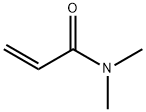
What is N,N-Dimethylacrylamide?
Description
N, N-dimethylacrylamide (DMAA) is an easily polymerized, nonionic monomer. The high reactivity and low initiation temperature of DMAA makes it appropriate for copolymerization. Copolymers of DMAA with N, N-dimethyl-N, and N-diallyl ammonium chloride (DMDAAC) can be used as polymeric flocculants for water treatment. The unique structure of DMAA shows amelioration in hydrogels for specific applications. DMAA, along with other hydrogels, has a three-dimensional network structure that is capable of retaining water. In addition, DMAA hydrogel can be applied to remove toxic metal ions from wastewater because of its characteristic properties such as chemical stability and high adsorption capacity. DMAA can also be used for flocculation due to its ability to augment the molecular weight of the copolymers[1].
Chemical properties
Colorless liquid
The Uses of N,N-Dimethylacrylamide
N,N-Dimethylacrylamide is a useful monomer for synthetic fibers and plastics. It is also used in the synthesis of photoresponsive polymers and copolymers by grafting polysiloxane on the side chain of DMA by homopolymerization or grafting cellulose to form cellulose polymers and copolymerization of methyl methacrylate with DMA or copolymerization of DMA with styrene and butadiene.
The Uses of N,N-Dimethylacrylamide
DMA is used in the synthesis of photoresponsive polymers. It is used in the synthesis of copolymers by
grafting polysiloxane on the side chain of DMA by homopolymerization or
grafting cellulose to form cellulose polymers and
copolymerization of methyl methacrylate with DMA or
copolymerization of DMA with styrene and butadiene
Synthesis Reference(s)
Journal of the American Chemical Society, 79, p. 875, 1957 DOI: 10.1021/ja01561a024
General Description
N,N-Dimethylacrylamide (DMA) is a nonionic acrylic monomer that can make swellable polymeric particles.
References
[1] Ayatzhan Akhmetzhan. “A Short Review on the N,N-Dimethylacrylamide-Based Hydrogels.” Gels 7 4 (2021).
Properties of N,N-Dimethylacrylamide
| Melting point: | 100 °C |
| Boiling point: | 80-81 °C/20 mmHg (lit.) |
| Density | 0.962 g/mL at 25 °C (lit.) |
| vapor pressure | 65Pa at 20℃ |
| refractive index | n |
| Flash point: | 161 °F |
| storage temp. | 2-8°C(protect from light) |
| form | Liquid |
| pka | -0.77±0.70(Predicted) |
| color | Colorless to Light yellow |
| Water Solubility | Slightly soluble in water (1.000 g/L at 20°C). |
| FreezingPoint | -40℃ |
| Sensitive | Light Sensitive |
| BRN | 1742219 |
| Exposure limits | ACGIH: TWA 5 mg/m3 NIOSH: TWA 5 mg/m3 |
| CAS DataBase Reference | 2680-03-7(CAS DataBase Reference) |
| NIST Chemistry Reference | 2-propenamide, N,N-dimethyl(2680-03-7) |
| EPA Substance Registry System | 2-Propenamide, N,N-dimethyl- (2680-03-7) |
Safety information for N,N-Dimethylacrylamide
| Signal word | Danger |
| Pictogram(s) |
 Corrosion Corrosives GHS05  Skull and Crossbones Acute Toxicity GHS06 |
| GHS Hazard Statements |
H318:Serious eye damage/eye irritation |
| Precautionary Statement Codes |
P264:Wash hands thoroughly after handling. P264:Wash skin thouroughly after handling. P270:Do not eat, drink or smoke when using this product. P280:Wear protective gloves/protective clothing/eye protection/face protection. P301+P310:IF SWALLOWED: Immediately call a POISON CENTER or doctor/physician. P305+P351+P338:IF IN EYES: Rinse cautiously with water for several minutes. Remove contact lenses, if present and easy to do. Continuerinsing. |
Computed Descriptors for N,N-Dimethylacrylamide
New Products
5-bromo-4-fluoro-2-nitrobenzaldehyde (R)-(-)-2-Amino-1-propanol Cyclobutanone Fmoc-OSu 1-(2-Chloroethyl)pyrrolidine Hydrochloride 2-Amino-2-(4-methylphenyl)acetic acid β-Bromostyrene Ethyl 3-phenylpropanoate Phenethyl cinnamate Dipropyl disulfide 4 pentyn 1 ol N-Vinylformamide Methacrylate-PEG-Methacrylate, Mn:35000 2,4-Dihydroxyacetophenone 2-Chloro 5-Fluoro Pyridine Vasicinone 2-Chloroisonicotinic Acid Tween 80 or Polysorbate 80 2-Butyn-1-oL 2-Pentyn-1-oL 4-Nitrobenzotrifluoride N-(4-fluoro-2-methoxy-5-nitrophenyl)-4-(1-methyl-1H-indol-3-yl)pyrimidin-2-amine Pirtobrutinib intd. N-(4-Cyano-3-(trifluoromethyl)phenyl)-2-methyloxirane-2-carboxamideRelated products of tetrahydrofuran



You may like
-
 N,N-Dimethylacrylamide, Stabilized with 100ppm 4-methoxyphenol CAS 2680-03-7View Details
2680-03-7 -
N,N-Dimethylacrylamide, Stabilized with 100ppm 4-methoxyphenol CAS 2680-03-7View Details
2680-03-7 -
N,N-Dimethylacrylamide, Stabilized with 100ppm 4-methoxyphenol CAS 2680-03-7View Details
2680-03-7 -
N,N-Dimethylacrylamide (stabilized with MEHQ) CAS 2680-03-7View Details
2680-03-7 -
N,N-Dimethylacrylamide CAS 2680-03-7View Details
2680-03-7 -
7250-67-1 1-(2-Chloroethyl)pyrrolidine Hydrochloride 98+View Details
7250-67-1 -
7250-67-1 1-(2-Chloroethyl)pyrrolidine Hydrochloride 98+View Details
7250-67-1 -
13227-01-5 98+View Details
13227-01-5