
NICLOFOLAN
- CAS NO.:10331-57-4
- Empirical Formula: C12H6Cl2N2O6
- Molecular Weight: 345.09
- MDL number: MFCD00867407
- EINECS: 233-720-0
- SAFETY DATA SHEET (SDS)
- Update Date: 2026-07-16 07:06:08
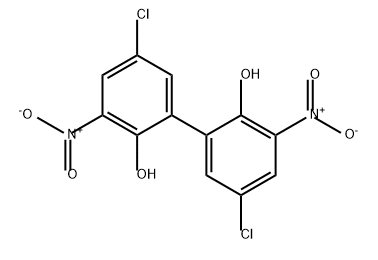
What is NICLOFOLAN?
Chemical properties
Orange-yellow crystalline powder. Melting point 178-182 ℃. Soluble in acetone, glacial acetic acid and sodium hydroxide solution, slightly soluble in water and ethanol.
The Uses of NICLOFOLAN
Niclofolan can be used as deworming drug and anti-creep drug. It is used for prevention and treatment of hepatic chioniasis of cattle and sheep.
Definition
ChEBI: Niclofolan is a polychlorobiphenyl.
Synthesis
Niclofolan is obtained by nitration of 5,5 '-dichloro-2, 2' dihydroxybiphenyl. The nitration was carried out in acetic acid at a temperature not exceeding 20℃. Then activated carbon was added for reflux decolorization for 1h. The filter was pumped with a nitrate filter rod. The filtrate was cooled below 15℃ and crystallized. Dinitrochlorophenol was obtained by filtration, washing with acetic acid and drying. The yield is 60%.
Properties of NICLOFOLAN
| Boiling point: | 251.5°C (rough estimate) |
| Density | 1.8594 (rough estimate) |
| refractive index | 1.7350 (estimate) |
| pka | 4.34±0.40(Predicted) |
| form | Solid |
| color | Light yellow to yellow |
| EPA Substance Registry System | Niclofolan (10331-57-4) |
Safety information for NICLOFOLAN
| Signal word | Danger |
| Pictogram(s) |
 Corrosion Corrosives GHS05  Exclamation Mark Irritant GHS07  Environment GHS09 |
| GHS Hazard Statements |
H302:Acute toxicity,oral H315:Skin corrosion/irritation H317:Sensitisation, Skin H318:Serious eye damage/eye irritation H410:Hazardous to the aquatic environment, long-term hazard |
| Precautionary Statement Codes |
P261:Avoid breathing dust/fume/gas/mist/vapours/spray. P264:Wash hands thoroughly after handling. P264:Wash skin thouroughly after handling. P270:Do not eat, drink or smoke when using this product. P272:Contaminated work clothing should not be allowed out of the workplace. P273:Avoid release to the environment. P280:Wear protective gloves/protective clothing/eye protection/face protection. P391:Collect spillage. Hazardous to the aquatic environment P302+P352:IF ON SKIN: wash with plenty of soap and water. P333+P313:IF SKIN irritation or rash occurs: Get medical advice/attention. P501:Dispose of contents/container to..… |
Computed Descriptors for NICLOFOLAN
New Products
9-Mesityl-10-methylacridinium perchlorate Sulfapyridine Fmoc-OSu (R)-(-)-2-Amino-1-propanol Cyclobutanone 5-bromo-4-fluoro-2-nitrobenzaldehyde 4 pentyn 1 ol N-Vinylformamide Phenethyl cinnamate Pyrrolo[1,2-a]pyrimidine-6-carboxylic acid, 4,6,7,8-tetrahydro-4-oxo-, sodium salt (1:1), (6S) Ethyl 3-phenylpropanoate β-Bromostyrene Methacrylate-PEG-Methacrylate, Mn:35000 2,4-Dihydroxyacetophenone 2-Chloro 5-Fluoro Pyridine Vasicinone 2-Chloroisonicotinic Acid Tween 80 or Polysorbate 80 5-Bromo-1-Pentyne 1-(2-Methyl-5-nitrophenyl)guanidine Nitrate Methyl trans-4-Aminocyclohexanecarboxylate Hydrochloride N-(4-Cyano-3-(trifluoromethyl)phenyl)-2-methyloxirane-2-carboxamide 4-Nitrobenzotrifluoride 2-Pentyn-1-oLRelated products of tetrahydrofuran


You may like
-
 1191-95-3 Cyclobutanone 98+View Details
1191-95-3 -
213382-45-7 98+View Details
213382-45-7 -
Fmoc-OSu 98+View Details
82911-69-1 -
(R)-(-)-2-Amino-1-propanol 35320-23-1 98+View Details
35320-23-1 -
1191-95-3 Cyclobutanone 98+View Details
1191-95-3 -
213382-45-7 98+View Details
213382-45-7 -
Fmoc-OSu 98+View Details
82911-69-1 -
(R)-(-)-2-Amino-1-propanol 35320-23-1 98+View Details
35320-23-1