
nickel(ii) formate dihydrate
- CAS NO.:15694-70-9
- Empirical Formula: Ni(HCO2)2.2H2O
- Molecular Weight: 0
- MDL number: MFCD00153034
- EINECS: 222-101-0
- SAFETY DATA SHEET (SDS)
- Update Date: 2026-06-15 22:31:22
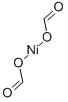
What is nickel(ii) formate dihydrate?
Description
Nickel(II) Formate Dihydrate [15694-70-9], Ni(HCOO)2·2 H2O, Mr 184.76, d 2.154, is obtained as green crystals by evaporation of a solution of nickel carbonate in formic acid. The anhydrous salt is obtained when the dihydrate is heated to 140 ℃; at 250 ℃, finely divided nickel metal is produced. Hence, nickel(II) formate is used in the production of nickel catalysts.
The Uses of nickel(ii) formate dihydrate
Nickel(II) formate dihydrate is used in nickel catalyst preparations. It is also used as a biochemical for proteomics research.
Properties of nickel(ii) formate dihydrate
| Melting point: | 130-140°C -2H₂O |
| Density | 2.15 |
| form | Powder |
| Specific Gravity | 2.15 |
| color | Green |
| Water Solubility | In the range 180-200° decomposes to Ni, CO, CO{2}, H{2}, H{2}O, CH{4}. Partially soluble in water |
| Merck | 14,6509 |
| Exposure limits | NIOSH: IDLH 10 mg/m3; TWA 0.015 mg/m3 |
Safety information for nickel(ii) formate dihydrate
| Signal word | Danger |
| Pictogram(s) |
 Health Hazard GHS08  Environment GHS09 |
| GHS Hazard Statements |
H317:Sensitisation, Skin H334:Sensitisation, respiratory H341:Germ cell mutagenicity H350:Carcinogenicity H360:Reproductive toxicity H372:Specific target organ toxicity, repeated exposure H400:Hazardous to the aquatic environment, acute hazard H410:Hazardous to the aquatic environment, long-term hazard |
| Precautionary Statement Codes |
P201:Obtain special instructions before use. P260:Do not breathe dust/fume/gas/mist/vapours/spray. P280:Wear protective gloves/protective clothing/eye protection/face protection. P284:Wear respiratory protection. P405:Store locked up. |
Computed Descriptors for nickel(ii) formate dihydrate
New Products
N-Carbethoxy-4-piperidone 1-Aminocyclopentane carbonitrile Tetrabutylammonium perchlorate N,O-Dimethylhydroxylamine hydrochloride (RS)-beta-Amino-beta-(4-bromophenyl)propionic acid 2-Amino-5-bromo-4-(trifluoromethyl)pyridine N-Vinylformamide 4 pentyn 1 ol Phenethyl cinnamate Dipropyl disulfide Ethyl 3-phenylpropanoate β-Bromostyrene Methacrylate-PEG-Methacrylate, Mn:35000 2,4-Dihydroxyacetophenone 2-Chloro 5-Fluoro Pyridine Vasicinone 2-Chloroisonicotinic Acid Tween 80 or Polysorbate 80 5-Bromo-1-Pentyne 1-(2-Methyl-5-nitrophenyl)guanidine Nitrate Methyl trans-4-Aminocyclohexanecarboxylate Hydrochloride N-(4-Cyano-3-(trifluoromethyl)phenyl)-2-methyloxirane-2-carboxamide 2-Pentyn-1-oL 4-NitrobenzotrifluorideRelated products of tetrahydrofuran

![hydrogen [N,N-bis(carboxymethyl)glycinato(3-)-N,O,O',O'']nickelate(1-)](https://img.chemicalbook.in/CAS/GIF/34831-03-3.gif)


You may like
-
 Nickel(II) formate dihydrate CAS 15694-70-9View Details
15694-70-9 -
Nickel(II) formate dihydrate CAS 15694-70-9View Details
15694-70-9 -
Nickel(II) formate dihydrate CAS 15694-70-9View Details
15694-70-9 -
144-83-2 Sulfapyridine 98+View Details
144-83-2 -
29976-53-2 98+View Details
29976-53-2 -
674783-97-2 98+View Details
674783-97-2 -
1-Aminocyclopentane carbonitrile 98+View Details
49830-37-7 -
Tetrabutylammonium perchlorate 1923-70-2 98+View Details
1923-70-2
Statement: All products displayed on this website are only used for non medical purposes such as industrial applications or scientific research, and cannot be used for clinical diagnosis or treatment of humans or animals. They are not medicinal or edible.