
NEORUSCOGENIN
- CAS NO.:17676-33-4
- Empirical Formula: C27H40O4
- Molecular Weight: 428.61
- MDL number: MFCD00210534
- EINECS: 241-660-1
- SAFETY DATA SHEET (SDS)
- Update Date: 2026-08-25 20:17:46
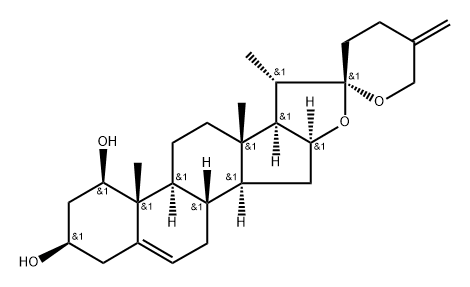
What is NEORUSCOGENIN?
The Uses of NEORUSCOGENIN
Neoruscogenin is a natural sapogenin isolated from Butcher’s broom (R. rhizoma), which is traditionally used against chronic venous disorders.
Biological Activity
neoruscogenin is a bioavailable, potent, and high-affinity agonist of the nuclear receptor rorα [1]. neoruscogenin is a natural sapogenin extracted from butcher’s broom (rusci rhizoma, ruscus aculeatus, ruscaceae) [2].rar-related orphan receptor alpha (rorα) is a nuclear receptor that participates in the transcriptional regulation of some genes involved incircadian rhythm. genetic studies have revealed that rorα plays an important role in the development of the central nervous system and has been associated with genetic lesions in mice [3].
in vitro
in confluent human microvascular endothelial cells (hmec-1), pre-treatment with neoruscogenin slightly decreased the permeability at concentrations up to 100 μm (71.8%). the ec50 of neoruscogenin against the nuclear receptor rorα was 110 nm [1].
in vivo
in mice, oral administration of neoruscogenin (3 mg/kg/d) for seven days up-regulated the expression of several rorα-inducible genes in the liver [1].
References
[1] helleboid s, haug c, lamottke k, et al. the identification of naturally occurring neoruscogenin as a bioavailable, potent, and high-affinity agonist of the nuclear receptor rorα (nr1f1)[j]. journal of biomolecular screening, 2013: 1087057113497095.
[2] barbi m, willer e a, rothenhfer m, et al. spirostanol saponins and esculin from rusci rhizoma reduce the thrombin-induced hyperpermeability of endothelial cells[j]. phytochemistry, 2013, 90: 106-113.
[3] giguère v. orphan nuclear receptors: from gene to function 1[j]. endocrine reviews, 1999, 20(5): 689-725.
Properties of NEORUSCOGENIN
| Melting point: | 196~198℃ |
| Density | 1.19±0.1 g/cm3 (20 ºC 760 Torr) |
| storage temp. | 4°C, protect from light |
| solubility | ≤30mg/ml in ethanol;30mg/ml in DMSO;30mg/ml in dimethyl formamide |
| form | crystalline solid |
| pka | 14.55±0.70(Predicted) |
| Boiling point: | 566.6±50.0 °C(Predicted) |
| color | White to off-white |
Safety information for NEORUSCOGENIN
Computed Descriptors for NEORUSCOGENIN
New Products
9-Mesityl-10-methylacridinium perchlorate Sulfapyridine Fmoc-OSu (R)-(-)-2-Amino-1-propanol Cyclobutanone 5-bromo-4-fluoro-2-nitrobenzaldehyde 4 pentyn 1 ol N-Vinylformamide Phenethyl cinnamate Pyrrolo[1,2-a]pyrimidine-6-carboxylic acid, 4,6,7,8-tetrahydro-4-oxo-, sodium salt (1:1), (6S) Ethyl 3-phenylpropanoate β-Bromostyrene Methacrylate-PEG-Methacrylate, Mn:35000 2,4-Dihydroxyacetophenone 2-Chloro 5-Fluoro Pyridine Vasicinone 2-Chloroisonicotinic Acid Tween 80 or Polysorbate 80 5-Bromo-1-Pentyne 1-(2-Methyl-5-nitrophenyl)guanidine Nitrate Methyl trans-4-Aminocyclohexanecarboxylate Hydrochloride 2-Pentyn-1-oL 4-Nitrobenzotrifluoride N-(4-Cyano-3-(trifluoromethyl)phenyl)-2-methyloxirane-2-carboxamideRelated products of tetrahydrofuran
You may like
-
 1191-95-3 Cyclobutanone 98+View Details
1191-95-3 -
213382-45-7 98+View Details
213382-45-7 -
Fmoc-OSu 98+View Details
82911-69-1 -
(R)-(-)-2-Amino-1-propanol 35320-23-1 98+View Details
35320-23-1 -
1191-95-3 Cyclobutanone 98+View Details
1191-95-3 -
213382-45-7 98+View Details
213382-45-7 -
Fmoc-OSu 98+View Details
82911-69-1 -
(R)-(-)-2-Amino-1-propanol 35320-23-1 98+View Details
35320-23-1