
Metribuzin
- CAS NO.:21087-64-9
- Empirical Formula: C8H14N4OS
- Molecular Weight: 214.29
- MDL number: MFCD00055525
- EINECS: 244-209-7
- SAFETY DATA SHEET (SDS)
- Update Date: 2026-07-31 15:25:14
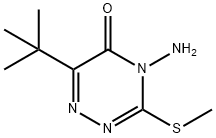
What is Metribuzin?
Description
Metribuzin is a colorless crystalline solid witha mild sulfurous odor; Freezing/Melting point =125- -127*C; Vapor pressure=4X 10⁻⁷ mmHg. SlightlyDescription: Metribuzin is a colorless crystalline solid witha mild sulfurous odor; Freezing/Melting point =125- -127*C; Vapor pressure=4X 10⁻⁷ mmHg. Slightlysoluble in water. Available in different concentrations (4%,50%, 75%).50%, 75%).
Chemical properties
White Solid
Chemical properties
Metribuzin is a colorless crystalline solid. Commercial product may be a flammable solution. Mild, sulfurous odor.
The Uses of Metribuzin
Metribuzin is an is an aminotriazinone herbicide used in agriculture for both pre- and post-emergence in crops including soy bean, potatoes, tomatoes and sugar cane. Metribuzin acts by inhibiting phot osynthesis by disrupting photosystem II.
The Uses of Metribuzin
Herbicide.
The Uses of Metribuzin
Selective herbicide used for preemergence broad-leaved weed control in potatoes, tomatoes, lucerne, raspberry and sugarcane, and postemergence weed control in beets. Also used for selective control of annual grasses.
Definition
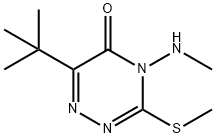
ChEBI: A member of the class of 1,2,4-triazines that is 1,2,4-triazin-5(4H)-one substituted by an amino group at position 4, tert-butyl group at position 6 and a methylsulfanyl group at position 3.
General Description
Colorless crystalline solid. Used as an herbicide. Non corrosive.
Reactivity Profile
A triazine derivative. Amines are chemical bases. They neutralize acids to form salts plus water. These acid-base reactions are exothermic. The amount of heat that is evolved per mole of amine in a neutralization is largely independent of the strength of the amine as a base. Amines may be incompatible with isocyanates, halogenated organics, peroxides, phenols (acidic), epoxides, anhydrides, and acid halides. Flammable gaseous hydrogen is generated by amines in combination with strong reducing agents, such as hydrides.
Hazard
Toxic material. Liver damage and hemato-logic effects. Questionable carcinogen.
Health Hazard
Low to moderate acute toxicity; single highdose may cause depression of central nervoussystem; repeated high doses affect thyroidand stimulate the metabolizing liver enzymes(ACGIH) 1986; excretes out rapidly; noirritant action on skin or eye; no teratogenic,mutagenic or carcinogenic effect observed inanimal studies.
LD50 oral (rat): 1100 mg/kg
LD50 oral (mouse): 698 mg/kg
LD50 oral (guinea pig): 250 mg/kg
LD50 skin (rat): 2000 mg/kg.
Agricultural Uses
Herbicide: Metribuzin is a selective triazine herbicide which inhibits photosynthesis of susceptible plant species. It is used for control of annual grasses and numerous broadleaf weeds in asparagus, potatoes, lucerne, peas, lentils, soya beans, sugar cane, sainfoin, pineapples and cereals. It is applied to fallow lands. Metribuzin is available as liquid suspension, water dispersible granular, and dry flowable formulations.
Trade name
AUTHORITY®; AXIOM® Metribuzin; BAY 61597®; BAY DIC 1468®; BAYER 6159H®; BAYER 6443H®; BAYER 94337®; BOUNDARY®; CANOPY®; CONQUEST®; DIC 1468®; DOMAIN®; LEXONE®; LEXONEEX®; PREVIEW®[C]; PYTHON®; SENCOR®; SENCORAL®; SENCOREX®; SENCORER®; VAPCOR®
Safety Profile
Poison by ingestion and intraperitoneal routes. Low toxicity by skin contact. When heated to decomposition it emits very toxic fumes of NOx and SOx.
Potential Exposure
A potential danger to those involved in manufacture, formulation, and application of this herbicide. A laboratory chemical. Used to make other chemicals.
First aid
If this chemical gets into the eyes, remove anycontact lenses at once and irrigate immediately for at least15 min, occasionally lifting upper and lower lids. Seek medical attention immediately. If this chemical contacts theskin, remove contaminated clothing and wash immediatelywith soap and water. Seek medical attention immediately. Ifthis chemical has been inhaled, remove from exposure,begin rescue breathing (using universal precautions, including resuscitation mask) if breathing has stopped and CPR ifheart action has stopped. Transfer promptly to a medicalfacility. When this chemical has been swallowed, get medical attention. Give large quantities of water and inducevomiting. Do not make an unconscious person vomit.
Environmental Fate
Soil. In soils, metribuzin undergoes deamination and further degradation forming water
soluble conjugates (Hartley and Kidd, 1987). Metribuzin degrades rapidly in soil (Kempson-
Jones and Hance, 1979; LaFleur, 1980). The half-lives in soil ranged from 4 to 9
weeks at 22°C and 60% moisture content to 9 to 11 weeks at 10°C and 10% moisture
content. The highest half-life reported ranged from 15 to 43 weeks in a soil having 60%
moisture content maintained at 10°C (Kempson-Jones and Hance, 1979).
The dissipation rates (day–1) for metribuzin on Hillsdale silty loam, Cecil silty loam,
Regina heavy clay, Melfort clay loam and White City silt loam were 0.013-0.017, 0.055-
0.131, >0.017, >0.0016 and >0.023, respectively.
Groundwater. According to the U.S. EPA (1986) metribuzin has a high potential to
leach to groundwater.
Plant. Metribuzin is metabolized in soybean plants to a deaminated diketo derivative
which is nonphytoxic (Duke et al., 1991).
Photolytic. The simulated sunlight (l >230 nm) photolysis as a thin film on silica gel
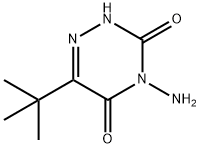
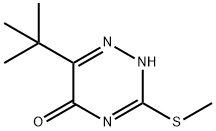
or sand yielded 6-(1,1-dimethylethyl)-3-(methylthio)-1,2,4-triazin-5-(4H)-one and two
additional photoproducts. In both of the unnamed photoproducts, the methylthio group in
the parent compound is replaced by oxygen and one of the compounds also underwent
N-deamination (Bartl and Korte, 1975).
Chemical/Physical. Emits toxic fumes of nitrogen and sulfur oxides when heated to
decomposition (Lewis, 1990).
Storage
Color Code—Blue: Health Hazard/Poison: Storein a secure poison location. Store in tightly closed containers in a cool, dry area.
Shipping
UN2763 Triazine pesticides, solid, toxic, Hazard Class: 6.1; Labels: 6.1-Poisonous materials.
Incompatibilities
Liquid is incompatible with oxidizers (chlorates, nitrates, peroxides, permanganates, perchlorates, chlorine, bromine, fluorine, etc.); contact may cause fires or explosions. Keep away from alkaline materials, strong bases, strong acids, oxoacids, epoxides.
Waste Disposal
In accordance with 40CFR165, follow recommendations for the disposal of pesticides and pesticide containers. Must be disposed properly by following package label directions or by contacting your local or federal environmental control agency, or by contacting your regional EPA office. Use a licensed professional waste disposal service to dispose of this material. Dissolve or mix the material with a combustible solvent and burn in a chemical incinerator equipped with an afterburner and scrubber. All federal, state, and local environmental regulations must be observed.
Properties of Metribuzin
| Melting point: | 125°C |
| Boiling point: | 132 °C(Press: 0.02 Torr) |
| Density | 1.28 |
| refractive index | 1.6390 (estimate) |
| Flash point: | 2 °C |
| storage temp. | APPROX 4°C
|
| solubility | DMSO (Slightly), Methanol (Slightly) |
| pka | -0.16±0.20(Predicted) |
| form | Solid |
| color | White |
| Odor | mild odor |
| Water Solubility | Slightly soluble |
| BRN | 746650 |
| Exposure limits | NIOSH REL: 5 mg/m3; ACGIH TLV: TWA 5 mg/m3. |
| NIST Chemistry Reference | Metribuzin(21087-64-9) |
| EPA Substance Registry System | Metribuzin (21087-64-9) |
Safety information for Metribuzin
| Signal word | Warning |
| Pictogram(s) |
 Exclamation Mark Irritant GHS07  Environment GHS09 |
| GHS Hazard Statements |
H302:Acute toxicity,oral H410:Hazardous to the aquatic environment, long-term hazard |
| Precautionary Statement Codes |
P264:Wash hands thoroughly after handling. P264:Wash skin thouroughly after handling. P270:Do not eat, drink or smoke when using this product. P273:Avoid release to the environment. P391:Collect spillage. Hazardous to the aquatic environment P501:Dispose of contents/container to..… |
Computed Descriptors for Metribuzin
Metribuzin manufacturer
Ekhande Agro Fertilizers Private Limited
New Products
2-Amino-5-bromo-4-(trifluoromethyl)pyridine Sulfapyridine Fmoc-OSu (R)-(-)-2-Amino-1-propanol Cyclobutanone 5-bromo-4-fluoro-2-nitrobenzaldehyde β-Bromostyrene Ethyl 3-phenylpropanoate Phenethyl cinnamate Dipropyl disulfide N-Vinylformamide 4 pentyn 1 ol Methacrylate-PEG-Methacrylate, Mn:35000 2,4-Dihydroxyacetophenone 2-Chloro 5-Fluoro Pyridine Vasicinone 2-Chloroisonicotinic Acid Tween 80 or Polysorbate 80 2-Butyn-1-oL 2-Pentyn-1-oL 4-Nitrobenzotrifluoride N-(4-fluoro-2-methoxy-5-nitrophenyl)-4-(1-methyl-1H-indol-3-yl)pyrimidin-2-amine Pirtobrutinib intd. N-(4-Cyano-3-(trifluoromethyl)phenyl)-2-methyloxirane-2-carboxamideRelated products of tetrahydrofuran

You may like
-
 21087-64-9 98%View Details
21087-64-9 -
 Metribuzin >98% (HPLC) CAS 21087-64-9View Details
21087-64-9 -
 Metribuzin 70 Wp HerbicideView Details
21087-64-9 -
 Granules Metribuzin 70% WP HerbicideView Details
21087-64-9 -
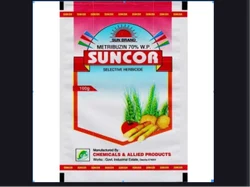 Suncor Metribuzin 70% WP HerbicideView Details
21087-64-9 -
 Powder Metribuzin 70% WP, 100 ml, Packaging Type: BottleView Details
21087-64-9 -
 METRIBUZINView Details
21087-64-9 -
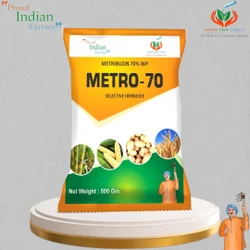 Powder Metribuzin 70 Wp Herbicide, 500 gmView Details
21087-64-9