
Methylmercury(II) hydroxide
- CAS NO.:1184-57-2
- Empirical Formula: CH4HgO
- Molecular Weight: 232.63
- MDL number: MFCD00013924
- EINECS: 214-667-2
- SAFETY DATA SHEET (SDS)
- Update Date: 2026-09-12 18:49:20
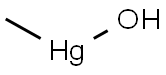
What is Methylmercury(II) hydroxide?
Chemical properties
usually provided as a colourless aqueous solution
The Uses of Methylmercury(II) hydroxide
Methyl mercury(II) hydroxide is used as defoliant and epoxidation catalyst, as denaturing agent.
General Description
Greenish-white powder or flakes with an unpleasant odor.
Air & Water Reactions
METHYLMERCURY(II) HYDROXIDE is sensitive to air and light. Slightly soluble in water.
Reactivity Profile
METHYLMERCURY(II) HYDROXIDE is incompatible with oxidizing materials, acid and acid fumes.
Fire Hazard
Flash point data for METHYLMERCURY(II) HYDROXIDE are not available. METHYLMERCURY(II) HYDROXIDE is probably combustible.
Safety Profile
Poison by intraperitoneal route. An experimental teratogen. Experimental reproductive effects. Human mutation data reported. When heated to decomposition it emits toxic fumes of Hg.
Properties of Methylmercury(II) hydroxide
| Melting point: | 137°C |
| Boiling point: | 39.8°C |
| RTECS | OW4900000 |
| form | Liquid |
| color | Colorless |
| Water Solubility | Slightly soluble in water. |
| Exposure limits | ACGIH: TWA 0.01 mg/m3; STEL 0.03 mg/m3 (Skin) OSHA: Ceiling 0.04 mg/m3 NIOSH: IDLH 2 mg/m3; IDLH 10 mg/m3; TWA 0.01 mg/m3; TWA 0.05 mg/m3; STEL 0.03 mg/m3; Ceiling 0.1 mg/m3 |
| Stability: | Stable. Incompatible with oxidizing agents, alkalis, acids, alkali earth metals, reactive inorganic and organic compounds. |
| CAS DataBase Reference | 1184-57-2 |
| EPA Substance Registry System | Methymercury hydroxide (1184-57-2) |
Safety information for Methylmercury(II) hydroxide
| Pictogram(s) |
 Skull and Crossbones Acute Toxicity GHS06  Health Hazard GHS08  Environment GHS09 |
| GHS Hazard Statements |
H300:Acute toxicity,oral H311:Acute toxicity,dermal H331:Acute toxicity,inhalation H373:Specific target organ toxicity, repeated exposure H401:Hazardous to the aquatic environment, acute hazard H411:Hazardous to the aquatic environment, long-term hazard |
| Precautionary Statement Codes |
P260:Do not breathe dust/fume/gas/mist/vapours/spray. P304+P340:IF INHALED: Remove victim to fresh air and Keep at rest in a position comfortable for breathing. P405:Store locked up. |
Computed Descriptors for Methylmercury(II) hydroxide
New Products
5-bromo-4-fluoro-2-nitrobenzaldehyde (R)-(-)-2-Amino-1-propanol Cyclobutanone Fmoc-OSu 1-(2-Chloroethyl)pyrrolidine Hydrochloride 2-Amino-2-(4-methylphenyl)acetic acid β-Bromostyrene Ethyl 3-phenylpropanoate Phenethyl cinnamate Dipropyl disulfide 4 pentyn 1 ol N-Vinylformamide Methacrylate-PEG-Methacrylate, Mn:35000 2,4-Dihydroxyacetophenone 2-Chloro 5-Fluoro Pyridine Vasicinone 2-Chloroisonicotinic Acid Tween 80 or Polysorbate 80 2-Butyn-1-oL 2-Pentyn-1-oL 4-Nitrobenzotrifluoride N-(4-fluoro-2-methoxy-5-nitrophenyl)-4-(1-methyl-1H-indol-3-yl)pyrimidin-2-amine Pirtobrutinib intd. N-(4-Cyano-3-(trifluoromethyl)phenyl)-2-methyloxirane-2-carboxamideRelated products of tetrahydrofuran



You may like
-
 Methylmercury(II) hydroxide CAS 1184-57-2View Details
1184-57-2 -
Methylmercury(II) hydroxide CAS 1184-57-2View Details
1184-57-2 -
7250-67-1 1-(2-Chloroethyl)pyrrolidine Hydrochloride 98+View Details
7250-67-1 -
13227-01-5 98+View Details
13227-01-5 -
7250-67-1 1-(2-Chloroethyl)pyrrolidine Hydrochloride 98+View Details
7250-67-1 -
13227-01-5 98+View Details
13227-01-5 -
7250-67-1 1-(2-Chloroethyl)pyrrolidine Hydrochloride 98+View Details
7250-67-1 -
13227-01-5 98+View Details
13227-01-5
Statement: All products displayed on this website are only used for non medical purposes such as industrial applications or scientific research, and cannot be used for clinical diagnosis or treatment of humans or animals. They are not medicinal or edible.