
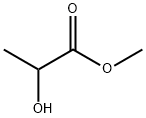
Methyl (R)-(+)-lactate
Synonym(s):D -Lactic acid methyl ester;Methyl (R)-(+)-lactate
- CAS NO.:17392-83-5
- Empirical Formula: C4H8O3
- Molecular Weight: 104.1
- MDL number: MFCD00004517
- EINECS: 241-420-6
- SAFETY DATA SHEET (SDS)
- Update Date: 2026-08-10 19:17:35
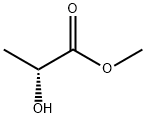
What is Methyl (R)-(+)-lactate?
Chemical properties
Colorless to light yellow liqui
The Uses of Methyl (R)-(+)-lactate
(+)-Methyl D-lactate can be used as a starting material in the asymmetric preparation of:
- Neomethymycin, a macrolide which contains 12-membered macrolactone that is used as a potent biological agent.
- PM-toxin A.
It can also be used as a chiral pool along with D-(-)-tartaric acid in the stereoselective total synthesis of separacenes A and B via Trost-Rychnovsky alkyne rearrangement, Horner-Wadsworth-Emmons olefination as well as Corey-Bakshi-Shibata reaction.
Definition
ChEBI: A methyl lactate that has R configuration.
General Description
This compound has benign qualities and is biodegradable, water miscible, and functions as a versatile solvent for CA membrane preparation. This is also used as an intermediate for the production of other chemicals, polymers, and derivatives. Thus this product has been enhanced for Safer solvents and auxiliaries.
Properties of Methyl (R)-(+)-lactate
| Boiling point: | 144-145 °C(lit.) |
| alpha | 8.5 º (c=neat) |
| Density | 1.09 g/mL at 25 °C(lit.) |
| refractive index | n |
| Flash point: | 121 °F |
| storage temp. | Inert atmosphere,2-8°C |
| solubility | Chloroform, Ethyl Acetate (Slightly), Methanol (Slightly) |
| pka | 13.07±0.20(Predicted) |
| form | Liquid |
| color | Clear colorless |
| optical activity | [α]21/D +8.4°, neat |
| Water Solubility | miscible, hydrolyses |
| Merck | 14,6094 |
| CAS DataBase Reference | 17392-83-5(CAS DataBase Reference) |
Safety information for Methyl (R)-(+)-lactate
| Signal word | Warning |
| Pictogram(s) |
 Flame Flammables GHS02  Exclamation Mark Irritant GHS07 |
| GHS Hazard Statements |
H226:Flammable liquids H319:Serious eye damage/eye irritation H335:Specific target organ toxicity, single exposure;Respiratory tract irritation |
| Precautionary Statement Codes |
P210:Keep away from heat/sparks/open flames/hot surfaces. — No smoking. P305+P351+P338:IF IN EYES: Rinse cautiously with water for several minutes. Remove contact lenses, if present and easy to do. Continuerinsing. |
Computed Descriptors for Methyl (R)-(+)-lactate
| InChIKey | LPEKGGXMPWTOCB-GSVOUGTGSA-N |
New Products
9-Mesityl-10-methylacridinium perchlorate Sulfapyridine Fmoc-OSu (R)-(-)-2-Amino-1-propanol Cyclobutanone 5-bromo-4-fluoro-2-nitrobenzaldehyde 4 pentyn 1 ol N-Vinylformamide Phenethyl cinnamate Pyrrolo[1,2-a]pyrimidine-6-carboxylic acid, 4,6,7,8-tetrahydro-4-oxo-, sodium salt (1:1), (6S) Ethyl 3-phenylpropanoate β-Bromostyrene Methacrylate-PEG-Methacrylate, Mn:35000 2,4-Dihydroxyacetophenone 2-Chloro 5-Fluoro Pyridine Vasicinone 2-Chloroisonicotinic Acid Tween 80 or Polysorbate 80 5-Bromo-1-Pentyne 1-(2-Methyl-5-nitrophenyl)guanidine Nitrate Methyl trans-4-Aminocyclohexanecarboxylate Hydrochloride N-(4-Cyano-3-(trifluoromethyl)phenyl)-2-methyloxirane-2-carboxamide 4-Nitrobenzotrifluoride 2-Pentyn-1-oLRelated products of tetrahydrofuran

You may like
-
 Methyl D-(+)-Lactate CAS 17392-83-5View Details
17392-83-5 -
Methyl (R)-(+)-lactate 98% CAS 17392-83-5View Details
17392-83-5 -
(+)-Methyl D-lactate, 98% CAS 17392-83-5View Details
17392-83-5 -
(+)-Methyl D-lactate CAS 17392-83-5View Details
17392-83-5 -
1191-95-3 Cyclobutanone 98+View Details
1191-95-3 -
213382-45-7 98+View Details
213382-45-7 -
Fmoc-OSu 98+View Details
82911-69-1 -
(R)-(-)-2-Amino-1-propanol 35320-23-1 98+View Details
35320-23-1
Statement: All products displayed on this website are only used for non medical purposes such as industrial applications or scientific research, and cannot be used for clinical diagnosis or treatment of humans or animals. They are not medicinal or edible.