
LORAZEPAM RELATED COMPOUND E (25 MG) (6-CHLORO-4-(O-CHLOROPHENYL)-2-QUINAZOLINE METHA-NOL)
- CAS NO.:773871-49-1
- Empirical Formula: C15H10Cl2N2O
- Molecular Weight: 305.16
- MDL number: MFCD06202988
- Update Date: 2026-05-28 01:13:51
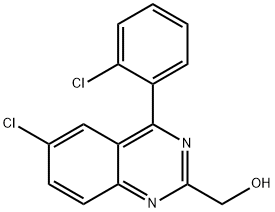
What is LORAZEPAM RELATED COMPOUND E (25 MG) (6-CHLORO-4-(O-CHLOROPHENYL)-2-QUINAZOLINE METHA-NOL)?
The Uses of LORAZEPAM RELATED COMPOUND E (25 MG) (6-CHLORO-4-(O-CHLOROPHENYL)-2-QUINAZOLINE METHA-NOL)
6-Chloro-4-(2-chlorophenyl)-2-quinazolinemethanol is a compound related to Lorazepam, an anxiolytic, and anticonvulsant. Lorazepam USP Related Compound E
Properties of LORAZEPAM RELATED COMPOUND E (25 MG) (6-CHLORO-4-(O-CHLOROPHENYL)-2-QUINAZOLINE METHA-NOL)
| Boiling point: | 384.4±42.0 °C(Predicted) |
| Density | 1.432±0.06 g/cm3(Predicted) |
| solubility | Chloroform (Slightly), Ethyl Acetate (Slightly) |
| form | neat |
| pka | 11.92±0.10(Predicted) |
Safety information for LORAZEPAM RELATED COMPOUND E (25 MG) (6-CHLORO-4-(O-CHLOROPHENYL)-2-QUINAZOLINE METHA-NOL)
| Signal word | Danger |
| Pictogram(s) |
 Corrosion Corrosives GHS05  Exclamation Mark Irritant GHS07 |
| GHS Hazard Statements |
H302:Acute toxicity,oral H318:Serious eye damage/eye irritation H413:Hazardous to the aquatic environment, long-term hazard |
| Precautionary Statement Codes |
P280:Wear protective gloves/protective clothing/eye protection/face protection. |
Computed Descriptors for LORAZEPAM RELATED COMPOUND E (25 MG) (6-CHLORO-4-(O-CHLOROPHENYL)-2-QUINAZOLINE METHA-NOL)
LORAZEPAM RELATED COMPOUND E (25 MG) (6-CHLORO-4-(O-CHLOROPHENYL)-2-QUINAZOLINE METHA-NOL) manufacturer
GLP Pharma Standards
3Y
Phone:+91-7893074638
Whatsapp: +91-7893074638
product: Lorazepam Related Compound-E NLT 95%
New Products
2-Amino-5-bromo- benzoic acid Dibenzoyl-L-tartaric acid Anhydrous (Resolution Reagent) 1,2,3,9-Tetrahydro-9-Methyl-4H-Carbazole-4-One Cis-Tosylate Dibenzo[b,f][1,4]thiazepin-11(10H)-one BOC Piperazine N-Methyl-2-amino-2-methylpropionamide 4-(FMOC-AMINO)-TETRAHYDROPYRAN-4-CARBOXYLIC ACID 1-Aminocyclobutanecarboxylic Acid Hydrochloride 3-Oxocyclobutanecarboxylic acid AMINO(2-BROMOPHENYL)ACETIC ACID 6-BROMOTETRAZOLO[1,5-A]PYRIDINE 4-Amino-2-chloro-6,7-dimethoxyquinazoline 2,3-Dimethoxypyridine 2,6-bis(bromomethyl)pyridine tert-Butyl 4-mercaptopiperidine-1-carboxylate 4'-(Methylmercapto)-acetophrnonone 1-Benzhydrylazetidin-3-ol-Hcl 1-(3-Chlorophenyl)piperazine hydrochloride Enzyme Breaker for Coal Bed Methane Slickwaterr Gas Well Guar Gum Enzyme Breaker Enzyme Breaker for Conventional Slickwater Fracturing Conventional Fracturing Guar Gum Enzyme Breaker Coalbed Methane Guar Gum Enzyme BreakerRelated products of tetrahydrofuran


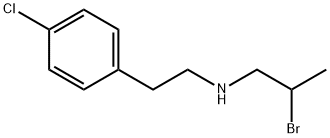
![1-[[2-(4-Chlorophenyl)ethyl]amino]-2-chloropropane](https://img.chemicalbook.in/CAS/GIF/953789-37-2.gif)
You may like
-
 Lorazepam Related Compound-E NLT 95%View Details
773871-49-1 -
254762-66-8 AMINO(2-BROMOPHENYL)ACETIC ACID 98+View Details
254762-66-8 -
23716-23-1 98+View Details
23716-23-1 -
6-BROMOTETRAZOLO[1,5-A]PYRIDINE 98+View Details
5799-75-7 -
254762-66-8 AMINO(2-BROMOPHENYL)ACETIC ACID 98+View Details
254762-66-8 -
23716-23-1 98+View Details
23716-23-1 -
6-BROMOTETRAZOLO[1,5-A]PYRIDINE 98+View Details
5799-75-7 -
1778-09-2 4'-(Methylmercapto)-acetophrnonone 98%View Details
1778-09-2
Statement: All products displayed on this website are only used for non medical purposes such as industrial applications or scientific research, and cannot be used for clinical diagnosis or treatment of humans or animals. They are not medicinal or edible.