
Lometrexol
Synonym(s):LY 264618 hydrate;N-[4-[2-[(6R)-2-amino-3,4,5,6,7,8-hexahydro-4-oxopyrido[2,3-d]pyrimidin-6-yl]ethyl]benzoyl]-L-glutamic acid hydrate
- CAS NO.:106400-81-1
- Empirical Formula: C21H25N5O6
- Molecular Weight: 443.45
- SAFETY DATA SHEET (SDS)
- Update Date: 2026-05-28 03:03:37
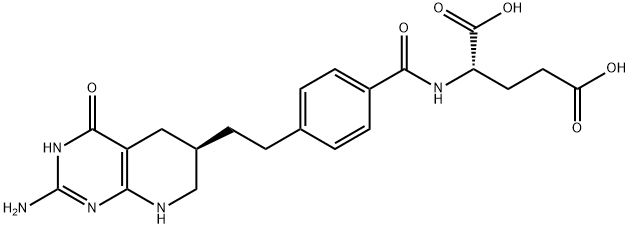
What is Lometrexol?
Description
Glycinamide ribonucleotide formyltransferase (GART) is a folate-dependent enzyme required for de novo purine synthesis. Lometrexol is a folate analog antimetabolite with antineoplastic activity. At nanomolar conentrations, it inhibits GART preventing de novo purine synthesis, inhibiting DNA synthesis, arresting cells in the S phase of the cell cycle, and inhibiting tumor cell proliferation.
The Uses of Lometrexol
Lometrexol hydrate was used to compare the biological activity of potent inhibitor of human GARFTase.
The Uses of Lometrexol
It is an antifolate which inhibits glycinamide ribonucleotide formyltransferase (GARFT), an enzyme essential for de novo purine synthesis.
Biochem/physiol Actions
Glycinamide Ribonucleotide Formyltransferase (GARFTase) is a folate-dependent enzyme required for de novo purine synthesis. Lometrexate is a potent inhibitor of GARFTase, but does not interfere with enzymes involved in the synthesis of folate. Lometrexerol has been tested clinically for the treatment of various cancers as an anti-folate like agent, similar to methotrexate. Treatment with lometrexol rapidly decreases ATP and GTP levels, cell cycle arrest and induces apoptosis. Although depletion of nucleotide pools induces p53 expression, lometrexol is cytotoxic in both wild-type and mutant p53 expressing tumor cells. Lometrexol is cytotoxic in CCRF-CEm leukemia cells with an IC50 of 2.9 nM.
Properties of Lometrexol
| Density | 1.56±0.1 g/cm3(Predicted) |
| storage temp. | 2-8°C |
| solubility | DMSO: ≥5mg/mL |
| pka | 3.60±0.10(Predicted) |
| form | powder |
| color | white to light yellow |
| Stability: | Hygroscopic |
Safety information for Lometrexol
| Signal word | Danger |
| Pictogram(s) |
 Skull and Crossbones Acute Toxicity GHS06 |
| GHS Hazard Statements |
H301:Acute toxicity,oral |
| Precautionary Statement Codes |
P301+P310:IF SWALLOWED: Immediately call a POISON CENTER or doctor/physician. |
Computed Descriptors for Lometrexol
New Products
Cyclobutanone (R)-(-)-2-Amino-1-propanol Fmoc-OSu 5-bromo-4-fluoro-2-nitrobenzaldehyde 2-Amino-2-(4-methylphenyl)acetic acid 1-(2-Chloroethyl)pyrrolidine Hydrochloride 2,4-Dihydroxybenzaldehyde Obidoxime hydrochloride API Pyrrolo[1,2-a]pyrimidine-6-carboxylic acid, 4,6,7,8-tetrahydro-4-oxo-, sodium salt (1:1), (6S) Dipropyl disulfide N-Vinylformamide 4 pentyn 1 ol Methacrylate-PEG-Methacrylate, Mn:35000 2,4-Dihydroxyacetophenone 2-Chloro 5-Fluoro Pyridine Vasicinone 2-Chloroisonicotinic Acid Tween 80 or Polysorbate 80 2-Butyn-1-oL N-(4-fluoro-2-methoxy-5-nitrophenyl)-4-(1-methyl-1H-indol-3-yl)pyrimidin-2-amine Pirtobrutinib intd. 2-Pentyn-1-oL 4-Nitrobenzotrifluoride N-(4-Cyano-3-(trifluoromethyl)phenyl)-2-methyloxirane-2-carboxamideRelated products of tetrahydrofuran


You may like
-
 Lometrexol hydrate CAS 106400-81-1View Details
106400-81-1 -
7250-67-1 1-(2-Chloroethyl)pyrrolidine Hydrochloride 98+View Details
7250-67-1 -
7250-67-1 1-(2-Chloroethyl)pyrrolidine Hydrochloride 98+View Details
7250-67-1 -
13227-01-5 98+View Details
13227-01-5 -
545445-44-1 3-Morpholino-1-(4-(2-oxopiperidin-1-yl) phenyl)-5,6-dihyropyridin-2-(1H)-one 98%View Details
545445-44-1 -
6629-04-5 98%View Details
6629-04-5 -
4-(4-Αminophenyl)-3-Morpholinone 98%View Details
438056-69-0 -
1-(4-Aminophenyl)-3-morpholino-5,6-dihydropyridin-2(1H)-one 1267610-26-3 98%View Details
1267610-26-3