
Lithium bis(oxalate)borate
Synonym(s):LiBOB;Lithium bis(ethanedioato)borate;Lithium bis(oxalate)borate
- CAS NO.:244761-29-3
- Empirical Formula: C4BLiO8
- Molecular Weight: 193.79
- MDL number: MFCD07776904
- EINECS: 456-990-3
- SAFETY DATA SHEET (SDS)
- Update Date: 2026-06-18 10:06:56
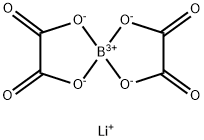
What is Lithium bis(oxalate)borate?
The Uses of Lithium bis(oxalate)borate
Lithium bis(oxalate)borate is a new and proprietary conductive salt for the use in high performance batteries like lithium batteries, lithium ion batteries and lithium polymer batteries. The new halide-free product may be used instead of traditional fluorinated compounds like LiPF6, LiBF4, Li-triflate, methanides, imides etc.
The Uses of Lithium bis(oxalate)borate
LiBOB is a novel boron based Li salt electrolyte material for Li ion batteries. It is environmentally friendly with good film forming property and high thermal stability and is compatible with a variety of anodes and metal oxide cathode.
General Description
This product has been enhanced for energy efficiency.
Flammability and Explosibility
Non flammable
Synthesis
Yu et al. employed a solid-state reaction using oxalic acid, lithium hydroxide, and boric acid as starting materials for the first time. This was followed by a thermal treatment in the air and a recrystallization process to obtain LiBOB. In addition, LiBOB decomposes into Li2C2O3, B2O3, CO2, and CO at temperatures higher than 300 °C [1].
References
[1] Ceren Zor. “Guide to Water Free Lithium Bis(oxalate) Borate (LiBOB).” The Journal of Physical Chemistry C 125 21 (2021): 11310–11317.
Properties of Lithium bis(oxalate)borate
| Melting point: | >300°C (lit.) |
| vapor pressure | 0.004Pa at 20℃ |
| storage temp. | Inert atmosphere,Room Temperature |
| form | powder or crystals |
| Water Solubility | 1015g/L at 20℃ |
| EPA Substance Registry System | Borate(1-), bis[ethanedioato(2-)-.kappa.O1,.kappa.O2]-, lithium, (T-4)- (244761-29-3) |
Safety information for Lithium bis(oxalate)borate
| Signal word | Danger |
| Pictogram(s) |
 Corrosion Corrosives GHS05  Exclamation Mark Irritant GHS07 |
| GHS Hazard Statements |
H302:Acute toxicity,oral H317:Sensitisation, Skin H318:Serious eye damage/eye irritation |
| Precautionary Statement Codes |
P261:Avoid breathing dust/fume/gas/mist/vapours/spray. P264:Wash hands thoroughly after handling. P264:Wash skin thouroughly after handling. P280:Wear protective gloves/protective clothing/eye protection/face protection. P301+P312:IF SWALLOWED: call a POISON CENTER or doctor/physician IF you feel unwell. P302+P352:IF ON SKIN: wash with plenty of soap and water. P305+P351+P338:IF IN EYES: Rinse cautiously with water for several minutes. Remove contact lenses, if present and easy to do. Continuerinsing. |
Computed Descriptors for Lithium bis(oxalate)borate
| InChIKey | NVQAYVUCVASGDK-UHFFFAOYSA-N |
New Products
Dibenzoyl-L-tartaric acid Anhydrous (Resolution Reagent) Cis-Tosylate Dibenzo[b,f][1,4]thiazepin-11(10H)-one 1,2,3,9-Tetrahydro-9-Methyl-4H-Carbazole-4-One 1-(4-methoxyphenyl)-4-(4-Nitrophenyl)Piperazine (IT-1) BOC Piperazine 1-Benzhydrylazetane-3-carbonitrile 8-oxa-1,3-diazaspiro[4.5]decane-2,4-dione (±)-amino(2-fluorophenyl)acetic acid 2-(2-Chlorophenyl)glycine AMINO-(3-CHLORO-PHENYL)-ACETIC ACID 2'-Fluoroacetophenone METHANOL-D1(OD) TERTIARY BUTANOL-D9 N-ETHYL-D5-AMINE HYDROCHLORIDE BENZOIC ACID-D CHLOROFORM-D TOLUENE-D3 Trans,trans muconic acid HC Blue-16 4-Amino-2-chloro-6,7-dimethoxyquinazoline Ethyl 4,5-bis(2-methoxyethoxy)-2-nitrobenzoate 2,3-Dimethoxypyridine 1-(3-Chlorophenyl)piperazine hydrochlorideRelated products of tetrahydrofuran






You may like
-
 Lithium Bis(oxalate)borate CAS 244761-29-3View Details
244761-29-3 -
Lithium bis(oxalate)borate 98.00% CAS 244761-29-3View Details
244761-29-3 -
Lithium bis(oxalate)borate 95% CAS 244761-29-3View Details
244761-29-3 -
Lithium bis(oxalato)borate CAS 244761-29-3View Details
244761-29-3 -
 Product InrtroductionView Details
 -
 DGO24View Details
 -
 DGO29View Details
 -
 DGO32View Details