
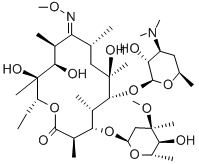
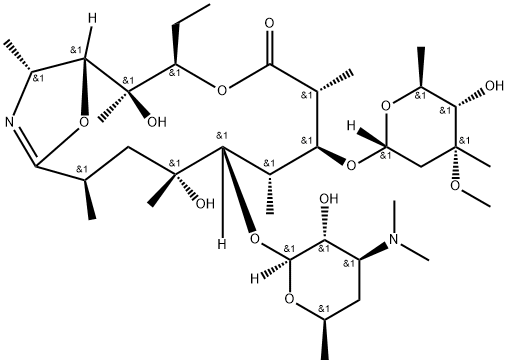
Lexithromycin
- CAS NO.:53066-26-5
- Empirical Formula: C38H70N2O13
- Molecular Weight: 762.97
- SAFETY DATA SHEET (SDS)
- Update Date: 2026-07-16 07:06:08
What is Lexithromycin?
Description
Lexithromycin is a semisynthetic antibiotic derived from erythromycin . Lexithromycin has improved absorption in vivo over erythromycin due to increased hydrophopicity and pH stability. As with other macrolides, lexithromycin prevents protein synthesis by binding the ribosome at the polypeptide exit tunnel. Formulations containing lexithromycin were tested in clinical trials as treatment for HIV but were discontinued.
The Uses of Lexithromycin
Lexithromycin is an early semi-synthetic erythromycin, prepared by reaction of the 9-keto moiety to methyl oxime. The structural change improves the pH stability profile and hydrophobicity of lexithromycin for better in vivo absorption. This same rationale was used to greater effect with roxithromycin and, as a result, lexithromycin was quickly superseded and has not been not extensively studied. Like all tetracyclines, lexithromycin shows broad spectrum antibacterial and antiprotozoan activity and acts by binding to the 30S and 50S ribosomal sub-units, blocking protein synthesis.
The Uses of Lexithromycin
Lexithromycin is a semi-synthetic erythromycin with improved pH stability and hydrophobicity. It is used in compositions and methods for treating viral infections.
What are the applications of Application
Lexithromycin is a semi-synthetic erythromycin with improved pH stability and hydrophobicity
Properties of Lexithromycin
| Melting point: | >115°C (dec.) |
| Boiling point: | 824.6±75.0 °C(Predicted) |
| Density | 1.26±0.1 g/cm3(Predicted) |
| storage temp. | Hygroscopic, -20°C Freezer, Under inert atmosphere |
| solubility | Chloroform (Slightly), DMSO (Slightly) |
| form | Solid |
| pka | 13.19±0.70(Predicted) |
| color | White to Off-White |
| Stability: | Hygroscopic |
Safety information for Lexithromycin
Computed Descriptors for Lexithromycin
New Products
2-(2-Chlorophenyl)glycine Propiolic Acid 1-(3-Hydroxy-4-methoxyphenyl)-2-nitroethene (±)-amino(2-fluorophenyl)acetic acid trans-3-Benzyloxy-4-methoxy-beta-nitrostyrene 1-Pentadecanol 4-(4-Αminophenyl)-3-Morpholinone 3-Morpholino-1-(4-(2-oxopiperidin-1-yl) phenyl)-5,6-dihyropyridin-2-(1H)-one 1-(4-Aminophenyl)-3-morpholino-5,6-dihydropyridin-2(1H)-one N-cyanoacetylurethane 1H-IndazoleRelated products of tetrahydrofuran

You may like
-
 40216-83-9 trans-4-Hydroxy-L-proline methyl ester hydrochloride 98+View Details
40216-83-9 -
471-25-0 Propiolic Acid 98+View Details
471-25-0 -
84145-28-8 98+View Details
84145-28-8 -
trans-3-Benzyloxy-4-methoxy-beta-nitrostyrene 98+View Details
63909-29-5 -
2-(2-Chlorophenyl)glycine 88744-36-9 98+View Details
88744-36-9 -
40216-83-9 trans-4-Hydroxy-L-proline methyl ester hydrochloride 98+View Details
40216-83-9 -
629-76-5 98+View Details
629-76-5 -
1-(3-Hydroxy-4-methoxyphenyl)-2-nitroethene 98+View Details
39816-35-8