
Leonurine hydrochloride
Synonym(s):4-Guanidino-1-butanol syringate;4-Guanidinobutyl 4-hydroxy-3,5-dimethoxybenzoate;SCM-198
- CAS NO.:24697-74-3
- Empirical Formula: C14H21N3O5
- Molecular Weight: 311.33
- MDL number: MFCD09839432
- EINECS: 683-174-6
- SAFETY DATA SHEET (SDS)
- Update Date: 2026-07-16 07:06:08
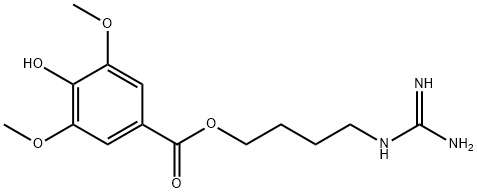
What is Leonurine hydrochloride?
Description
An amorphous alkaloid, leonurine has been obtained from the leaves of Leonurus sibiricus L. and is characterized as the crystalline hydrochloride hydra te, m.p. 19l-4°C. Hydrolysis yields syringic acid and Q-hydroxybutylguanidine. The total synthesis of the alkaloid has been achieved, confirming the above structure.
The Uses of Leonurine hydrochloride
Leonurine Hydrochloride is an alkaloid plant extract used in the treatment of uterine disorders. Used in the modification of uterine contractions in rats.
The Uses of Leonurine hydrochloride
Leonurine is a pseudoalkaloid that has been isolated from Leonotis leonurus. A natural product with antioxidant, anti-inflammatory and cardioprotective properties for the treatment of wild variety of conditions including stroke, cerebral thrombosis and cardiovascular diseases.
Definition
ChEBI: Leonurine is a trihydroxybenzoic acid.
References
Kubota, Nakajima., Nippon Yakubusugaku Zasshi., 163 (1930)
Goto et al., Tetrahedron Lett., 545 (1962)
Total synthesis:
Kishi et al., Tetrahedron Lett., 637 (1968)
Properties of Leonurine hydrochloride
| Melting point: | 238 °C |
| Boiling point: | 496.7±55.0 °C(Predicted) |
| Density | 1.29±0.1 g/cm3(Predicted) |
| storage temp. | Keep in dark place,Inert atmosphere,2-8°C |
| solubility | DMSO: soluble2mg/mL, clear (warmed) |
| pka | 8.26±0.25(Predicted) |
| form | powder |
| color | white to beige |
| Stability: | Stable for 1 year from date of purchase as supplied. Solutions in DMSO may be stored at -20°C for up to 1 month. |
Safety information for Leonurine hydrochloride
| Signal word | Warning |
| Pictogram(s) |
 Exclamation Mark Irritant GHS07 |
| GHS Hazard Statements |
H315:Skin corrosion/irritation H319:Serious eye damage/eye irritation H335:Specific target organ toxicity, single exposure;Respiratory tract irritation |
| Precautionary Statement Codes |
P261:Avoid breathing dust/fume/gas/mist/vapours/spray. P264:Wash hands thoroughly after handling. P264:Wash skin thouroughly after handling. P271:Use only outdoors or in a well-ventilated area. P280:Wear protective gloves/protective clothing/eye protection/face protection. P302+P352:IF ON SKIN: wash with plenty of soap and water. P305+P351+P338:IF IN EYES: Rinse cautiously with water for several minutes. Remove contact lenses, if present and easy to do. Continuerinsing. |
Computed Descriptors for Leonurine hydrochloride
| InChIKey | WNGSUWLDMZFYNZ-UHFFFAOYSA-N |
New Products
9-Mesityl-10-methylacridinium perchlorate Sulfapyridine Fmoc-OSu (R)-(-)-2-Amino-1-propanol Cyclobutanone 5-bromo-4-fluoro-2-nitrobenzaldehyde 4 pentyn 1 ol N-Vinylformamide Phenethyl cinnamate Pyrrolo[1,2-a]pyrimidine-6-carboxylic acid, 4,6,7,8-tetrahydro-4-oxo-, sodium salt (1:1), (6S) Ethyl 3-phenylpropanoate β-Bromostyrene Methacrylate-PEG-Methacrylate, Mn:35000 2,4-Dihydroxyacetophenone 2-Chloro 5-Fluoro Pyridine Vasicinone 2-Chloroisonicotinic Acid Tween 80 or Polysorbate 80 Methyl trans-4-Aminocyclohexanecarboxylate Hydrochloride N-(4-fluoro-2-methoxy-5-nitrophenyl)-4-(1-methyl-1H-indol-3-yl)pyrimidin-2-amine Pirtobrutinib intd. 4-Nitrobenzotrifluoride 2-Pentyn-1-oL N-(4-Cyano-3-(trifluoromethyl)phenyl)-2-methyloxirane-2-carboxamideRelated products of tetrahydrofuran

You may like
-
 Leonurine 97% CAS 24697-74-3View Details
24697-74-3 -
Leonurine CAS 24697-74-3View Details
24697-74-3 -
Fmoc-OSu 98+View Details
82911-69-1 -
(R)-(-)-2-Amino-1-propanol 35320-23-1 98+View Details
35320-23-1 -
1191-95-3 Cyclobutanone 98+View Details
1191-95-3 -
213382-45-7 98+View Details
213382-45-7 -
Fmoc-OSu 98+View Details
82911-69-1 -
(R)-(-)-2-Amino-1-propanol 35320-23-1 98+View Details
35320-23-1