
L-Aspartic acid
Synonym(s):(S)-(+)-Aminosuccinic acid;(S)-Aminobutanedioic acid;(S)-(+)-Aspartic acid;L -Aspartic acid;L-α-Aminosuccinic acid, L-αlpha-Aminosuccinic acid, Asp
- CAS NO.:6899-03-2
- Empirical Formula: C4H7NO4
- Molecular Weight: 133.1
- MDL number: MFCD00002616
- EINECS: 614-886-7
- SAFETY DATA SHEET (SDS)
- Update Date: 2026-09-12 18:55:14
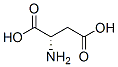
What is L-Aspartic acid?
Description
Aspartic acid an amino acid building block for other amino acids and several types of nucleotides, is produced in the body and provided by dietary sources including beef, poultry, dairy products, and seed sprouts. It is one component (the other is phenylalanine) of the artificial sweetener aspartame.
The Uses of L-Aspartic acid
aspartic acid is an amino acid used to enhance skin smoothness. It is usually present in products for dry skin. Aspartic acid is a nonessential amino acid naturally occurring in animals, plants, sugarcane, sugar beets, and molasses. A synthetic version is more commonly used for commercial applications.
The Uses of L-Aspartic acid
Aspartic Acid is a nonessential amino acid that exists as colorless or white crystals of acid taste. It is slightly soluble in water. It functions to improve the biological quality of a total protein in a food containing naturally occurring primarily intact protein and as a nutrient and dietary supplement.
Definition
ChEBI: L-aspartic acid is the L-enantiomer of aspartic acid. It has a role as an Escherichia coli metabolite, a mouse metabolite and a neurotransmitter. It is an aspartate family amino acid, a proteinogenic amino acid, an aspartic acid and a L-alpha-amino acid. It is a conjugate acid of a L-aspartate(1-). It is an enantiomer of a D-aspartic acid.
Properties of L-Aspartic acid
| Melting point: | >300 °C (dec.)(lit.) |
| storage temp. | -20°C |
| solubility | H2O: 5 mg/mL |
| form | powder |
| pka | 1.99(at 25℃) |
| CAS DataBase Reference | 6899-03-2(CAS DataBase Reference) |
Safety information for L-Aspartic acid
Computed Descriptors for L-Aspartic acid
New Products
5-bromo-4-fluoro-2-nitrobenzaldehyde (R)-(-)-2-Amino-1-propanol Cyclobutanone Fmoc-OSu 1-(2-Chloroethyl)pyrrolidine Hydrochloride 2-Amino-2-(4-methylphenyl)acetic acid β-Bromostyrene Ethyl 3-phenylpropanoate Phenethyl cinnamate Dipropyl disulfide 4 pentyn 1 ol N-Vinylformamide Methacrylate-PEG-Methacrylate, Mn:35000 2,4-Dihydroxyacetophenone 2-Chloro 5-Fluoro Pyridine Vasicinone 2-Chloroisonicotinic Acid Tween 80 or Polysorbate 80 2-Butyn-1-oL 2-Pentyn-1-oL 4-Nitrobenzotrifluoride N-(4-fluoro-2-methoxy-5-nitrophenyl)-4-(1-methyl-1H-indol-3-yl)pyrimidin-2-amine Pirtobrutinib intd. N-(4-Cyano-3-(trifluoromethyl)phenyl)-2-methyloxirane-2-carboxamideRelated products of tetrahydrofuran



You may like
-
 Fmoc-OSu 98+View Details
82911-69-1 -
(R)-(-)-2-Amino-1-propanol 35320-23-1 98+View Details
35320-23-1 -
7250-67-1 1-(2-Chloroethyl)pyrrolidine Hydrochloride 98+View Details
7250-67-1 -
13227-01-5 98+View Details
13227-01-5 -
7250-67-1 1-(2-Chloroethyl)pyrrolidine Hydrochloride 98+View Details
7250-67-1 -
13227-01-5 98+View Details
13227-01-5 -
7250-67-1 1-(2-Chloroethyl)pyrrolidine Hydrochloride 98+View Details
7250-67-1 -
13227-01-5 98+View Details
13227-01-5