
kyanite
- CAS NO.:1302-76-7
- Empirical Formula: Al2H6O5Si
- Molecular Weight: 168.093216
- EINECS: 215-106-4
- SAFETY DATA SHEET (SDS)
- Update Date: 2026-05-28 04:12:23
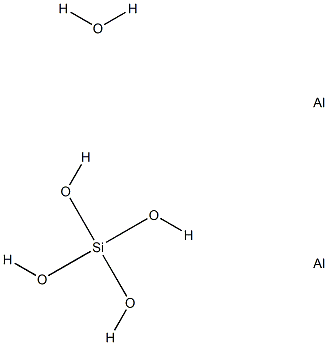
What is kyanite ?
Description
Kyanite is easily distinguished from sillimanite or andalusite by its tabular, long-bladed, or acicular habit and by its bluish color and slightly lower hardness than sillimanite and andalusite. The decomposition of kyanite is unpredictable; it first starts to decompose slowly at 1310°C, and the reaction disrupts at about 1350 to 1380°C with an important volume expansion of 17 vol.%. For that reason, kyanite must always be calcined prior to being incorporated into a refractory in order to avoid blistering and spalling.
Chemical properties
white powder(s) [STR93]
Physical properties
Habit: blady, columnar, tabular, fibrous.
Color: blue, white, yellowish, gray, green,
or black.
Luster: vitreous (i.e., glassy), pearly.
Diaphaneity: translucent to transparent.
Streak: white.
Fracture: uneven, brittle.
Luminescence: pink to red.
Cleavage: (100) perfect, (010) imperfect.
Twinning: {100}. Chemical: insoluble in strong mineral acids.
Occurrence
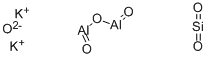
The mineral kyanite is an aluminum silicate, corresponding to the formula Al2SiO5. It is triclinic, and has a good cleavage parallel to the macropinacoid. Its hardness varies considerably, depending on the crystallographic direction from 5 to 7.5; specific gravity, 3.56–3.67; luster, vitreous to pearly; color, commonly blue to white, but sometimes gray to green or nearly black; transparent to translucent; usually found in long-bladed crystals or columnar to fibrous structures. Kyanite is found in some metamorphic rocks as gneisses or mica schists. Of the many European localities for fine specimens might be mentioned the Ural Mountains of the former U.S.S.R.; the Czech Republic and Slovakia; Austria; Trentino, Italy; the St. Gotthard region of Switzerland; and France. In the United States, Chesterfield, Massachusetts; Litchfield, Connecticut; and Gaston County, North Carolina, have furnished fine specimens. Kyanite derives its name from the Greek word meaning blue, in reference to the delicate blue of the inner portions of the bladed crystals.
The Uses of kyanite
Kyanite in the form of mullite is widely used in the manufacture of glass, burner tips, spark plugs, heating elements, and high-voltage electrical insulations and in the ceramic industry. India is the largest producer of kyanite in the world.
Properties of kyanite
| Density | 2.600 |
| color | blue or gray triclinic
crystals, crystalline |
| EPA Substance Registry System | Kyanite (Al2O(SiO4)) (1302-76-7) |
Safety information for kyanite
Computed Descriptors for kyanite
New Products
3-AMINO-3-(2-CHLORO-PHENYL)-PROPIONIC ACID 4-Fluorophenylglycine 1-Boc-3-(cyanomethyl)azetidine Dimedone 1-N-Boc-3-(aminoethyl)azetidine N-BOC-piperidine-4-carboxylic acid 4,6-Dichlororesorcinol 5-Amino-2-Bromo-3-Chloropyridine 2-Picolinic acid N-oxide 4-Butyl Resorcinol 2-Bromo-5-Chloropyridine 5-Bromo-2-Hydroxy-3-Nitro Pyridine 2-Amino-4-phenyl-thiazole N-(4-Bromophenyl)-2-chloroacetamide TRIFLOURO ACETICACID-D METHANE SULFONIC ACID-D4 PHOSPORIC ACID-D3 85 W% IN D2O DEUTERIUM OXIDE FOR NMR BENZENE-D6 TOLUENE-D3Related products of tetrahydrofuran

You may like
-
 IODOETHANE-D5 6485-58-1 99%View Details
6485-58-1 -
32008-59-6 PARAFORMALDEHYDE-D2 98%View Details
32008-59-6 -
CHLORO BENZENE-D5 3114-55-4 99%View Details
3114-55-4 -
PHENYL ACETYLENE-D 3240-11-07 99%View Details
3240-11-07 -
918-20-7 TERT-BUTYL CHLORIDE-D9 98%View Details
918-20-7 -
84358-13-4 N-BOC-piperidine-4-carboxylic acid 98+View Details
84358-13-4 -
84358-13-4 N-BOC-piperidine-4-carboxylic acid 98+View Details
84358-13-4 -
84358-13-4 N-BOC-piperidine-4-carboxylic acid 98+View Details
84358-13-4