
Isopropyl nitrate
- CAS NO.:1712-64-7
- Empirical Formula: C3H7NO3
- Molecular Weight: 105.09
- MDL number: MFCD00007041
- EINECS: 216-983-6
- SAFETY DATA SHEET (SDS)
- Update Date: 2026-08-25 20:17:46
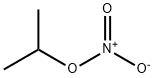
What is Isopropyl nitrate ?
Chemical properties
colourless liquid
The Uses of Isopropyl nitrate
Isopropyl nitrate is used as a diesel cetane improver.
The Uses of Isopropyl nitrate
Isopropyl nitrate is a monopropellant with large detonation length scale. This can increase the diagnostic resolution as a result of which it can be used as a substitute for nitromethane, to study homogenous liquid explosives. It can also be used in the synthesis of 1,2-dimethoxy-4-(nitromethyl)benzene, a nitro alkane derivative which can be converted to the corresponding carboxylic acid in a continuous flow reactor via Nef oxidation method.
What are the applications of Application
Isopropyl nitrate is a colorless liquid used in jet engines
General Description
A clear colorless liquid with a pleasant odor. Flash point 32 to 73°F. May spontaneously decompose and explode under prolonged exposure to fire or heat. Denser than water and insoluble in water. Vapors are heavier than air. Produces toxic oxides of nitrogen during combustion.
Air & Water Reactions
Highly flammable. Insoluble in water.
Reactivity Profile
Organonitrates, such as Isopropyl nitrate , range from slight to strong oxidizing agents. If mixed with reducing agents, including hydrides, sulfides and nitrides, they may begin a vigorous reaction that culminates in a detonation. Nitroalkanes are milder oxidizing agents, but still react violently with reducing agents at higher temperature and pressures. Nitroalkanes react with inorganic bases to form explosive salts. The presence of metal oxides increases the thermal sensitivity of nitroalkanes. Nitroalkanes with more than one nitro group are generally explosive. Contact with either strong oxidizers or with combustibles may cause fires and explosions.
Hazard
Oxidizing material, fire risk in contact with organic materials.
Health Hazard
May cause toxic effects if inhaled or absorbed through skin. Inhalation or contact with material may irritate or burn skin and eyes. Fire will produce irritating, corrosive and/or toxic gases. Vapors may cause dizziness or suffocation. Runoff from fire control or dilution water may cause pollution.
Fire Hazard
HIGHLY FLAMMABLE: Will be easily ignited by heat, sparks or flames. Vapors may form explosive mixtures with air. Vapors may travel to source of ignition and flash back. Most vapors are heavier than air. They will spread along ground and collect in low or confined areas (sewers, basements, tanks). Vapor explosion hazard indoors, outdoors or in sewers. Runoff to sewer may create fire or explosion hazard. Containers may explode when heated. Many liquids are lighter than water.
Properties of Isopropyl nitrate
| Melting point: | -99.99°C |
| Boiling point: | 101-102 °C(lit.) |
| Density | 1.040 g/mL at 20 °C(lit.) |
| vapor pressure | 36-49.996hPa at 20℃ |
| refractive index | n |
| Flash point: | 55 °F |
| form | Liquid |
| Water Solubility | Partly miscible in water. |
| BRN | 1701405 |
| Dielectric constant | 11.5(19℃) |
| Stability: | Stability Highly flammable. Incompatible with strong reducing agents, strong acids, finely powdered metals, tin chloride, boron trifluoride. |
| CAS DataBase Reference | 1712-64-7(CAS DataBase Reference) |
| NIST Chemistry Reference | Nitric acid, 1-methylethyl ester(1712-64-7) |
| EPA Substance Registry System | Nitric acid, 1-methylethyl ester (1712-64-7) |
Safety information for Isopropyl nitrate
| Signal word | Danger |
| Pictogram(s) |
 Flame Flammables GHS02  Flame Over Circle Oxidizers GHS03  Exclamation Mark Irritant GHS07 |
| GHS Hazard Statements |
H225:Flammable liquids H272:Oxidising liquids;Oxidising solids H332:Acute toxicity,inhalation |
| Precautionary Statement Codes |
P210:Keep away from heat/sparks/open flames/hot surfaces. — No smoking. P220:Keep/Store away from clothing/…/combustible materials. P221:Take any precaution to avoid mixing with combustibles/… P261:Avoid breathing dust/fume/gas/mist/vapours/spray. P303+P361+P353:IF ON SKIN (or hair): Remove/Take off Immediately all contaminated clothing. Rinse SKIN with water/shower. |
Computed Descriptors for Isopropyl nitrate
| InChIKey | GAPFWGOSHOCNBM-UHFFFAOYSA-N |
New Products
2-Amino-5-bromo-4-(trifluoromethyl)pyridine Sulfapyridine Fmoc-OSu (R)-(-)-2-Amino-1-propanol Cyclobutanone 5-bromo-4-fluoro-2-nitrobenzaldehyde β-Bromostyrene Ethyl 3-phenylpropanoate Phenethyl cinnamate Dipropyl disulfide N-Vinylformamide 4 pentyn 1 ol Methacrylate-PEG-Methacrylate, Mn:35000 2,4-Dihydroxyacetophenone 2-Chloro 5-Fluoro Pyridine Vasicinone 2-Chloroisonicotinic Acid Tween 80 or Polysorbate 80 2-Butyn-1-oL 2-Pentyn-1-oL 4-Nitrobenzotrifluoride N-(4-fluoro-2-methoxy-5-nitrophenyl)-4-(1-methyl-1H-indol-3-yl)pyrimidin-2-amine Pirtobrutinib intd. N-(4-Cyano-3-(trifluoromethyl)phenyl)-2-methyloxirane-2-carboxamideRelated products of tetrahydrofuran




You may like
-
 1191-95-3 Cyclobutanone 98+View Details
1191-95-3 -
213382-45-7 98+View Details
213382-45-7 -
Fmoc-OSu 98+View Details
82911-69-1 -
(R)-(-)-2-Amino-1-propanol 35320-23-1 98+View Details
35320-23-1 -
1191-95-3 Cyclobutanone 98+View Details
1191-95-3 -
213382-45-7 98+View Details
213382-45-7 -
Fmoc-OSu 98+View Details
82911-69-1 -
(R)-(-)-2-Amino-1-propanol 35320-23-1 98+View Details
35320-23-1