
Isopropyl Methyl Phosphorodithioate
- CAS NO.:92351-18-3
- Empirical Formula: C4H11O2PS2
- Molecular Weight: 186.232701
- Update Date: 2023-04-23 13:52:06
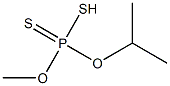
What is Isopropyl Methyl Phosphorodithioate?
The Uses of Isopropyl Methyl Phosphorodithioate
Isopropyl methyl phosphorodithioate is an impurity in the synthesis of Isodimethoate which is an isomer of Dimethoate (D460505), which is an organophosphate insecticide. Isodimethoate is present in usual pesticide formulations of Dimethoate that is anticholinesterase which disables cholinesterase, an enzyme essential for central nervous system function and thus is neurotoxic for humans. Isodimethoate reacts with human red blood cell acetylcholinesterase (AChE) rendering part of AChE making it non-reactivatable.
Properties of Isopropyl Methyl Phosphorodithioate
| solubility | Chloroform, Ethyl Acetate, Methanol |
Safety information for Isopropyl Methyl Phosphorodithioate
Computed Descriptors for Isopropyl Methyl Phosphorodithioate
New Products
(E)-1-Ethoxyethene-2-boronic Acid Pinacol Ester 1,3-Diethyl-1,3-Diphenylurea 3-(4-morpholinophenylamino)-5-amino-1H-pyrazole-4-carbonitrile Methyl 2-methylquinoline-6-carboxylate 2,4-dihydroxybenzaldehyde 2-((4-morpholinophenylamino) (methylthio) methylene) malononitrile 1,3-Di Iodo Benzene Methyl 2-oxo-2,3-dihydrobenzo[d]oxazole-7-carboxylate 4-(2-Aminoethyl)-7-hydroxy-2H-chromoen-2-one 3-Hydroxy-4-nitrobromobenzene 2-Ethyl-1,4-diaminobenzene 2-Ethylhexyl 4-aminobenzoate Thio AcetamideYou may like
-
 MFCD22560726 98%View Details
MFCD22560726 -
3-Hydroxy-4-nitrobromobenzene 98%View Details
2768-84-0 -
4-(2-Aminoethyl)-7-hydroxy-2H-chromoen-2-one 98%View Details
1234064-08-4. -
2-Ethyl-1,4-diaminobenzene 98%View Details
MFCD19203885 -
85-81-4 6-Methoxy-8-nitroquinoline 98%View Details
85-81-4 -
2-((4-morpholinophenylamino) (methylthio) methylene) malononitrile 98%View Details
-
 Hot Sales:Thio AcetamideView Details
62-55-5 -
 CosmoticsView Details
26218-04-2
Statement: All products displayed on this website are only used for non medical purposes such as industrial applications or scientific research, and cannot be used for clinical diagnosis or treatment of humans or animals. They are not medicinal or edible.