
INSECTICIDE
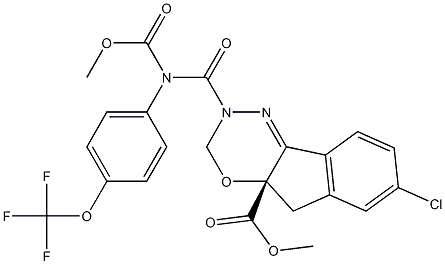
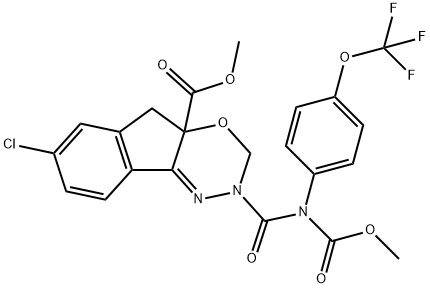
- CAS NO.:174060-41-4
- Empirical Formula: C22H17ClF3N3O7
- Molecular Weight: 527.8344896
- EINECS: 605-683-4
- SAFETY DATA SHEET (SDS)
- Update Date: 2026-08-28 09:47:33
What is INSECTICIDE?
Definition
ChEBI: Indoxacarb is an organochlorine insecticide and a methyl ester. It has a role as a voltage-gated sodium channel blocker.
Agricultural Uses
Insecticide is a substance which is toxic to insects and hence used to control them. Insecticides are used where insects cause economic damage or endanger the health of man and his domestic animals.
The broad types of insecticides are: (i) Inorganic insecticides: arsenic, lead and copper compounds and their mixtures, the use of which has diminished sharply in recent years because of the development of more effective types that are less toxic to man. (ii) Natural organic compounds: rotenone and pyrethrins (which are relatively harmless to man), nicotine, copper MphtheMte and petroleum derivatives. (iii) Synthetic organic compounds: (a) chlorinated hydrocarbons, such as DDT, dieldrin, endrin, lindane, chlordane and p- dichlorbenzene, (b) organic esters of phosphorus, and (c) imidazole and its derivatives which act on the principle of metabolic inhibition. Besides direct application, these can be fed to growing plants, with the result that the plants can no longer serve as nutrient for the specific insect.
There are three main types of insecticides based on their mechanism of action. They are (a) stomach insecticides which are ingested by the insects with their food, (b) contact insecticides which penetrate the cuticle, and (c) fumigant insecticides which are inhaled. Stomach insecticides are used to control chewing insects like caterpillars and sucking insects like aphids. They may be applied to the plant (in anticipation) where they remain active for a considerable time. Polychlorinated biphenyls (PCBs) are added to some insecticides to increase their effectiveness and persistence.
Insecticides must be used with considerable caution on food plants or animal forage. For example, arsenic compounds are absorbed by the plant and transported to all its parts. Contact insecticides (like nicotine, demes and pyrethrum), and some synthetic compounds such as DDT and other chlorinated hydrocarbons, organophosphates (Malathion) and carbamates are quickly broken down, and have lasting presence on the plants
Highly persistent insecticides may be concentrated in food chains and exert harmful effects on other animals such as birds and fish.
Safety information for INSECTICIDE
New Products
5-bromo-4-fluoro-2-nitrobenzaldehyde (R)-(-)-2-Amino-1-propanol Cyclobutanone Fmoc-OSu 1-(2-Chloroethyl)pyrrolidine Hydrochloride 2-Amino-2-(4-methylphenyl)acetic acid β-Bromostyrene Ethyl 3-phenylpropanoate Phenethyl cinnamate Dipropyl disulfide 4 pentyn 1 ol N-Vinylformamide Methacrylate-PEG-Methacrylate, Mn:35000 2,4-Dihydroxyacetophenone 2-Chloro 5-Fluoro Pyridine Vasicinone 2-Chloroisonicotinic Acid Tween 80 or Polysorbate 80 2-Butyn-1-oL 2-Pentyn-1-oL 4-Nitrobenzotrifluoride N-(4-fluoro-2-methoxy-5-nitrophenyl)-4-(1-methyl-1H-indol-3-yl)pyrimidin-2-amine Pirtobrutinib intd. N-(4-Cyano-3-(trifluoromethyl)phenyl)-2-methyloxirane-2-carboxamideRelated products of tetrahydrofuran

You may like
-
 Fmoc-OSu 98+View Details
82911-69-1 -
(R)-(-)-2-Amino-1-propanol 35320-23-1 98+View Details
35320-23-1 -
7250-67-1 1-(2-Chloroethyl)pyrrolidine Hydrochloride 98+View Details
7250-67-1 -
13227-01-5 98+View Details
13227-01-5 -
7250-67-1 1-(2-Chloroethyl)pyrrolidine Hydrochloride 98+View Details
7250-67-1 -
13227-01-5 98+View Details
13227-01-5 -
7250-67-1 1-(2-Chloroethyl)pyrrolidine Hydrochloride 98+View Details
7250-67-1 -
13227-01-5 98+View Details
13227-01-5