
Ibogamine
- CAS NO.:481-87-8
- Empirical Formula: C19H24N2
- Molecular Weight: 280.41
- SAFETY DATA SHEET (SDS)
- Update Date: 2026-09-12 18:52:21
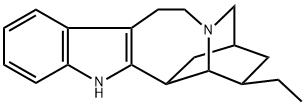
What is Ibogamine?
The Uses of Ibogamine
Ibogamine is used for treatment of movement-related disorders using noribogaine.
Definition
ChEBI: Ibogamine is a monoterpenoid indole alkaloid with formula C19H24N2. It is isolated from the flowering plant genus, Tabernaemontana and exhibits anti-addictive properties. It has a role as an EC 3.1.1.7 (acetylcholinesterase) inhibitor, a plant metabolite and a oneirogen. It is an indole alkaloid fundamental parent, an organic heteropentacyclic compound, a monoterpenoid indole alkaloid and a tertiary amino compound. It is a conjugate base of an ibogamine(1+).
Properties of Ibogamine
| Melting point: | 162-164 °C |
| Boiling point: | 452.2±35.0 °C(Predicted) |
| Density | 1.18±0.1 g/cm3(Predicted) |
| pka | 17.55±0.40(Predicted) |
Safety information for Ibogamine
Computed Descriptors for Ibogamine
New Products
2-(2-Chlorophenyl)glycine Propiolic Acid 1-(3-Hydroxy-4-methoxyphenyl)-2-nitroethene (±)-amino(2-fluorophenyl)acetic acid trans-3-Benzyloxy-4-methoxy-beta-nitrostyrene 1-Pentadecanol 4-(4-Αminophenyl)-3-Morpholinone 3-Morpholino-1-(4-(2-oxopiperidin-1-yl) phenyl)-5,6-dihyropyridin-2-(1H)-one 1-(4-Aminophenyl)-3-morpholino-5,6-dihydropyridin-2(1H)-one N-cyanoacetylurethane 1H-IndazoleYou may like
-
 40216-83-9 trans-4-Hydroxy-L-proline methyl ester hydrochloride 98+View Details
40216-83-9 -
471-25-0 Propiolic Acid 98+View Details
471-25-0 -
84145-28-8 98+View Details
84145-28-8 -
trans-3-Benzyloxy-4-methoxy-beta-nitrostyrene 98+View Details
63909-29-5 -
2-(2-Chlorophenyl)glycine 88744-36-9 98+View Details
88744-36-9 -
40216-83-9 trans-4-Hydroxy-L-proline methyl ester hydrochloride 98+View Details
40216-83-9 -
629-76-5 98+View Details
629-76-5 -
1-(3-Hydroxy-4-methoxyphenyl)-2-nitroethene 98+View Details
39816-35-8
Statement: All products displayed on this website are only used for non medical purposes such as industrial applications or scientific research, and cannot be used for clinical diagnosis or treatment of humans or animals. They are not medicinal or edible.