
H-ASP-ARG-VAL-TYR-ILE-HIS-PRO-PHE-HIS-OH
- CAS NO.:34273-12-6
- Empirical Formula: C56H78N16O13
- Molecular Weight: 1183.32
- MDL number: MFCD00167490
- SAFETY DATA SHEET (SDS)
- Update Date: 2026-07-08 07:26:47
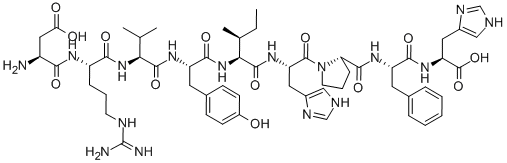
What is H-ASP-ARG-VAL-TYR-ILE-HIS-PRO-PHE-HIS-OH?
Chemical properties
White powder
Definition
ChEBI: Angiotensin (1-9) is a nine amino acid peptide which is formed when angiotensin converting enzyme 2 (ACE2) hydrolyzes the carboxy terminal leucine from angiotensin I. It is a anti-cardiac hypertrophy agent. It has a role as a human metabolite, a rat metabolite, an antihypertensive agent and a cardioprotective agent. It is a tautomer of an angiotensin (1-9) dizwitterion.
Biological Activity
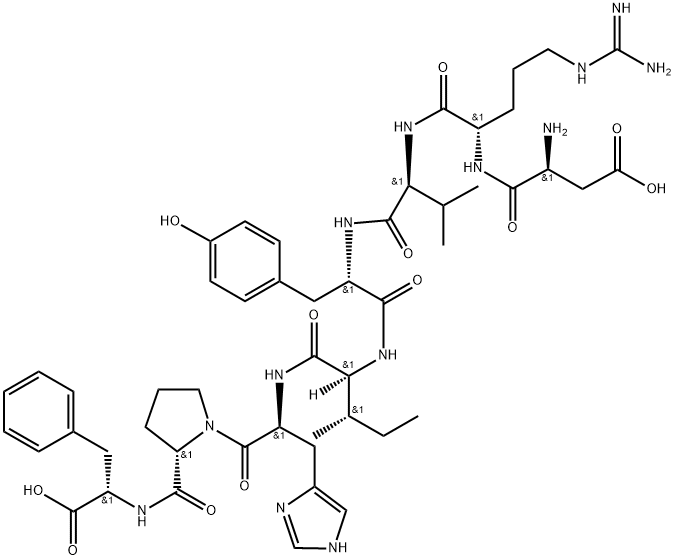
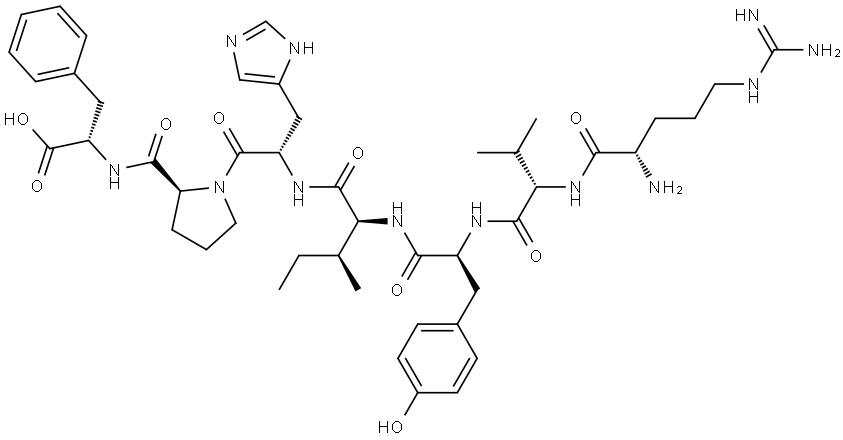
angiotensin i/ii (1-9) is a peptide (asp-arg-val-tyr-ile-his-pro-phe-his) containing the amino acids 1-9 that are converted from angiotensin i/ii peptide.angiotensin i is formed by the action of renin on angiotensinogen, which has 12 amino acids and is an α-2-globulin produced constitutively and released into the circulation mainly by the liver. renin cleaves the peptide bond between the leucine (leu) and valine (val) residues on angiotensinogen, creating the ten-amino acid peptide angiotensin i. angiotensin i is converted to angiotensin ii (aii) through removal of two c-terminal residues by the enzymeangiotensin-converting enzyme (ace), primarily through ace within the lung.angiotensin is a peptide hormone that causes vasoconstriction and a subsequent increase in blood pressure. angiotensin also stimulates the release of aldosterone, which promotes sodium retention in the distal nephron so that drives blood pressure up.figure1 formula of angiotensin i/ii (1-9)
References
1. Basso N, Terragno NA (December 2001). "History about the discovery of the renin-angiotensin system". Hypertension 38 (6): 1246–9. 2. Richard A. Preston. et. (1998). “Age-Race Subgroup Compared With Renin Profile as Predictors of Blood Pressure Response to Antihypertensive Therapy”. JAMA. 1998;280(13):1168-1172.3. Williams GH, Dluhy RG (2008). "Chapter 336: Disorders of the Adrenal Cortex". In Loscalzo J, Fauci AS, Braunwald E, Kasper DL, Hauser SL, Longo DL. Harrison's principles of internal medicine. McGraw-Hill Medical.
Properties of H-ASP-ARG-VAL-TYR-ILE-HIS-PRO-PHE-HIS-OH
| Density | 1.46±0.1 g/cm3(Predicted) |
| storage temp. | -15°C |
| solubility | ≥118.3 mg/mL in DMSO; insoluble in EtOH; ≥51 mg/mL in H2O |
| form | solid |
| pka | 2.91±0.10(Predicted) |
Safety information for H-ASP-ARG-VAL-TYR-ILE-HIS-PRO-PHE-HIS-OH
Computed Descriptors for H-ASP-ARG-VAL-TYR-ILE-HIS-PRO-PHE-HIS-OH
New Products
Dibenzoyl-L-tartaric acid Anhydrous (Resolution Reagent) Cis-Tosylate Dibenzo[b,f][1,4]thiazepin-11(10H)-one 1,2,3,9-Tetrahydro-9-Methyl-4H-Carbazole-4-One 1-(4-methoxyphenyl)-4-(4-Nitrophenyl)Piperazine (IT-1) BOC Piperazine 1-Benzhydrylazetane-3-carbonitrile 8-oxa-1,3-diazaspiro[4.5]decane-2,4-dione (±)-amino(2-fluorophenyl)acetic acid 2-(2-Chlorophenyl)glycine AMINO-(3-CHLORO-PHENYL)-ACETIC ACID 2'-Fluoroacetophenone METHANOL-D1(OD) TERTIARY BUTANOL-D9 N-ETHYL-D5-AMINE HYDROCHLORIDE BENZOIC ACID-D CHLOROFORM-D TOLUENE-D3 Trans,trans muconic acid HC Blue-16 4-Amino-2-chloro-6,7-dimethoxyquinazoline Ethyl 4,5-bis(2-methoxyethoxy)-2-nitrobenzoate 2,3-Dimethoxypyridine 1-(3-Chlorophenyl)piperazine hydrochlorideRelated products of tetrahydrofuran

You may like
-
 Product IntroductionView Details
 -
 Product InrtroductionView Details
 -
 DGO24View Details
 -
 DGO25View Details
 -
 DGO29View Details
 -
 DGO32View Details
 -
 DGO36View Details
 -
 DGO37View Details