
GSK-872 (hydrochloride)
- CAS NO.:2703752-81-0
- Empirical Formula: C19H18ClN3O2S2
- Molecular Weight: 419.94
- MDL number: MFCD34564887
- Update Date: 2026-04-22 18:57:36
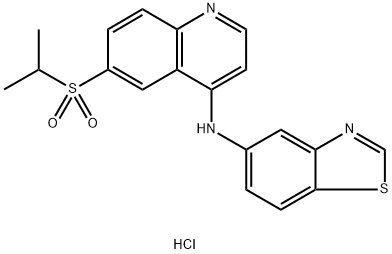
What is GSK-872 (hydrochloride)?
Biological Activity
GSK-872 hydrochloride is a RIPK3 inhibitor, which binds RIP3 kinase domain with an IC50 of 1.8 nM, and inhibits kinase activity with an IC50 of 1.3 nM. GSK-872 hydrochloride decreases the RIPK3-mediated necroptosis and subsequent cytoplasmic translocation and expression of HMGB1, as well as ameliorates brain edema and neurological deficits in early brain injury[1][2][3]. GSK-872 (GSK’872; 0.01-3 μM; 24 hours) blocks TNF-induced necroptosis in human HT-29 cells in a concentration-dependent manner[1]. GSK-872 hydrochloride (25 mM; intracerebroventricular injection) can attenuate brain edema and improve neurological function following subarachnoid hemorrhage (SAH) and reduce the number of necrotic cells. GSK-872 hydrochloride can also decrease the protein levels of RIPK3 and MLKL, and cytoplasmic translocation and expression of HMGB1, an important pro-inflammatory protein[3].
References
[1]. Mandal P, et al. RIP3 induces apoptosis independent of pronecrotic kinase activity. Mol Cell. 2014 Nov 20;56(4):481-95. [2]. Arora D, et al. Deltamethrin induced RIPK3-mediated caspase-independent non-apoptotic cell death in rat primary hepatocytes. Biochem Biophys Res Commun. 2016 Oct 14;479(2):217-223. [3]. Chen T, et al. Inhibiting of RIPK3 attenuates early brain injury following subarachnoid hemorrhage: Possibly through alleviating necroptosis. Biomed Pharmacother. 2018;107:563-570.
Properties of GSK-872 (hydrochloride)
| storage temp. | Store at -20°C |
| solubility | DMSO : 10 mg/mL (23.81 mM; ultrasonic and warming and heat to 60°C)| |
| form | Solid |
| color | Yellow to brown |
| Water Solubility | Water : 2.5 mg/mL (5.95 mM; ultrasonic and warming and heat to 60°C) |
Safety information for GSK-872 (hydrochloride)
Computed Descriptors for GSK-872 (hydrochloride)
New Products
Cis-Tosylate Dibenzoyl-L-tartaric acid Anhydrous (Resolution Reagent) 2,6-Dipicolic Acid 4-Fluorophenylglycine Dimedone 1-N-Boc-3-(aminoethyl)azetidine 1-Boc-3-(cyanomethyl)azetidine N-BOC-piperidine-4-carboxylic acid 1-Benzhydrylazetane-3-carbonitrile 4, 4'-Ditolylamine (or) 4,4-Dimethyl Diphenylamine 5-Amino-2-Iodopyridine BENZOIC ACID-D METHANE SULFONIC ACID-D4 PHOSPORIC ACID-D3 85 W% IN D2O DEUTERIUM OXIDE FOR NMR TOLUENE-D3 BENZENE-D6 1-Benzhydrylazetidin-3-ol-Hcl 5-Acetylsalicylamide 1-(3-Chlorophenyl)piperazine hydrochlorideYou may like
-
 350-03-8 3-AcetylpyridineView Details
350-03-8 -
1-(4-Aminophenyl)-4-(4-methoxyphenyl)Piperazine 74852-62-3View Details
74852-62-3 -
556-08-1 4-Acetamidobenzoic acidView Details
556-08-1 -
5-Bromo-2-Chlorobenzoic acid 21739-92-4View Details
21739-92-4 -
15128-52-6View Details
15128-52-6 -
36476-86-5 1-Benzhydrylazetane-3-carbonitrile 98+View Details
36476-86-5 -
36476-86-5 1-Benzhydrylazetane-3-carbonitrile 98+View Details
36476-86-5 -
36476-86-5 1-Benzhydrylazetane-3-carbonitrile 98+View Details
36476-86-5