
GLYX 13
Synonym(s):L-Threonyl-L-prolyl-L-prolyl-L-threoninamide trifluoroacetate; Thr-Pro-Pro-Thr-NH2 trifluoroacetate;Rapastinel;TPPT-amide trifluoroacetate
- CAS NO.:117928-94-6
- Empirical Formula: C18H31N5O6
- Molecular Weight: 413.47
- MDL number: MFCD12912477
- SAFETY DATA SHEET (SDS)
- Update Date: 2026-08-05 09:01:00
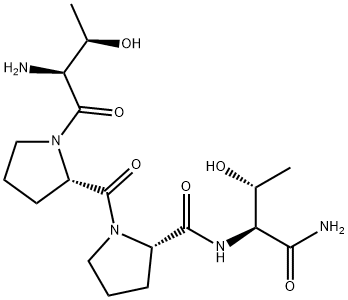
What is GLYX 13?
The Uses of GLYX 13
Rapastinel is a novel antidepressant drug approved as an adjunctive therapy for the treatment of treatment-resistant major depressive disorder. It is a centrally active, intravenously administered (non-orally active) amidated tetrapeptide (Thr-Pro-Pro-Thr-NH2) that acts as a selective, weak partial agonist (mixed antagonist/agonist) of an allosteric site at the glycine site of the NMDA receptor complex (Emax ≈ 25%).The drug is a rapid-acting and long-lasting antidepressant as well as robust cognitive enhancer by virtue of its ability to both inhibit and enhance NMDA receptor-mediated signal transduction.
The Uses of GLYX 13
GLYX-13 is a long lasting and rapid acting antidepressant. Investigational drug for the treatment of depressive disoder.
The Uses of GLYX 13
GLYX-13 trifluoroacetate has been used as an activator of NMDA (N-methyl-D-aspartate) receptor.
Biochem/physiol Actions
GLYX-13 is a glycine-site functional partial agonist (GFPA) selective modulator of the NMDA receptor (NMDAR). It is a brain penetrable tetrapeptide which acts as a positive allosteric modulator of the NMDA receptor, acting via the glycine site. GLYX-13 has been found to be a cognitive enhancer in learning models and is currently in clinical trials as an antidepressant.
Storage
Store at -20°C
Properties of GLYX 13
| Boiling point: | 844.2±65.0 °C(Predicted) |
| Density | 1.370±0.06 g/cm3(Predicted) |
| storage temp. | Keep in dark place,Inert atmosphere,Store in freezer, under -20°C |
| solubility | DMF: 25 mg/ml; DMSO: 15 mg/ml; Ethanol: 10 mg/ml; PBS (pH 7.2): 5 mg/ml |
| form | powder |
| pka | 12.26±0.45(Predicted) |
| color | white to tan |
| Water Solubility | Soluble to 2 mg/ml in water |
Safety information for GLYX 13
| Signal word | Warning |
| Pictogram(s) |
 Exclamation Mark Irritant GHS07 |
| GHS Hazard Statements |
H302:Acute toxicity,oral H315:Skin corrosion/irritation H319:Serious eye damage/eye irritation H335:Specific target organ toxicity, single exposure;Respiratory tract irritation |
| Precautionary Statement Codes |
P261:Avoid breathing dust/fume/gas/mist/vapours/spray. P305+P351+P338:IF IN EYES: Rinse cautiously with water for several minutes. Remove contact lenses, if present and easy to do. Continuerinsing. |
Computed Descriptors for GLYX 13
New Products
9-Mesityl-10-methylacridinium perchlorate Sulfapyridine Fmoc-OSu (R)-(-)-2-Amino-1-propanol Cyclobutanone 5-bromo-4-fluoro-2-nitrobenzaldehyde 4 pentyn 1 ol N-Vinylformamide Phenethyl cinnamate Pyrrolo[1,2-a]pyrimidine-6-carboxylic acid, 4,6,7,8-tetrahydro-4-oxo-, sodium salt (1:1), (6S) Ethyl 3-phenylpropanoate β-Bromostyrene Methacrylate-PEG-Methacrylate, Mn:35000 2,4-Dihydroxyacetophenone 2-Chloro 5-Fluoro Pyridine Vasicinone 2-Chloroisonicotinic Acid Tween 80 or Polysorbate 80 5-Bromo-1-Pentyne 1-(2-Methyl-5-nitrophenyl)guanidine Nitrate Methyl trans-4-Aminocyclohexanecarboxylate Hydrochloride N-(4-Cyano-3-(trifluoromethyl)phenyl)-2-methyloxirane-2-carboxamide 4-Nitrobenzotrifluoride 2-Pentyn-1-oLRelated products of tetrahydrofuran
You may like
-
 GLYX-13 trifluoroacetate CAS 117928-94-6View Details
117928-94-6 -
1191-95-3 Cyclobutanone 98+View Details
1191-95-3 -
Fmoc-OSu 98+View Details
82911-69-1 -
(R)-(-)-2-Amino-1-propanol 35320-23-1 98+View Details
35320-23-1 -
1191-95-3 Cyclobutanone 98+View Details
1191-95-3 -
213382-45-7 98+View Details
213382-45-7 -
Fmoc-OSu 98+View Details
82911-69-1 -
(R)-(-)-2-Amino-1-propanol 35320-23-1 98+View Details
35320-23-1