
Glycylglycine
Synonym(s):Diglycine;Glycylglycine;Glycyl-glycine;Gly-Gly
- CAS NO.:556-50-3
- Empirical Formula: C4H8N2O3
- Molecular Weight: 132.12
- MDL number: MFCD00008130
- EINECS: 209-127-8
- SAFETY DATA SHEET (SDS)
- Update Date: 2026-07-16 07:06:08
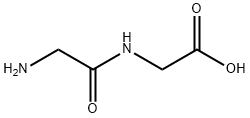
What is Glycylglycine?
Chemical properties
White crystals
The Uses of Glycylglycine
Glycylglycine is as a buffering reagent and also used in biochemical research. It is the simplest of all dipeptides and is used as a starting template for preparation of more complex peptides. It is also employed as a practical buffer with a buffering range of 7.5 - 8.9 (at 25°C). Valuable agent for experiments investigating peptide transport and absorption.
What are the applications of Application
Glycylglycine, Free Base is a dipeptide used as a buffering reagent
Definition
ChEBI: A dipeptide formed from glycine residues.
Synthesis Reference(s)
Journal of the American Chemical Society, 75, p. 5323, 1953 DOI: 10.1021/ja01117a053
Biochem/physiol Actions
Glycine is a non-essential amino acid. Influx of calcium through the cell membrane is mediated by glycine-gated channel. Glycine participates in the synthesis of porphyrins, purine and serine. It also serves as a competitive agonist for glutamate in binding to the NMDA (N-methyl-D-aspartate) receptors. Glycine synthesis might be increased in rapidly proliferating cancer cells, due to increased demand for the amino acid. Diglycine is known to catalyze the formation of homo- and hetero dipeptides more efficiently than glycine.
Purification Methods
Crystallise glycylglycine from aqueous 50% EtOH or water at 50-60o by addition of EtOH. Dry it at 110o. It sublimes at 190-200o/0.3mm with 30% recovery [Gross & Gradsky J Am Chem Soc 77 1678 1955, King J Am Chem Soc 79 6153 1957]. [Beilstein 4 IV 2459.]
Properties of Glycylglycine
| Melting point: | 220-240 °C (dec.) |
| Boiling point: | 267.18°C (rough estimate) |
| Density | 1.5851 (rough estimate) |
| vapor pressure | 0.058Pa at 20-50℃ |
| refractive index | 1.4880 (estimate) |
| storage temp. | Keep in dark place,Inert atmosphere,Room temperature |
| solubility | H2O: 1 M at 20 °C, clear, colorless |
| pka | 3.139(at 25℃) |
| form | Solid |
| color | White |
| PH | 4.5-6.0 (20℃, 1M in H2O) |
| PH Range | 7.5 - 8.9 |
| Water Solubility | SOLUBLE IN HOT WATER |
| λmax | λ: 260 nm Amax: 0.075 λ: 280 nm Amax: 0.072 |
| Merck | 14,4503 |
| BRN | 1765223 |
| Stability: | Stable. Incompatible with strong oxidizing agents. |
| CAS DataBase Reference | 556-50-3(CAS DataBase Reference) |
| NIST Chemistry Reference | N-Glycylglycine(556-50-3) |
| EPA Substance Registry System | Glycylglycine (556-50-3) |
Safety information for Glycylglycine
| Signal word | Warning |
| Pictogram(s) |
 Exclamation Mark Irritant GHS07 |
| GHS Hazard Statements |
H319:Serious eye damage/eye irritation |
| Precautionary Statement Codes |
P264:Wash hands thoroughly after handling. P264:Wash skin thouroughly after handling. P305+P351+P338:IF IN EYES: Rinse cautiously with water for several minutes. Remove contact lenses, if present and easy to do. Continuerinsing. P337+P313:IF eye irritation persists: Get medical advice/attention. |
Computed Descriptors for Glycylglycine
| InChIKey | YMAWOPBAYDPSLA-UHFFFAOYSA-N |
Glycylglycine manufacturer
New Products
Cyclobutanone (R)-(-)-2-Amino-1-propanol Fmoc-OSu 5-bromo-4-fluoro-2-nitrobenzaldehyde 2-Amino-2-(4-methylphenyl)acetic acid 1-(2-Chloroethyl)pyrrolidine Hydrochloride 2,4-Dihydroxybenzaldehyde Obidoxime hydrochloride API Pyrrolo[1,2-a]pyrimidine-6-carboxylic acid, 4,6,7,8-tetrahydro-4-oxo-, sodium salt (1:1), (6S) Dipropyl disulfide N-Vinylformamide 4 pentyn 1 ol Methacrylate-PEG-Methacrylate, Mn:35000 2,4-Dihydroxyacetophenone 2-Chloro 5-Fluoro Pyridine Vasicinone 2-Chloroisonicotinic Acid Tween 80 or Polysorbate 80 2-Butyn-1-oL N-(4-fluoro-2-methoxy-5-nitrophenyl)-4-(1-methyl-1H-indol-3-yl)pyrimidin-2-amine Pirtobrutinib intd. 2-Pentyn-1-oL 4-Nitrobenzotrifluoride N-(4-Cyano-3-(trifluoromethyl)phenyl)-2-methyloxirane-2-carboxamideRelated products of tetrahydrofuran
You may like
-
 Glycyl-glycine,98% 556-50-3 99%View Details
556-50-3 -
Glycylglycine 98% (HPLC) CAS 556-50-3View Details
556-50-3 -
Glycylglycine 96% CAS 556-50-3View Details
556-50-3 -
Gly-Gly ≥99% (titration) CAS 556-50-3View Details
556-50-3 -
Glycylglycine CAS 556-50-3View Details
556-50-3 -
Glycyl glycine CAS 556-50-3View Details
556-50-3 -
GLYCYL GLYCINE For Biochemistry CAS 556-50-3View Details
556-50-3 -
Dyglycine CAS 556-50-3View Details
556-50-3