
Glucose-13C6
Synonym(s):D -Glucose-ul-13C;Dextrose-13C6;Labeled Glucose
- CAS NO.:110187-42-3
- Empirical Formula: C6H12O6
- Molecular Weight: 186.11
- MDL number: MFCD00037544
- SAFETY DATA SHEET (SDS)
- Update Date: 2026-07-16 07:06:08
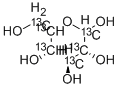
What is Glucose-13C6?
Chemical properties
White Solid
The Uses of Glucose-13C6
Glucose-13C6 is a simple sugar that is present in plants. A monosaccharide that may exist in open chain or cyclic conformation if in solution. It plays a vital role in photosynthesis and fuels the energy required for cellular respiration. D-Glucose is used in various metabolic processes including enzymic synthesis of cyclohexyl-α and β-D-glucosides. Can also be used as a diagnostic tool in detection of type 2 diabetes mellitus and potentially Huntington's disease through analysis of blood-glucose in type 1 diabetes mellitus.
The Uses of Glucose-13C6
Glucose-13C6 can be used in enzymic synthesis of cyclohexyl-α and β-D-glucosides
The Uses of Glucose-13C6
D-Glucose-13C6 has been used:
- for de novo fatty acid (FA) synthesis
- as a component in tracing media for the analysis of stable isotope tracer
- in minimal media for recombinant protein production
- for cell suspension
What are the applications of Application
D-Glucose-13C6 is a monosaccharide present in plants, used as an internal standard for the quantification of D-(+)-glucose.
Biochem/physiol Actions
D-Glucose-13C6 functions as a tracer and helps to access glucose kinetics in vivo.
Properties of Glucose-13C6
| Melting point: | 150-152 °C(lit.) |
| storage temp. | Refrigerator |
| solubility | Methanol (Slightly, Heated, Sonicated), Water (Sparingly, Sonicated) |
| form | Solid |
| color | White to Off-White |
| optical activity | [α]25/D +52.0°, c = 2 in H2O (trace NH4OH) |
Safety information for Glucose-13C6
| Signal word | Warning |
| Pictogram(s) |
 Exclamation Mark Irritant GHS07 |
| GHS Hazard Statements |
H302:Acute toxicity,oral H315:Skin corrosion/irritation H319:Serious eye damage/eye irritation H335:Specific target organ toxicity, single exposure;Respiratory tract irritation |
| Precautionary Statement Codes |
P261:Avoid breathing dust/fume/gas/mist/vapours/spray. P280:Wear protective gloves/protective clothing/eye protection/face protection. P301+P312:IF SWALLOWED: call a POISON CENTER or doctor/physician IF you feel unwell. P302+P352:IF ON SKIN: wash with plenty of soap and water. P305+P351+P338:IF IN EYES: Rinse cautiously with water for several minutes. Remove contact lenses, if present and easy to do. Continuerinsing. |
Computed Descriptors for Glucose-13C6
| InChIKey | WQZGKKKJIJFFOK-NYKRWLDMSA-N |
New Products
9-Mesityl-10-methylacridinium perchlorate Sulfapyridine Fmoc-OSu (R)-(-)-2-Amino-1-propanol Cyclobutanone 5-bromo-4-fluoro-2-nitrobenzaldehyde Phenethyl cinnamate Obidoxime hydrochloride API Pyrrolo[1,2-a]pyrimidine-6-carboxylic acid, 4,6,7,8-tetrahydro-4-oxo-, sodium salt (1:1), (6S) Dipropyl disulfide N-Vinylformamide 4 pentyn 1 ol Methacrylate-PEG-Methacrylate, Mn:35000 2,4-Dihydroxyacetophenone 2-Chloro 5-Fluoro Pyridine Vasicinone 2-Chloroisonicotinic Acid Tween 80 or Polysorbate 80 Carbozantinib intermediate(n-1) N-(4-fluoro-2-methoxy-5-nitrophenyl)-4-(1-methyl-1H-indol-3-yl)pyrimidin-2-amine Pirtobrutinib intd. N-(4-Cyano-3-(trifluoromethyl)phenyl)-2-methyloxirane-2-carboxamide 2-Pentyn-1-oL 4-NitrobenzotrifluorideRelated products of tetrahydrofuran

![BETA-D-[UL-13C6]FRUCTOFURANOSYL ALPHA-D-[UL-13C6]GLUCOPYRANOSIDE](https://img.chemicalbook.in/CAS/GIF/41055-68-9.gif)
You may like
-
 D-Glucose-13C6 CAS 110187-42-3View Details
110187-42-3 -
D-Glucose-13C6 CAS 110187-42-3View Details
110187-42-3 -
Fmoc-OSu 98+View Details
82911-69-1 -
(R)-(-)-2-Amino-1-propanol 35320-23-1 98+View Details
35320-23-1 -
1191-95-3 Cyclobutanone 98+View Details
1191-95-3 -
213382-45-7 98+View Details
213382-45-7 -
Fmoc-OSu 98+View Details
82911-69-1 -
(R)-(-)-2-Amino-1-propanol 35320-23-1 98+View Details
35320-23-1