
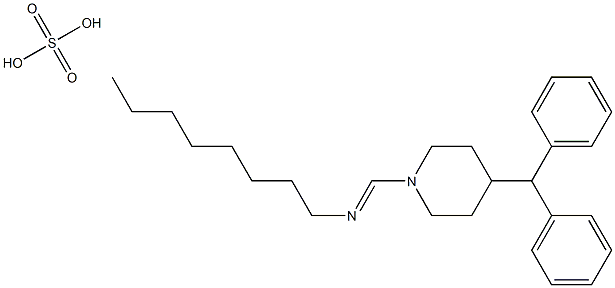
Fenoctimine Sulfate
- CAS NO.:69365-67-9
- Empirical Formula: C27H40N2O4S
- Molecular Weight: 488.6825
- SAFETY DATA SHEET (SDS)
- Update Date: 2022-12-21 16:56:50
What is Fenoctimine Sulfate?
Originator
Fenoctimine sulfate,ZYF Pharm Chemical
The Uses of Fenoctimine Sulfate
Antisecretory (gastric).
Manufacturing Process
Dimethyl sulfate (126.1 g, 1.0 mole) was heated to 65°C. The temperature
was maintained at 60-70°C while dimethylformamide (73.1 g, 1.0 mole) was
added over a period of about 30 minutes. After the addition was complete, the
reaction was heated at 70°C for 7 hours, then cooled to below 30°C. n-
Octylamine (129.2 g, 1.0 mole) was added over a 20 minute period with
external cooling to maintain the temperature at 40°C. The reaction was stirred
an additional 3 hours at 40°C after addition was complete. The reaction was
cooled to about 10°C and treated with toluene (200 ml), water (200 ml) and
finally 27% sodium hydroxide solution (180 g , 2 moles). The organic phase
was separated, dried over anhydrous sodium sulfate, filtered and evaporated
under reduced pressure to yield 190 g of a light yellow liquid which was
fractionally distilled twice to yield 113 g (61%) of the title compound as a
water white liquid; b.p. 115.-117°C at 15 mm Hg.
4-(Diphenylmethyl)piperidine (12.5 g, 0.05 mole) and N,N-dimethyl-N'-
octylformamidine (11.5 g, 0.06 mole) were placed in a 3-necked flask
equipped with magnetic stirrer, heating mantle, thermometer and nitrogen
inlet. A moderate stream of nitrogen was blown through the flask while the
reaction was heated to 120°C. The reaction was stirred and heated at 120°C
for 5 hours, then cooled to 20°C and diluted with toluene (35 ml). The
reaction was cooled in an ice bath, stirred, and treated with a mixture of ice
(50 g) and sulfuric acid (9 g, 0.088 mole). After stirring for 15 min, the
resulting solid was isolated by filtration, and washed sequentially with toluene
(10 ml), and 1 N sulfuric acid (2 x 10 ml). The solid was suspended twice in a mixture of water (100 ml) and 1 N sulfuric acid (20 ml) and stirred for 30 min
each time prior to filtration. Finally, the product was washed with water (2x10
ml), and cyclohexane (20 ml). The filter cake was dried under reduced
pressure at 30°C to constant weight to yield 21.3 g (85.6%) of the 4-
(diphenylmethyl)-1-[(octylimino)methyl]piperidine sulfate (1:1), m.p. 113-
115°C. 4-(Diphenylmethyl)-1-[(octylimino)methyl]piperidine may be used as a
sulfate.
Therapeutic Function
Gastric antisecretory
Safety information for Fenoctimine Sulfate
New Products
2-(2-Chlorophenyl)glycine Propiolic Acid 1-(3-Hydroxy-4-methoxyphenyl)-2-nitroethene (±)-amino(2-fluorophenyl)acetic acid trans-3-Benzyloxy-4-methoxy-beta-nitrostyrene 1-Pentadecanol 4-(4-Αminophenyl)-3-Morpholinone 3-Morpholino-1-(4-(2-oxopiperidin-1-yl) phenyl)-5,6-dihyropyridin-2-(1H)-one 1-(4-Aminophenyl)-3-morpholino-5,6-dihydropyridin-2(1H)-one N-cyanoacetylurethane 1H-IndazoleYou may like
-
 40216-83-9 trans-4-Hydroxy-L-proline methyl ester hydrochloride 98+View Details
40216-83-9 -
471-25-0 Propiolic Acid 98+View Details
471-25-0 -
84145-28-8 98+View Details
84145-28-8 -
trans-3-Benzyloxy-4-methoxy-beta-nitrostyrene 98+View Details
63909-29-5 -
2-(2-Chlorophenyl)glycine 88744-36-9 98+View Details
88744-36-9 -
40216-83-9 trans-4-Hydroxy-L-proline methyl ester hydrochloride 98+View Details
40216-83-9 -
629-76-5 98+View Details
629-76-5 -
1-(3-Hydroxy-4-methoxyphenyl)-2-nitroethene 98+View Details
39816-35-8