
FEMA 2302
- CAS NO.:140-27-2
- Empirical Formula: C14H18O2
- Molecular Weight: 218.29
- MDL number: MFCD00048351
- EINECS: 205-407-9
- SAFETY DATA SHEET (SDS)
- Update Date: 2026-06-24 18:39:39
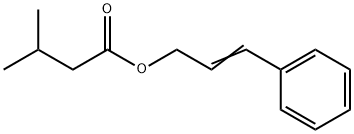
What is FEMA 2302?
Chemical properties
Cinnamyl isovalerate has a characteristic rose-like odor and an apple-like taste.
Occurrence
Has apparently not been reported to occur in nature.
The Uses of FEMA 2302
Used quite frequently in flavor compositions for imitation Apple, Apricot, Cherry, Chocolate, Grape, Maple, Nut, Peach, Pineapple, Plum, Spice, Strawberry, etc. Also, in tobacco flavorings.
Preparation
By esterification of cinnamic alcohol with isovaleric acid.
Taste threshold values
Taste characteristics at 25 ppm: fruity, sweet, pineapple, with waxy and spicy nuances.
Safety Profile
Low toxicity by ingestion and skin contact. When heated to decomposition it emits acrid smoke and irritating vapors.
Properties of FEMA 2302
| Boiling point: | 313 °C(lit.) |
| Density | 0.992 g/mL at 25 °C(lit.) |
| refractive index | n |
| FEMA | 2302 | CINNAMYL ISOVALERATE |
| Flash point: | >230 °F |
| solubility | Insoluble in water, soluble in alcohol, miscible with most perfume oils. Poorly soluble in Propylene glycol |
| color | Colorless liquid |
| Odor | at 100.00 %. sweet spice melon cherry green apple |
| JECFA Number | 654 |
| NIST Chemistry Reference | Butanoic acid, 3-methyl-, 3-phenyl-2-propenyl ester(140-27-2) |
| EPA Substance Registry System | Butanoic acid, 3-methyl-, 3-phenyl-2-propenyl ester (140-27-2) |
Safety information for FEMA 2302
| Signal word | Warning |
| Pictogram(s) |
 Exclamation Mark Irritant GHS07 |
| GHS Hazard Statements |
H302:Acute toxicity,oral H315:Skin corrosion/irritation H319:Serious eye damage/eye irritation |
| Precautionary Statement Codes |
P264:Wash hands thoroughly after handling. P264:Wash skin thouroughly after handling. P270:Do not eat, drink or smoke when using this product. P280:Wear protective gloves/protective clothing/eye protection/face protection. P302+P352:IF ON SKIN: wash with plenty of soap and water. P305+P351+P338:IF IN EYES: Rinse cautiously with water for several minutes. Remove contact lenses, if present and easy to do. Continuerinsing. P332+P313:IF SKIN irritation occurs: Get medical advice/attention. P337+P313:IF eye irritation persists: Get medical advice/attention. |
Computed Descriptors for FEMA 2302
New Products
Cyclobutanone (R)-(-)-2-Amino-1-propanol Fmoc-OSu 5-bromo-4-fluoro-2-nitrobenzaldehyde 2-Amino-2-(4-methylphenyl)acetic acid 1-(2-Chloroethyl)pyrrolidine Hydrochloride 2,4-Dihydroxybenzaldehyde Obidoxime hydrochloride API Pyrrolo[1,2-a]pyrimidine-6-carboxylic acid, 4,6,7,8-tetrahydro-4-oxo-, sodium salt (1:1), (6S) Dipropyl disulfide N-Vinylformamide 4 pentyn 1 ol Methacrylate-PEG-Methacrylate, Mn:35000 2,4-Dihydroxyacetophenone 2-Chloro 5-Fluoro Pyridine Vasicinone 2-Chloroisonicotinic Acid Tween 80 or Polysorbate 80 2-Butyn-1-oL N-(4-fluoro-2-methoxy-5-nitrophenyl)-4-(1-methyl-1H-indol-3-yl)pyrimidin-2-amine Pirtobrutinib intd. 2-Pentyn-1-oL 4-Nitrobenzotrifluoride N-(4-Cyano-3-(trifluoromethyl)phenyl)-2-methyloxirane-2-carboxamideRelated products of tetrahydrofuran


You may like
-
 7250-67-1 1-(2-Chloroethyl)pyrrolidine Hydrochloride 98+View Details
7250-67-1 -
13227-01-5 98+View Details
13227-01-5 -
7250-67-1 1-(2-Chloroethyl)pyrrolidine Hydrochloride 98+View Details
7250-67-1 -
13227-01-5 98+View Details
13227-01-5 -
545445-44-1 3-Morpholino-1-(4-(2-oxopiperidin-1-yl) phenyl)-5,6-dihyropyridin-2-(1H)-one 98%View Details
545445-44-1 -
6629-04-5 98%View Details
6629-04-5 -
4-(4-Αminophenyl)-3-Morpholinone 98%View Details
438056-69-0 -
1-(4-Aminophenyl)-3-morpholino-5,6-dihydropyridin-2(1H)-one 1267610-26-3 98%View Details
1267610-26-3
Statement: All products displayed on this website are only used for non medical purposes such as industrial applications or scientific research, and cannot be used for clinical diagnosis or treatment of humans or animals. They are not medicinal or edible.