
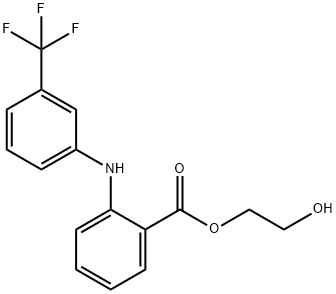
Etofenamate
Synonym(s):2-[[3-(Trifluoromethyl)phenyl]amino]benzoic acid 2-(2-hydroxyethoxy)ethyl ester
- CAS NO.:30544-47-9
- Empirical Formula: C18H18F3NO4
- Molecular Weight: 369.33
- MDL number: MFCD00242806
- EINECS: 250-231-8
- SAFETY DATA SHEET (SDS)
- Update Date: 2026-11-04 17:01:56
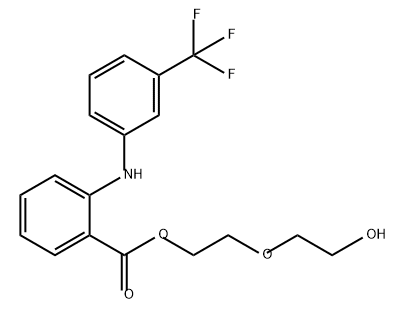
What is Etofenamate?
Chemical properties
Light Yellow Oil
Originator
Rheumon,Troponwerke,W. Germany,1977
The Uses of Etofenamate
As a histamine H1 -receptor antagonist, Etofenamate can be used as anti-inflammatory;cyclooxygenase inhibitor and medication used to alleviate joint and muscle pain.
What are the applications of Application
Etofenamate is an anti-inflammatory, anti-arrhythmic amino acid
Definition
ChEBI: 2-[3-(trifluoromethyl)anilino]benzoic acid 2-(2-hydroxyethoxy)ethyl ester is a benzoate ester.
Manufacturing Process
16.0 g (0.05 mol) of the potassium salt of N-(3-trifluoromethylphenyl)- anthranilic acid are dissolved in 60 ml of dimethylformamide and heated to 110°C, and 6.2 g (0.05 mol) of 2-(2-chloroethoxy)-ethanol are slowly added. The reaction mixture is then heated to boiling for 2 hours. The precipitated potassium chloride is filtered off and the solvent is removed by evaporation. The residue is separated over a column with 400 g of silica gel (particle size 0.05 to 0.2 mm), using a 1:1 mixture of cyclohexane and glacial acetic acid as eluting agent. 16.0 g of the 2-(2-hydroxyethoxy)-ethyl ester of N-(3- trifluoromethylphenyl)-anthranilic acid are obtained in the form of a pale yellow oil which does not crystallize and cannot be distilled.
Therapeutic Function
Antiinflammatory
Properties of Etofenamate
| Melting point: | 25°C |
| Boiling point: | bp.001 130-135° |
| Density | 1.2866 (estimate) |
| refractive index | nD25 1.564 |
| storage temp. | Sealed in dry,2-8°C |
| solubility | Practically insoluble in water, miscible with ethanol (96 per cent) and with ethyl acetate. |
| form | neat |
| pka | 14.32±0.10(Predicted) |
| form | Oil |
| color | Light yellow to yellow |
| Stability: | Light Sensitive |
Safety information for Etofenamate
| Signal word | Danger |
| Pictogram(s) |
 Skull and Crossbones Acute Toxicity GHS06  Environment GHS09 |
| GHS Hazard Statements |
H301:Acute toxicity,oral H410:Hazardous to the aquatic environment, long-term hazard |
Computed Descriptors for Etofenamate
Etofenamate manufacturer
New Products
2-(2-Chlorophenyl)glycine Propiolic Acid 1-(3-Hydroxy-4-methoxyphenyl)-2-nitroethene (±)-amino(2-fluorophenyl)acetic acid trans-3-Benzyloxy-4-methoxy-beta-nitrostyrene 1-Pentadecanol 4-(4-Αminophenyl)-3-Morpholinone 3-Morpholino-1-(4-(2-oxopiperidin-1-yl) phenyl)-5,6-dihyropyridin-2-(1H)-one 1-(4-Aminophenyl)-3-morpholino-5,6-dihydropyridin-2(1H)-one N-cyanoacetylurethane 1H-IndazoleRelated products of tetrahydrofuran


You may like
-
 30544-47-9 Etofenamate 98%View Details
30544-47-9 -
 Etofenamate 95% CAS 30544-47-9View Details
30544-47-9 -
Etofenamate CAS 30544-47-9View Details
30544-47-9 -
Etofenamate for peak identification CAS 30544-47-9View Details
30544-47-9 -
 99% Etofenamate IP powder, 25 KGView Details
30544-47-9 -
471-25-0 Propiolic Acid 98+View Details
471-25-0 -
2-(2-Chlorophenyl)glycine 88744-36-9 98+View Details
88744-36-9 -
40216-83-9 trans-4-Hydroxy-L-proline methyl ester hydrochloride 98+View Details
40216-83-9