
DIISOBUTYLALUMINUM CHLORIDE
- CAS NO.:1779-25-5
- Empirical Formula: C8H18AlCl
- Molecular Weight: 176.66
- MDL number: MFCD00008927
- EINECS: 217-216-8
- SAFETY DATA SHEET (SDS)
- Update Date: 2026-05-27 23:14:58
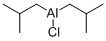
What is DIISOBUTYLALUMINUM CHLORIDE?
Chemical properties
liquid; pyrophoric; sensitive to air; uses: transmetallating reagent [ALD94]
The Uses of DIISOBUTYLALUMINUM CHLORIDE
Diisobutylaluminum chloride is used as cocatlyst component in Ziegler-Natta type catalyst systems of olefins and alkylation reactions.
The Uses of DIISOBUTYLALUMINUM CHLORIDE
Transmetalating reagent
Safety Profile
Mildly toxic by inhalation. See also ALUMINUM COMPOUNDS and CHLORIDES. Ignites spontaneously in air. When heated to decomposition it emits toxic fumes of Cl-.
Properties of DIISOBUTYLALUMINUM CHLORIDE
| Melting point: | -40°C |
| Boiling point: | 152°C 10mm |
| Density | 0.905 g/mL at 25 °C(lit.) |
| refractive index | n20/D 1.4506(lit.) |
| Flash point: | -18°C |
| storage temp. | Flammables area |
| solubility | soluble in ethyl ether, hx |
| form | Liquid |
| Specific Gravity | 0.74 |
| color | Colorless |
| Water Solubility | Soluble in aromatic, saturated aliphatic and cycloaliphatic hydrocarbon. Reacts with water. |
| Sensitive | Air & Moisture Sensitive |
| Hydrolytic Sensitivity | 8: reacts rapidly with moisture, water, protic solvents |
| Exposure limits | ACGIH: TWA 50 ppm (Skin) OSHA: TWA 500 ppm(1800 mg/m3) NIOSH: IDLH 1100 ppm; TWA 50 ppm(180 mg/m3) |
| CAS DataBase Reference | 1779-25-5 |
| EPA Substance Registry System | Aluminum, chlorobis(2-methylpropyl)- (1779-25-5) |
Safety information for DIISOBUTYLALUMINUM CHLORIDE
| Signal word | Danger |
| Pictogram(s) |
 Flame Flammables GHS02  Corrosion Corrosives GHS05  Skull and Crossbones Acute Toxicity GHS06 |
| GHS Hazard Statements |
H250:Pyrophoric liquids; Pyrorophoric solids H261:Substances And Mixtures Which, In Contact With Water,Emit Flammable Gases H314:Skin corrosion/irritation H330:Acute toxicity,inhalation |
| Precautionary Statement Codes |
P280:Wear protective gloves/protective clothing/eye protection/face protection. P231+P232:Handle under inert gas. Protect from moisture. P303+P361+P353:IF ON SKIN (or hair): Remove/Take off Immediately all contaminated clothing. Rinse SKIN with water/shower. P305+P351+P338:IF IN EYES: Rinse cautiously with water for several minutes. Remove contact lenses, if present and easy to do. Continuerinsing. P370+P378:In case of fire: Use … for extinction. |
Computed Descriptors for DIISOBUTYLALUMINUM CHLORIDE
| InChIKey | HQMRIBYCTLBDAK-UHFFFAOYSA-M |
New Products
Dibenzoyl-L-tartaric acid Anhydrous (Resolution Reagent) Cis-Tosylate Dibenzo[b,f][1,4]thiazepin-11(10H)-one 1,2,3,9-Tetrahydro-9-Methyl-4H-Carbazole-4-One 1-(4-methoxyphenyl)-4-(4-Nitrophenyl)Piperazine (IT-1) BOC Piperazine 1-Benzhydrylazetane-3-carbonitrile 8-oxa-1,3-diazaspiro[4.5]decane-2,4-dione (±)-amino(2-fluorophenyl)acetic acid 2-(2-Chlorophenyl)glycine AMINO-(3-CHLORO-PHENYL)-ACETIC ACID 2'-Fluoroacetophenone METHANOL-D1(OD) TERTIARY BUTANOL-D9 N-ETHYL-D5-AMINE HYDROCHLORIDE BENZOIC ACID-D CHLOROFORM-D TOLUENE-D3 Trans,trans muconic acid HC Blue-16 4-Amino-2-chloro-6,7-dimethoxyquinazoline Ethyl 4,5-bis(2-methoxyethoxy)-2-nitrobenzoate 2,3-Dimethoxypyridine 1-(3-Chlorophenyl)piperazine hydrochlorideRelated products of tetrahydrofuran




You may like
-
 1779-25-5 Di-Isobutyl Aluminium Chloride (1.0M Hexane)View Details
1779-25-5 -
 Product IntroductionView Details
 -
 Product InrtroductionView Details
 -
 DGO24View Details
 -
 DGO25View Details
 -
 DGO29View Details
 -
 DGO32View Details
 -
 DGO36View Details
Statement: All products displayed on this website are only used for non medical purposes such as industrial applications or scientific research, and cannot be used for clinical diagnosis or treatment of humans or animals. They are not medicinal or edible.