
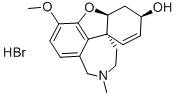
Dihydrogalanthamine
- CAS NO.:21133-52-8
- Empirical Formula: C17H23NO3
- Molecular Weight: 289.37
- MDL number: MFCD22683780
- SAFETY DATA SHEET (SDS)
- Update Date: 2026-11-04 17:02:55

What is Dihydrogalanthamine?
The Uses of Dihydrogalanthamine
One of the minor alkaloids of Lycoris radiata, a highly efficient, selective and sensitive acetylcholinesterase inhibitor.
The Uses of Dihydrogalanthamine
One of the minor alkaloids of Lycoris radiata, a highly efficient, selective and sensitive acetylcholinesterase inhibitor. An analog of Galanthamine (G188500).
Definition
ChEBI: Lycoramine is a benzazepine.
Properties of Dihydrogalanthamine
| Melting point: | 122-124 ºC |
| Boiling point: | 436.4±45.0 °C(Predicted) |
| alpha | D27 -98° (alcohol) |
| Density | 1.25 |
| storage temp. | 4°C, protect from light |
| solubility | Chloroform (Slightly), Methanol (Slightly) |
| form | Solid |
| pka | 14.77±0.20(Predicted) |
| color | White to Pale Yellow |
Safety information for Dihydrogalanthamine
Computed Descriptors for Dihydrogalanthamine
New Products
2-(2-Chlorophenyl)glycine Propiolic Acid 1-(3-Hydroxy-4-methoxyphenyl)-2-nitroethene (±)-amino(2-fluorophenyl)acetic acid trans-3-Benzyloxy-4-methoxy-beta-nitrostyrene 1-Pentadecanol 4-(4-Αminophenyl)-3-Morpholinone 3-Morpholino-1-(4-(2-oxopiperidin-1-yl) phenyl)-5,6-dihyropyridin-2-(1H)-one 1-(4-Aminophenyl)-3-morpholino-5,6-dihydropyridin-2(1H)-one N-cyanoacetylurethane 1H-IndazoleRelated products of tetrahydrofuran





You may like
-
 40216-83-9 trans-4-Hydroxy-L-proline methyl ester hydrochloride 98+View Details
40216-83-9 -
471-25-0 Propiolic Acid 98+View Details
471-25-0 -
84145-28-8 98+View Details
84145-28-8 -
trans-3-Benzyloxy-4-methoxy-beta-nitrostyrene 98+View Details
63909-29-5 -
2-(2-Chlorophenyl)glycine 88744-36-9 98+View Details
88744-36-9 -
40216-83-9 trans-4-Hydroxy-L-proline methyl ester hydrochloride 98+View Details
40216-83-9 -
629-76-5 98+View Details
629-76-5 -
1-(3-Hydroxy-4-methoxyphenyl)-2-nitroethene 98+View Details
39816-35-8
Statement: All products displayed on this website are only used for non medical purposes such as industrial applications or scientific research, and cannot be used for clinical diagnosis or treatment of humans or animals. They are not medicinal or edible.