
Difenacoum
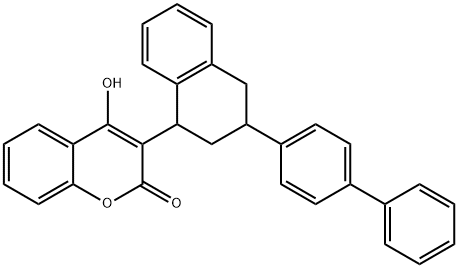
Synonym(s):3-(3-Biphenyl-4-yl-1,2,3,4-tetrahydro-1-naphthyl)-4-hydroxycoumarin;3-(3-Biphenyl-4-yl-1,2,3,4-tetrahydro-naphthalen-1-yl)-4-hydroxychromen-2-one
- CAS NO.:56073-07-5
- Empirical Formula: C31H24O3
- Molecular Weight: 444.52
- MDL number: MFCD01632770
- EINECS: 259-978-4
- SAFETY DATA SHEET (SDS)
- Update Date: 2026-10-13 16:36:52
What is Difenacoum?
Description
Difenacoum, is also called 3-(3-biphenyl-4-yl-1,2,3,4- tetrahydro-1-naphthyl)-4-hydroxycoumarin, consists of colorless crystals which are insoluble in water, moderately to readily soluble in acetone, chloroform, ethyl acetate, benzene.Difenacoum is synthesized by the condensation of 4-hydroxycoumarin and 3-biphenyl-4-yl-1,2,3,4-tetrahydro-1-naphthol (49).
The Uses of Difenacoum
Difenacoum is a 4-hydroxycouramin derivative. Difenacoum is a second generation anticoagulant rodenticide used against rodent pests such as rats and mice.
The Uses of Difenacoum
Pesticide.
Definition
ChEBI: Difenacoum is a ring assembly, a member of benzenes and a member of naphthalenes.
Agricultural Uses
Rodenticide: Difenacoum is an anticoagulant that is effective against rats and mice, including warfarin-resistant strains. It is used in agriculture and urban rodent control as ready-to-use baits.
Trade name
COMPO®; MATRAK®; NEOSOREXA® PELLETS; NEOSOREXA PP580®; RASTOP®; RATAK®; RATRICK®; SILO; SOREXA GEL; STORM
Safety Profile
A poison by ingestion and skincontact. When heated to decomposition it emits acridsmoke and irritating vapors.
Toxicity evaluation
Appearing in 1974, difenacoum was the first of the new generation of anticoagulants to be commercialized for the control of rodents resistant to warfarin and related compounds (42). LD50 values (acute oral) for warfarinsusceptible rodent strains are about a factor of 2 lower than for warfarin-resistant strains. There is also a degree of specificity. The compound is generally less toxic to nontarget animals than to targets. A wide range of bait types containing 0.005% difenacoum is available, including meals, broken and whole grains, pellets, and wax blocks. A 0.1% contact dust is no longer widely used. Resistance to difenacoum was detected among a population of Norway rats in the United Kingdom in 1978 (50). This remains a problem of local importance but relatively low resistance factors indicate that other behavioral factors also play a significant role (51). Difenacoum resistance has also been recorded in other European countries (39).
Properties of Difenacoum
| Melting point: | 215-217° |
| Boiling point: | 514.5°C (rough estimate) |
| Density | 1.0800 (rough estimate) |
| refractive index | 1.5500 (estimate) |
| solubility | Chloroform (Slightly), Methanol (Slightly) |
| pka | 4.50±1.00(Predicted) |
| form | neat |
| BRN | 8360065 |
| CAS DataBase Reference | 56073-07-5(CAS DataBase Reference) |
| EPA Substance Registry System | Difenacoum (56073-07-5) |
Safety information for Difenacoum
| Signal word | Danger |
| Pictogram(s) |
 Skull and Crossbones Acute Toxicity GHS06  Health Hazard GHS08  Environment GHS09 |
| GHS Hazard Statements |
H372:Specific target organ toxicity, repeated exposure H410:Hazardous to the aquatic environment, long-term hazard |
| Precautionary Statement Codes |
P202:Do not handle until all safety precautions have been read and understood. P264:Wash hands thoroughly after handling. P264:Wash skin thouroughly after handling. P273:Avoid release to the environment. P280:Wear protective gloves/protective clothing/eye protection/face protection. |
Computed Descriptors for Difenacoum
New Products
2-(2-Chlorophenyl)glycine Propiolic Acid 1-(3-Hydroxy-4-methoxyphenyl)-2-nitroethene (±)-amino(2-fluorophenyl)acetic acid trans-3-Benzyloxy-4-methoxy-beta-nitrostyrene 1-Pentadecanol 4-(4-Αminophenyl)-3-Morpholinone 3-Morpholino-1-(4-(2-oxopiperidin-1-yl) phenyl)-5,6-dihyropyridin-2-(1H)-one 1-(4-Aminophenyl)-3-morpholino-5,6-dihydropyridin-2(1H)-one N-cyanoacetylurethane 1H-IndazoleRelated products of tetrahydrofuran

You may like
-
 40216-83-9 trans-4-Hydroxy-L-proline methyl ester hydrochloride 98+View Details
40216-83-9 -
471-25-0 Propiolic Acid 98+View Details
471-25-0 -
84145-28-8 98+View Details
84145-28-8 -
trans-3-Benzyloxy-4-methoxy-beta-nitrostyrene 98+View Details
63909-29-5 -
2-(2-Chlorophenyl)glycine 88744-36-9 98+View Details
88744-36-9 -
40216-83-9 trans-4-Hydroxy-L-proline methyl ester hydrochloride 98+View Details
40216-83-9 -
629-76-5 98+View Details
629-76-5 -
1-(3-Hydroxy-4-methoxyphenyl)-2-nitroethene 98+View Details
39816-35-8