
DBCO-PEG4-TAMRA
Synonym(s):ADIBO-PEG4-TAMRA;DBCO-PEG4-Fluor 545;DBCO-PEG4-TAMRA;DBCO-PEG4-tetramethylrhodamine
- Molecular Weight: 0
- Update Date: 2026-01-13 11:18:37
What is DBCO-PEG4-TAMRA?
The Uses of DBCO-PEG4-TAMRA
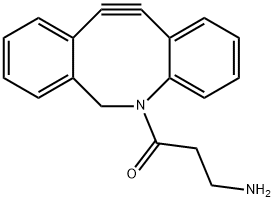
This azadibenzocyclooctyne-tetramethyl rhodamine (TAMRA) derivative is a versatile fluorescent reagent for labeling azide containing molecules or compounds. Cyclooctynes are useful in strain-promoted copper-free azide-alkyne click chemistry reactions.This dibenzocyclooctyne will react with azide-functionalized compounds or biomolecules without the need for a Cu(I) catalyst to result in a stable triazole linkage. Subsequent labeled molecules can be visualized by fluorescence spectroscopy.
Spectral Properties: Abs/Em = 545/567nm
Properties of DBCO-PEG4-TAMRA
| storage temp. | -20°C |
Safety information for DBCO-PEG4-TAMRA
Computed Descriptors for DBCO-PEG4-TAMRA
New Products
2-(2-Chlorophenyl)glycine Propiolic Acid 1-(3-Hydroxy-4-methoxyphenyl)-2-nitroethene (±)-amino(2-fluorophenyl)acetic acid trans-3-Benzyloxy-4-methoxy-beta-nitrostyrene 1-Pentadecanol 4-(4-Αminophenyl)-3-Morpholinone 3-Morpholino-1-(4-(2-oxopiperidin-1-yl) phenyl)-5,6-dihyropyridin-2-(1H)-one 1-(4-Aminophenyl)-3-morpholino-5,6-dihydropyridin-2(1H)-one N-cyanoacetylurethane 1H-IndazoleRelated products of tetrahydrofuran



You may like
-
 Dibenzocyclooctyne-PEG4-Fluor 545 CASView Details
-
471-25-0 Propiolic Acid 98+View Details
471-25-0 -
84145-28-8 98+View Details
84145-28-8 -
trans-3-Benzyloxy-4-methoxy-beta-nitrostyrene 98+View Details
63909-29-5 -
2-(2-Chlorophenyl)glycine 88744-36-9 98+View Details
88744-36-9 -
40216-83-9 trans-4-Hydroxy-L-proline methyl ester hydrochloride 98+View Details
40216-83-9 -
629-76-5 98+View Details
629-76-5 -
1-(3-Hydroxy-4-methoxyphenyl)-2-nitroethene 98+View Details
39816-35-8
Statement: All products displayed on this website are only used for non medical purposes such as industrial applications or scientific research, and cannot be used for clinical diagnosis or treatment of humans or animals. They are not medicinal or edible.