
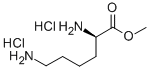
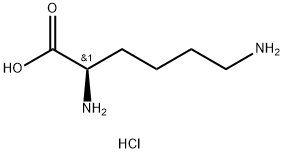
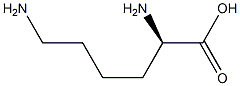
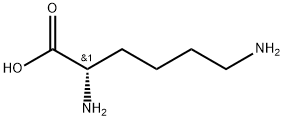
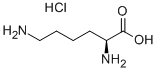
D-Lysine
Synonym(s):(R)-2,6-Diaminocaproic acid
- CAS NO.:923-27-3
- Empirical Formula: C6H14N2O2
- Molecular Weight: 146.19
- MDL number: MFCD00008234
- EINECS: 213-091-9
- SAFETY DATA SHEET (SDS)
- Update Date: 2026-05-28 03:13:12
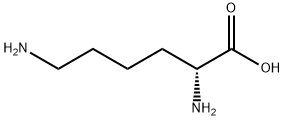
What is D-Lysine ?
Chemical properties
white to light yellow crystal powde
The Uses of D-Lysine
D-Lysine is the unnatural isomer of L-Lysine (L468895) that has the ability to reduce non-enzymatic glycation in vitro. D-Lysine also exists as polypeptide chains of poly-D-lysine, a nonspecific adhesion-promoting molecule that has the potential to be a polymeric drug carrier.
The Uses of D-Lysine
D-Lysine is used as a component of a wide array of polymers (poly-D-lysine), surfactants and biofilms to confer a positive (cationic) charge.
What are the applications of Application
D-Lysine is used as a component of a wide array of polymers (poly-D-lysine), surfactants and biofilms
Definition
ChEBI: The D-enantiomer of the alpha-amino acid lysine.
Properties of D-Lysine
| Melting point: | 218 °C (dec.)(lit.) |
| Boiling point: | 311.5±32.0 °C(Predicted) |
| Density | 1.125±0.06 g/cm3(Predicted) |
| storage temp. | -20°C |
| solubility | H2O: soluble |
| form | Solid |
| pka | 2.49±0.24(Predicted) |
| color | Off-White to Pale Beige |
| BRN | 1722530 |
| CAS DataBase Reference | 923-27-3(CAS DataBase Reference) |
| EPA Substance Registry System | D-Lysine (923-27-3) |
Safety information for D-Lysine
| Signal word | Danger |
| Pictogram(s) |
 Corrosion Corrosives GHS05  Exclamation Mark Irritant GHS07 |
| GHS Hazard Statements |
H302:Acute toxicity,oral H314:Skin corrosion/irritation |
| Precautionary Statement Codes |
P260:Do not breathe dust/fume/gas/mist/vapours/spray. P264:Wash hands thoroughly after handling. P264:Wash skin thouroughly after handling. P270:Do not eat, drink or smoke when using this product. P280:Wear protective gloves/protective clothing/eye protection/face protection. P363:Wash contaminated clothing before reuse. P301+P330+P331:IF SWALLOWED: Rinse mouth. Do NOT induce vomiting. P303+P361+P353:IF ON SKIN (or hair): Remove/Take off Immediately all contaminated clothing. Rinse SKIN with water/shower. P405:Store locked up. |
Computed Descriptors for D-Lysine
New Products
5-bromo-4-fluoro-2-nitrobenzaldehyde (R)-(-)-2-Amino-1-propanol Cyclobutanone Fmoc-OSu 1-(2-Chloroethyl)pyrrolidine Hydrochloride 2-Amino-2-(4-methylphenyl)acetic acid β-Bromostyrene Ethyl 3-phenylpropanoate Phenethyl cinnamate Dipropyl disulfide 4 pentyn 1 ol N-Vinylformamide Methacrylate-PEG-Methacrylate, Mn:35000 2,4-Dihydroxyacetophenone 2-Chloro 5-Fluoro Pyridine Vasicinone 2-Chloroisonicotinic Acid Tween 80 or Polysorbate 80 2-Butyn-1-oL 2-Pentyn-1-oL 4-Nitrobenzotrifluoride N-(4-fluoro-2-methoxy-5-nitrophenyl)-4-(1-methyl-1H-indol-3-yl)pyrimidin-2-amine Pirtobrutinib intd. N-(4-Cyano-3-(trifluoromethyl)phenyl)-2-methyloxirane-2-carboxamideRelated products of tetrahydrofuran
You may like
-
 D-Lysine 98.00% CAS 923-27-3View Details
923-27-3 -
D-Lysine 95% CAS 923-27-3View Details
923-27-3 -
D-Lysine CAS 923-27-3View Details
923-27-3 -
7250-67-1 1-(2-Chloroethyl)pyrrolidine Hydrochloride 98+View Details
7250-67-1 -
7250-67-1 1-(2-Chloroethyl)pyrrolidine Hydrochloride 98+View Details
7250-67-1 -
13227-01-5 98+View Details
13227-01-5 -
7250-67-1 1-(2-Chloroethyl)pyrrolidine Hydrochloride 98+View Details
7250-67-1 -
13227-01-5 98+View Details
13227-01-5
Statement: All products displayed on this website are only used for non medical purposes such as industrial applications or scientific research, and cannot be used for clinical diagnosis or treatment of humans or animals. They are not medicinal or edible.