
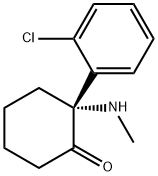
d-Ketamine
- CAS NO.:33643-49-1
- Empirical Formula: C13H16ClNO
- Molecular Weight: 237.73
- SAFETY DATA SHEET (SDS)
- Update Date: 2026-11-04 17:01:56
What is d-Ketamine?
The Uses of d-Ketamine
(R)-Ketamine is an intermediate in the synthesis of (R)-Ketamine Hydrochloride (K165305). (R)-Ketamine is the less active enantiomer of the NMDA receptor antagonist and anesthetic agent Ketamine (K165300). Controlled Substance.
Definition
ChEBI: (R)-ketamine is the R- (less active) enantiomer of ketamine. It has a role as an intravenous anaesthetic, an analgesic and a NMDA receptor antagonist. It is an enantiomer of an esketamine.
Properties of d-Ketamine
| Boiling point: | 363.8±42.0 °C(Predicted) |
| Density | 1.17±0.1 g/cm3(Predicted) |
| pka | 6.46±0.20(Predicted) |
Safety information for d-Ketamine
Computed Descriptors for d-Ketamine
d-Ketamine manufacturer
New Products
2-(2-Chlorophenyl)glycine Propiolic Acid 1-(3-Hydroxy-4-methoxyphenyl)-2-nitroethene (±)-amino(2-fluorophenyl)acetic acid trans-3-Benzyloxy-4-methoxy-beta-nitrostyrene 1-Pentadecanol 4-(4-Αminophenyl)-3-Morpholinone 3-Morpholino-1-(4-(2-oxopiperidin-1-yl) phenyl)-5,6-dihyropyridin-2-(1H)-one 1-(4-Aminophenyl)-3-morpholino-5,6-dihydropyridin-2(1H)-one N-cyanoacetylurethane 1H-IndazoleRelated products of tetrahydrofuran
You may like
-
 33643-49-1 NLT 95%View Details
33643-49-1 -
471-25-0 Propiolic Acid 98+View Details
471-25-0 -
84145-28-8 98+View Details
84145-28-8 -
trans-3-Benzyloxy-4-methoxy-beta-nitrostyrene 98+View Details
63909-29-5 -
2-(2-Chlorophenyl)glycine 88744-36-9 98+View Details
88744-36-9 -
40216-83-9 trans-4-Hydroxy-L-proline methyl ester hydrochloride 98+View Details
40216-83-9 -
629-76-5 98+View Details
629-76-5 -
1-(3-Hydroxy-4-methoxyphenyl)-2-nitroethene 98+View Details
39816-35-8
Statement: All products displayed on this website are only used for non medical purposes such as industrial applications or scientific research, and cannot be used for clinical diagnosis or treatment of humans or animals. They are not medicinal or edible.