
Cycloheptane
- CAS NO.:291-64-5
- Empirical Formula: C7H14
- Molecular Weight: 98.19
- MDL number: MFCD00004147
- EINECS: 206-030-2
- SAFETY DATA SHEET (SDS)
- Update Date: 2026-09-12 18:54:55
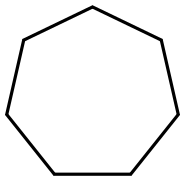
What is Cycloheptane?
Chemical properties
Clear colourless liquid
Physical properties
Clear, oily, flammable liquid with a faint odor resembling cyclohexane, cyclooctane, or gasoline.
The Uses of Cycloheptane
Cycloheptane is used as a nonpolar solvent for the chemical industry and as an intermediate in the manufacture of chemicals and pharmaceutical drugs. It can be used to get fluorocycloheptane.
Synthesis Reference(s)
Journal of the American Chemical Society, 95, p. 1669, 1973 DOI: 10.1021/ja00786a057
Tetrahedron Letters, 17, p. 463, 1976 DOI: 10.1016/S0040-4039(00)77883-X
The Journal of Organic Chemistry, 40, p. 3652, 1975 DOI: 10.1021/jo00913a008
General Description
A colorless oily liquid. Insoluble in water and less dense than water. Flash point 60°F. Vapors heavier than air. Inhalation of high concentrations may have a narcotic effect. Used to make other chemicals.
Air & Water Reactions
Highly flammable. Insoluble in water.
Reactivity Profile
Saturated aliphatic hydrocarbons, such as CYCLOHEPTANE, may be incompatible with strong oxidizing agents like nitric acid. Charring of the hydrocarbon may occur followed by ignition of unreacted hydrocarbon and other nearby combustibles. In other settings, aliphatic saturated hydrocarbons are mostly unreactive. They are not affected by aqueous solutions of acids, alkalis, most oxidizing agents, and most reducing agents.
Health Hazard
May be harmful by inhalation, ingestion, or skin absorption. May cause eye and skin irritation.
Fire Hazard
Special Hazards of Combustion Products: Vapor may travel considerable distance to a source of ignition and flash back. Container explosion may occur under fire conditions. Forms explosive mixures in air.
Environmental Fate
Biological. Cycloheptane may be oxidized by microbes to cycloheptanol, which may oxidize to
give cycloheptanone (Dugan, 1972).
Photolytic. The following rate constants were reported for the reaction of cycloheptane and OH
radicals in the atmosphere: 1.31 x 10⁻¹² cm3/molecule?sec at 298 K (Atkinson, 1985) and 1.25 x
10-11 cm3/molecule?sec (Atkinson, 1990).
Chemical/Physical. Cycloheptane will not hydrolyze because it has no hydrolyzable functional
group.
Purification Methods
Distil it from sodium using a Vigreux column (p 11), under nitrogen. It is highly flammable. [Bocian & Strauss J Am Chem Soc 99 2866 1977, Ruzicka et al. Helv Chim Acta 28 395 1945, Beilstein 5 H 92, 5 IV 92.]
Properties of Cycloheptane
| Melting point: | -12 °C |
| Boiling point: | 118.5 °C(lit.) |
| Density | 0.811 g/mL at 25 °C(lit.) |
| vapor pressure | 44 mm Hg ( 37.7 °C) |
| refractive index | n |
| Flash point: | 43 °F |
| storage temp. | Flammables area |
| solubility | Soluble in alcohol, benzene, chloroform, ether, and ligroin (Weast, 1986) |
| form | Liquid |
| color | Clear colorless |
| Water Solubility | Soluble in water 30 mg @ 20°C. |
| BRN | 1900279 |
| Henry's Law Constant | 9.35 x 10⁻² atm?m3/mol(approximate - calculated from water solubility and vapor pressure) |
| Exposure limits | Organic synthesis; gasoline component. |
| Dielectric constant | 2.0800000000000001 |
| CAS DataBase Reference | 291-64-5(CAS DataBase Reference) |
| EPA Substance Registry System | Cycloheptane (291-64-5) |
Safety information for Cycloheptane
| Signal word | Danger |
| Pictogram(s) |
 Flame Flammables GHS02  Health Hazard GHS08 |
| GHS Hazard Statements |
H225:Flammable liquids H304:Aspiration hazard |
| Precautionary Statement Codes |
P210:Keep away from heat/sparks/open flames/hot surfaces. — No smoking. P233:Keep container tightly closed. P240:Ground/bond container and receiving equipment. P241:Use explosion-proof electrical/ventilating/lighting/…/equipment. P331:Do NOT induce vomiting. P301+P310:IF SWALLOWED: Immediately call a POISON CENTER or doctor/physician. |
Computed Descriptors for Cycloheptane
New Products
9-Mesityl-10-methylacridinium perchlorate Sulfapyridine Fmoc-OSu (R)-(-)-2-Amino-1-propanol Cyclobutanone 5-bromo-4-fluoro-2-nitrobenzaldehyde 4 pentyn 1 ol N-Vinylformamide Phenethyl cinnamate Pyrrolo[1,2-a]pyrimidine-6-carboxylic acid, 4,6,7,8-tetrahydro-4-oxo-, sodium salt (1:1), (6S) Ethyl 3-phenylpropanoate β-Bromostyrene Methacrylate-PEG-Methacrylate, Mn:35000 2,4-Dihydroxyacetophenone 2-Chloro 5-Fluoro Pyridine Vasicinone 2-Chloroisonicotinic Acid Tween 80 or Polysorbate 80 5-Bromo-1-Pentyne 1-(2-Methyl-5-nitrophenyl)guanidine Nitrate Methyl trans-4-Aminocyclohexanecarboxylate Hydrochloride 2-Pentyn-1-oL 4-Nitrobenzotrifluoride N-(4-Cyano-3-(trifluoromethyl)phenyl)-2-methyloxirane-2-carboxamideRelated products of tetrahydrofuran

You may like
-
 Cycloheptane CAS 291-64-5View Details
291-64-5 -
Cycloheptane CAS 291-64-5View Details
291-64-5 -
Fmoc-OSu 98+View Details
82911-69-1 -
(R)-(-)-2-Amino-1-propanol 35320-23-1 98+View Details
35320-23-1 -
1191-95-3 Cyclobutanone 98+View Details
1191-95-3 -
213382-45-7 98+View Details
213382-45-7 -
Fmoc-OSu 98+View Details
82911-69-1 -
(R)-(-)-2-Amino-1-propanol 35320-23-1 98+View Details
35320-23-1