
Cryptochlorogenic acid
Synonym(s):4-O-(3,4-Dihydroxycinnamoyl)-D -quinic acid;4-O-Caffeoylquinic acid;Cryptochlorogenic acid
- CAS NO.:905-99-7
- Empirical Formula: C16H18O9
- Molecular Weight: 354.31
- MDL number: MFCD10566638
- SAFETY DATA SHEET (SDS)
- Update Date: 2026-05-28 03:57:17
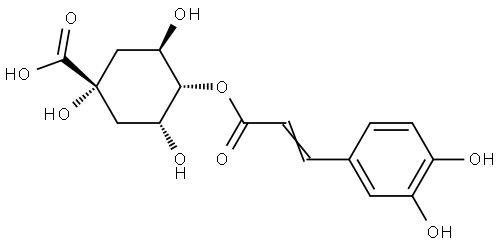
What is Cryptochlorogenic acid?
The Uses of Cryptochlorogenic acid
Cryptochlorogenic acid may be used as a reference standard in the determination of cryptochlorogenic acid in the leaves of Hibiscus sabdariffa using high performance liquid chromatography coupled with mass spectrometry (HPLC-MS).
The Uses of Cryptochlorogenic acid
4-O-Caffeoylquinic acid has been used as a reference compound for the quantification in high performance liquid chromatography-diode array detector (HPLC-DAD).
Definition
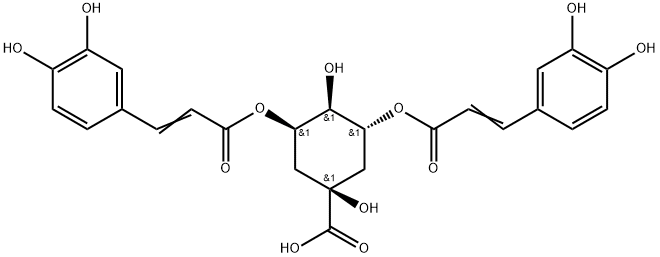
ChEBI: A cinnamate ester obtained by formal condensation of the carboxy group of trans-caffeic acid with the 4-hydroxy group of (+)-quinic acid.
General Description
Cryptochlorogenic acid is a polyphenol, found in a variety of plants, which plays a crucial role in protection against various age-related diseases.
Biochem/physiol Actions
4-O-Caffeoylquinic acid (4-CQA) is a major active antioxidant marker in mulberry leaf extract. It is an inhibitor of ferroptosis hence, it is recognized as a potent anti-diabetic agent. 4-CQA plays an important role in the upregulation of nuclear factor (erythroid-derived 2)-like 2 (Nrf2) pathway.
Properties of Cryptochlorogenic acid
| Boiling point: | 694.9±55.0 °C(Predicted) |
| Density | 1.65 |
| storage temp. | 2-8°C |
| solubility | DMSO : 50 mg/mL (141.12 mM; Need ultrasonic) |
| form | neat |
| pka | 4.07±0.50(Predicted) |
| form | Solid |
| color | White-pale yellow |
| optical activity | [α]/D -76.0±5.0°, c = 0.5 in H2O |
| Stability: | Hygroscopic |
Safety information for Cryptochlorogenic acid
| Signal word | Warning |
| Pictogram(s) |
 Exclamation Mark Irritant GHS07 |
| GHS Hazard Statements |
H302:Acute toxicity,oral H315:Skin corrosion/irritation H319:Serious eye damage/eye irritation H335:Specific target organ toxicity, single exposure;Respiratory tract irritation |
| Precautionary Statement Codes |
P261:Avoid breathing dust/fume/gas/mist/vapours/spray. P305+P351+P338:IF IN EYES: Rinse cautiously with water for several minutes. Remove contact lenses, if present and easy to do. Continuerinsing. |
Computed Descriptors for Cryptochlorogenic acid
New Products
9-Mesityl-10-methylacridinium perchlorate Sulfapyridine Fmoc-OSu (R)-(-)-2-Amino-1-propanol Cyclobutanone 5-bromo-4-fluoro-2-nitrobenzaldehyde 4 pentyn 1 ol N-Vinylformamide Phenethyl cinnamate Pyrrolo[1,2-a]pyrimidine-6-carboxylic acid, 4,6,7,8-tetrahydro-4-oxo-, sodium salt (1:1), (6S) Ethyl 3-phenylpropanoate β-Bromostyrene Methacrylate-PEG-Methacrylate, Mn:35000 2,4-Dihydroxyacetophenone 2-Chloro 5-Fluoro Pyridine Vasicinone 2-Chloroisonicotinic Acid Tween 80 or Polysorbate 80 5-Bromo-1-Pentyne 1-(2-Methyl-5-nitrophenyl)guanidine Nitrate Methyl trans-4-Aminocyclohexanecarboxylate Hydrochloride 2-Pentyn-1-oL 4-Nitrobenzotrifluoride N-(4-Cyano-3-(trifluoromethyl)phenyl)-2-methyloxirane-2-carboxamideRelated products of tetrahydrofuran

You may like
-
 Cryptochlorogenic acid CAS 905-99-7View Details
905-99-7 -
4-O-Caffeoylquinic acid CAS 905-99-7View Details
905-99-7 -
Fmoc-OSu 98+View Details
82911-69-1 -
(R)-(-)-2-Amino-1-propanol 35320-23-1 98+View Details
35320-23-1 -
1191-95-3 Cyclobutanone 98+View Details
1191-95-3 -
213382-45-7 98+View Details
213382-45-7 -
Fmoc-OSu 98+View Details
82911-69-1 -
(R)-(-)-2-Amino-1-propanol 35320-23-1 98+View Details
35320-23-1