
COG 133
Synonym(s):Ac- LRVRLASHLRKLRKRLL-NH2;Ac-Leu-Arg-Val-Arg-Leu-Ala-Ser-His-Leu- Arg-Lys-Leu-Arg-Lys-Arg-Leu-Leu-NH2;apoE(133-149);COG133;N-acetyl-L-leucyl-L-arginyl-L-valyl-L-arginyl-L-leucyl-L-alanyl-L-seryl-L-histidyl-L-leucyl-L-arginyl-L-lysyl-L-leucyl-L-arginyl-L-lysyl-L-arginyl-L-leucyl-L-Leucinamide
- CAS NO.:514200-66-9
- Empirical Formula: C97H181N37O19
- Molecular Weight: 2169.71
- MDL number: MFCD12912476
- SAFETY DATA SHEET (SDS)
- Update Date: 2026-04-24 14:58:21
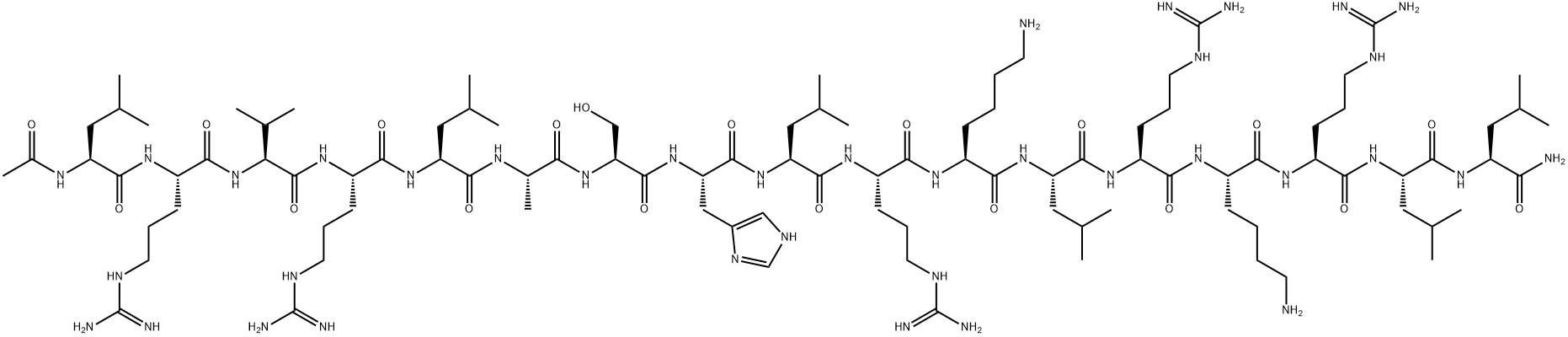
What is COG 133?
Biological Activity
cog 133, (c97h181n37o19), a peptide with the sequence ac-leu-arg-val-arg-leu-ala-ser-his-leu-arg-lys-leu-arg-lys-arg-leu-leu-amide,mw= 2169.73.apolipoprotein e (apoe) is 299 amino acids long and transports lipoproteins(1), fat-soluble vitamins, and cholesterol into the lymph system and then into the blood. it is synthesized principally in the liver, but has also been found in other tissues such as the brain, kidneys, and spleen. in the nervous system, non-neuronal cell types, most notably astroglia and microglia, are the primary producers of apoe, while neurons preferentially express the receptors for apoe. there are seven currently identified mammalian receptors for apoe which belong to the evolutionarily conserved low density lipoprotein receptor gene family.apoe was initially recognized for its importance in lipoprotein metabolism and cardiovascular disease(2). defects in apoe result in familial dysbetalipoproteinemia aka type iii hyperlipoproteinemia (hlp iii), in which increased plasma cholesterol and triglycerides are the consequence of impaired clearance of chylomicron, vldl and ldl remnants[citation needed]. more recently, it has been studied for its role in several biological processes not directly related to lipoprotein transport, including alzheimer's disease (ad), immunoregulation, and cognition(3).figure1 the structures of apolipoprotein e (apoe) cog 133figure2 potential roles of apoe in neurons and alzheimer's disease
Storage
Store at -20°C
References
1. Singh PP, Singh M, Mastana SS (2002). "Genetic variation of apolipoproteins in North Indians". Hum. Biol. 74 (5): 673–82.2. van den Elzen P, Garg S, León L, Brigl M, Leadbetter EA, Gumperz JE, Dascher CC, Cheng TY, Sacks FM, Illarionov PA, Besra GS, Kent SC, Moody DB, BrennerMB. (2005). "Apolipoprotein-mediated pathways of lipid antigen presentation.". Nature 437 (7060): 906-10.3. Zhang HL, Wu J, Zhu J (2010). "The Role of Apolipoprotein E in Guillain-Barré Syndrome and Experimental Autoimmune Neuritis". J. Biomed. Biotechnol. 2010: 357412.
Properties of COG 133
| storage temp. | -20°C |
| solubility | H2O: >1mg/mL |
| form | lyophilized |
| color | white |
| Water Solubility | Soluble to 1 mg/ml in water |
Safety information for COG 133
Computed Descriptors for COG 133
New Products
Dibenzoyl-L-tartaric acid Anhydrous (Resolution Reagent) Cis-Tosylate Dibenzo[b,f][1,4]thiazepin-11(10H)-one 1,2,3,9-Tetrahydro-9-Methyl-4H-Carbazole-4-One 1-(4-methoxyphenyl)-4-(4-Nitrophenyl)Piperazine (IT-1) BOC Piperazine 1-Benzhydrylazetane-3-carbonitrile 8-oxa-1,3-diazaspiro[4.5]decane-2,4-dione (±)-amino(2-fluorophenyl)acetic acid 2-(2-Chlorophenyl)glycine AMINO-(3-CHLORO-PHENYL)-ACETIC ACID 2'-Fluoroacetophenone METHANOL-D1(OD) TERTIARY BUTANOL-D9 N-ETHYL-D5-AMINE HYDROCHLORIDE BENZOIC ACID-D CHLOROFORM-D TOLUENE-D3 Trans,trans muconic acid HC Blue-16 4-Amino-2-chloro-6,7-dimethoxyquinazoline Ethyl 4,5-bis(2-methoxyethoxy)-2-nitrobenzoate 2,3-Dimethoxypyridine 1-(3-Chlorophenyl)piperazine hydrochlorideRelated products of tetrahydrofuran
You may like
-
 COG 133 trifluoroacetate salt CAS 514200-66-9View Details
514200-66-9 -
 Product IntroductionView Details
 -
 Product InrtroductionView Details
 -
 DGO24View Details
 -
 DGO25View Details
 -
 DGO29View Details
 -
 DGO32View Details
 -
 DGO36View Details