
Chelerythrine
Synonym(s):1,2-Dimethoxy-N-methyl(1,3)benzodioxolo(5,6-c)phenanthridinium chloride;Toddaline chloride
- CAS NO.:34316-15-9
- Empirical Formula: C21H18NO4+
- Molecular Weight: 348.37192
- MDL number: MFCD00270393
- EINECS: 251-930-0
- SAFETY DATA SHEET (SDS)
- Update Date: 2026-05-28 02:43:57
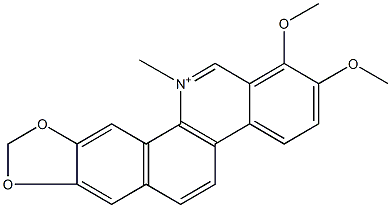
What is Chelerythrine?
The Uses of Chelerythrine
Chelerythrine Chloride is a cell permeable protein kinase C (PKC) inhibitor.
Definition
ChEBI: A benzophenanthridine alkaloid isolated from the root of Zanthoxylum simulans, Chelidonium majus L., and other Papaveraceae.
Biological Activity
Potent, cell-permeable inhibitor of protein kinase C (IC 50 = 660 nM); competitive with respect to the phosphate acceptor and non-competitive with respect to ATP. Has a wide range of biological activities, including antiplatelet, anti-inflammatory, antibacterial and antitumor effects. Activates MAPK pathways, independent of PKC inhibition. Inhibits binding of BclXL to Bak (IC 50 = 1.5 μ M) or Bad proteins and stimulates apoptosis.
Purification Methods
Chelerythrine crystallises from CHCl3 on addition of MeOH [Manske Can J Res 21B 140 1943, UV: Hruban et al. Coll Czech Chem Commun 35 3420 1970]. The pseudo base is colourless while the salts are yellow in aqueous solution and are fluorescent.
Properties of Chelerythrine
| Melting point: | 195-205°C |
| Boiling point: | 496.37°C (rough estimate) |
| Density | 1.2985 (rough estimate) |
| refractive index | 1.5614 (estimate) |
| storage temp. | Desiccate at -20°C |
| solubility | Chloroform (Slightly, Sonicated), DMSO (Slightly, Sonicated), Methanol (Slightly |
| form | Solid |
| color | Light Yellow to Dark Orange |
| Stability: | Hygroscopic |
| CAS DataBase Reference | 34316-15-9(CAS DataBase Reference) |
Safety information for Chelerythrine
| Signal word | Danger |
| Pictogram(s) |
 Skull and Crossbones Acute Toxicity GHS06  Exclamation Mark Irritant GHS07 |
| GHS Hazard Statements |
H300:Acute toxicity,oral H315:Skin corrosion/irritation H319:Serious eye damage/eye irritation H335:Specific target organ toxicity, single exposure;Respiratory tract irritation |
| Precautionary Statement Codes |
P261:Avoid breathing dust/fume/gas/mist/vapours/spray. P264:Wash hands thoroughly after handling. P264:Wash skin thouroughly after handling. P305+P351+P338:IF IN EYES: Rinse cautiously with water for several minutes. Remove contact lenses, if present and easy to do. Continuerinsing. |
Computed Descriptors for Chelerythrine
New Products
5-bromo-4-fluoro-2-nitrobenzaldehyde (R)-(-)-2-Amino-1-propanol Cyclobutanone Fmoc-OSu 1-(2-Chloroethyl)pyrrolidine Hydrochloride 2-Amino-2-(4-methylphenyl)acetic acid β-Bromostyrene Ethyl 3-phenylpropanoate Phenethyl cinnamate Dipropyl disulfide 4 pentyn 1 ol N-Vinylformamide Methacrylate-PEG-Methacrylate, Mn:35000 2,4-Dihydroxyacetophenone 2-Chloro 5-Fluoro Pyridine Vasicinone 2-Chloroisonicotinic Acid Tween 80 or Polysorbate 80 2-Butyn-1-oL 2-Pentyn-1-oL 4-Nitrobenzotrifluoride N-(4-fluoro-2-methoxy-5-nitrophenyl)-4-(1-methyl-1H-indol-3-yl)pyrimidin-2-amine Pirtobrutinib intd. N-(4-Cyano-3-(trifluoromethyl)phenyl)-2-methyloxirane-2-carboxamideRelated products of tetrahydrofuran


You may like
-
 Fmoc-OSu 98+View Details
82911-69-1 -
(R)-(-)-2-Amino-1-propanol 35320-23-1 98+View Details
35320-23-1 -
7250-67-1 1-(2-Chloroethyl)pyrrolidine Hydrochloride 98+View Details
7250-67-1 -
13227-01-5 98+View Details
13227-01-5 -
7250-67-1 1-(2-Chloroethyl)pyrrolidine Hydrochloride 98+View Details
7250-67-1 -
13227-01-5 98+View Details
13227-01-5 -
7250-67-1 1-(2-Chloroethyl)pyrrolidine Hydrochloride 98+View Details
7250-67-1 -
13227-01-5 98+View Details
13227-01-5