
Cellulose triacetate
Synonym(s):Triacetylcellulose
- CAS NO.:9012-09-3
- Empirical Formula: C40H54O27
- Molecular Weight: 966.84056
- MDL number: MFCD00132680
- EINECS: 227-712-6
- SAFETY DATA SHEET (SDS)
- Update Date: 2026-09-12 18:50:04
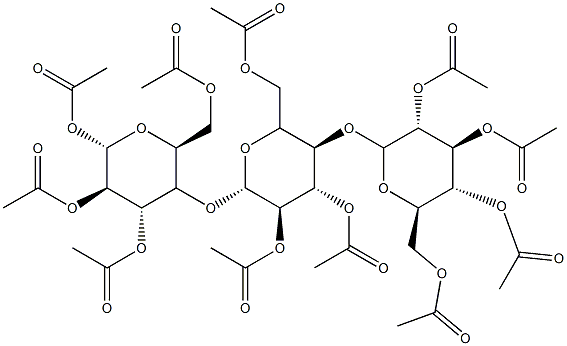
What is Cellulose triacetate?
Description
Glacial acetic acid is introduced gradually in the reactor to dissolve the newly formed cellulose acetate. The product obtained is the nonflammable cellulose triacetate which is insoluble in most organic solvents including acetone, and ether but it is soluble in chloroform, dichloromethane, glacial acetic acid and nitrobenzene. Cellulose triacetate exhibits good dimensional stability and heat resistance, possesses a dielectric constant, resistance to water and good optical transparency. Mechanically, cellulose triacetate has good folding endurance and burst strength. In order to render it soluble, a retrogadation (reverse) reaction, in which one ester functional group is partially saponified, is used to yield the cellulose diacetate or simply cellulose acetate which is soluble in acetone but not in chloroform. Afterwards, its dissolution into a solvent and addition of a plasticizer yields commercial cellulose acetate.
Chemical properties
white to slightly yellow pellets or rods
The Uses of Cellulose triacetate
Cellulose Triacetate Polymer can be used to treat, prevent, and/or alleviate osteoarthritis.
What are the applications of Application
Cellulose triacetate is a polymer film
Preparation
Cellulose triacetate is prepared according to the following reaction:
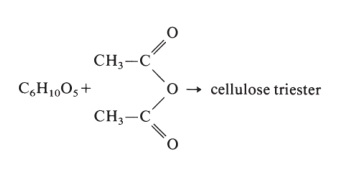
Because cellulose triacetate has a high softening temperature, it must be processed in solution. A mixture of dichloromethane and methanol is a common solvent.
Cellulose triacetate sheeting and film have good gauge uniformity and good optical clarity. Cellulose triacetate products have good dimensional stability and resistance to water and have good folding endurance and burst strength. It is highly resistant to solvents such as acetone. Cellulose triacetate products have good heat resistance and a high dielectric constant.
Definition
ChEBI: Triacetylcellulose is a (1->4)-beta-D-glucan compound formed by total acetylation of cellulose. It is functionally related to a (1->4)-beta-D-glucan.
Properties of Cellulose triacetate
| Melting point: | 120-160 °C |
| Density | 1.29 g/cm3 |
| solubility | chloroform: 0.1 g/10 mL leave for 5 h, clear, colorless |
| form | pellets |
| color | White to slightly yellow |
| CAS DataBase Reference | 9012-09-3 |
| EPA Substance Registry System | Cellulose, triacetate (9012-09-3) |
Safety information for Cellulose triacetate
Computed Descriptors for Cellulose triacetate
New Products
9-Mesityl-10-methylacridinium perchlorate Sulfapyridine Fmoc-OSu (R)-(-)-2-Amino-1-propanol Cyclobutanone 5-bromo-4-fluoro-2-nitrobenzaldehyde 4 pentyn 1 ol N-Vinylformamide Phenethyl cinnamate Pyrrolo[1,2-a]pyrimidine-6-carboxylic acid, 4,6,7,8-tetrahydro-4-oxo-, sodium salt (1:1), (6S) Ethyl 3-phenylpropanoate β-Bromostyrene Methacrylate-PEG-Methacrylate, Mn:35000 2,4-Dihydroxyacetophenone 2-Chloro 5-Fluoro Pyridine Vasicinone 2-Chloroisonicotinic Acid Tween 80 or Polysorbate 80 5-Bromo-1-Pentyne 1-(2-Methyl-5-nitrophenyl)guanidine Nitrate Methyl trans-4-Aminocyclohexanecarboxylate Hydrochloride 2-Pentyn-1-oL 4-Nitrobenzotrifluoride N-(4-Cyano-3-(trifluoromethyl)phenyl)-2-methyloxirane-2-carboxamideRelated products of tetrahydrofuran





You may like
-
 Cellulose triacetate CAS 9012-09-3View Details
9012-09-3 -
Cellulose triacetate CAS 9012-09-3View Details
9012-09-3 -
Fmoc-OSu 98+View Details
82911-69-1 -
(R)-(-)-2-Amino-1-propanol 35320-23-1 98+View Details
35320-23-1 -
1191-95-3 Cyclobutanone 98+View Details
1191-95-3 -
213382-45-7 98+View Details
213382-45-7 -
Fmoc-OSu 98+View Details
82911-69-1 -
(R)-(-)-2-Amino-1-propanol 35320-23-1 98+View Details
35320-23-1