
Cellulose acetate phthalate
Synonym(s):Cellulose acetate phthalate
- CAS NO.:9004-38-0
- Empirical Formula: C116H116O64
- Molecular Weight: 2534.12
- MDL number: MFCD00072769
- EINECS: 618-347-7
- Update Date: 2026-05-28 06:14:01
What is Cellulose acetate phthalate?
Chemical properties
white granular powder
Chemical properties
Cellulose acetate phthalate is a hygroscopic, white to off-white, freeflowing powder, granule, or flake. It is tasteless and odorless, or might have a slight odor of acetic acid.
The Uses of Cellulose acetate phthalate
Enteric coating in pharmaceutical products.
Production Methods
Cellulose acetate phthalate is produced by reacting the partial acetate ester of cellulose with phthalic anhydride in the presence of a tertiary organic base such as pyridine, or a strong acid such as sulfuric acid.
Pharmaceutical Applications
Cellulose acetate phthalate (CAP) is used as an enteric film coating
material, or as a matrix binder for tablets and capsules. Such
coatings resist prolonged contact with the strongly acidic gastric
fluid, but dissolve in the mildly acidic or neutral intestinal
environment.
Cellulose acetate phthalate is commonly applied to solid-dosage
forms either by coating from organic or aqueous solvent systems, or
by direct compression. Concentrations generally used are 0.5–9.0%
of the core weight. The addition of plasticizers improves the water
resistance of this coating material, and formulations using such
plasticizers are more effective than when cellulose acetate phthalate
is used alone.
Cellulose acetate phthalate is compatible with many plasticizers,
including acetylated monoglyceride; butyl phthalybutyl glycolate;
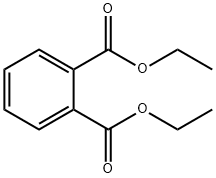
dibutyl tartrate; diethyl phthalate; dimethyl phthalate; ethyl
phthalylethyl glycolate; glycerin; propylene glycol; triacetin; triacetin
citrate; and tripropionin. It is also used in combination with
other coating agents such as ethyl cellulose, in drug controlledrelease
preparations.
Therapeutically, cellulose acetate phthalate has recently been
reported to exhibit experimental microbicidal activity against
sexually transmitted disease pathogens, such as the HIV-1 retrovirus.
Safety Profile
An experimental teratogen. When heated to decomposition it emits acrid smoke and irritating fumes.
Safety
Cellulose acetate phthalate is widely used in oral pharmaceutical products and is generally regarded as a nontoxic material, free of adverse effects. Results of long-term feeding in rats and dogs have indicated a low oral toxicity. Rats survived daily feedings of up to 30% in the diet for up to 1 year without showing a depression in growth. Dogs fed 16 g daily in the diet for 1 year remained normal.
Storage
Slow hydrolysis of cellulose acetate phthalate will occur under prolonged adverse conditions such as high temperatures and high humidity, with a resultant increase in free acid content, viscosity, and odor of acetic acid. However, cellulose acetate phthalate is stable if stored in a well-closed container in a cool, dry place.
Incompatibilities
Cellulose acetate phthalate is incompatible with ferrous sulfate, ferric chloride, silver nitrate, sodium citrate, aluminum sulfate, calcium chloride, mercuric chloride, barium nitrate, basic lead acetate, and strong oxidizing agents such as strong alkalis and acids.
Regulatory Status
Included in the FDA Inactive Ingredients Database (oral tablets). Included in nonparenteral medicines licensed in the UK. Included in the Canadian List of Acceptable Non-medicinal Ingredients.
Properties of Cellulose acetate phthalate
| solubility | Practically insoluble in water, freely soluble in acetone, soluble in diethylene glycol, practically insoluble in ethanol (96 per cent) and in methylene chloride. It dissolves in dilute solutions of alkali hydroxides |
| form | neat |
| EPA Substance Registry System | Cellulose, acetate hydrogen 1,2-benzenedicarboxylate (9004-38-0) |
Safety information for Cellulose acetate phthalate
Computed Descriptors for Cellulose acetate phthalate
Cellulose acetate phthalate manufacturer
Attar Global
Chemie Trade
Bazayan & Co.
New Products
9-Mesityl-10-methylacridinium perchlorate Sulfapyridine Fmoc-OSu (R)-(-)-2-Amino-1-propanol Cyclobutanone 5-bromo-4-fluoro-2-nitrobenzaldehyde 4 pentyn 1 ol N-Vinylformamide Phenethyl cinnamate Pyrrolo[1,2-a]pyrimidine-6-carboxylic acid, 4,6,7,8-tetrahydro-4-oxo-, sodium salt (1:1), (6S) Ethyl 3-phenylpropanoate β-Bromostyrene Methacrylate-PEG-Methacrylate, Mn:35000 2,4-Dihydroxyacetophenone 2-Chloro 5-Fluoro Pyridine Vasicinone 2-Chloroisonicotinic Acid Tween 80 or Polysorbate 80 5-Bromo-1-Pentyne 1-(2-Methyl-5-nitrophenyl)guanidine Nitrate Methyl trans-4-Aminocyclohexanecarboxylate Hydrochloride 2-Pentyn-1-oL 4-Nitrobenzotrifluoride N-(4-Cyano-3-(trifluoromethyl)phenyl)-2-methyloxirane-2-carboxamideRelated products of tetrahydrofuran

You may like
-
 9004-38-0 Cellulose acetate phthalate 99%View Details
9004-38-0 -
9004-38-0 98%View Details
9004-38-0 -
Cellulose acetate phthalate,95% 99%View Details
9004-38-0 -
Cellulose acetate phthalate CAS 9004-38-0View Details
9004-38-0 -
Cellulose Acetate Phthalate extrapure CAS 9004-38-0View Details
9004-38-0 -
Cellacefate CAS 9004-38-0View Details
9004-38-0 -
Cellulose acetate phthalate,95% CAS 9004-38-0View Details
9004-38-0 -
Fmoc-OSu 98+View Details
82911-69-1