
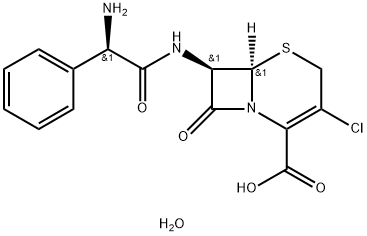
Cefaclor monohydrate
- CAS NO.:70356-03-5
- Empirical Formula: C15H16ClN3O5S
- Molecular Weight: 385.82
- MDL number: MFCD00071999
- EINECS: 641-991-5
- SAFETY DATA SHEET (SDS)
- Update Date: 2026-07-14 16:49:18
What is Cefaclor monohydrate?
Description
Cefaclor was found by Eli Lilly & Co. in 1976 in the course of studies on the improvement of synthetic procedures for cephalexin. The intermediates with chlorine at the 3 position of the cephem nucleus have excellent antibacterial activity. Cefaclor was selected from among the various derivatives that differed at the 7 position because of its strong activity and high bioavailability following oral administration.
Chemical properties
Crystalline Solid
The Uses of Cefaclor monohydrate
Second-generation cephalosporin antibiotic. Antibacterial
The Uses of Cefaclor monohydrate
Antibacterial;Bacterial transpeptidase inhibitor
The Uses of Cefaclor monohydrate
Second-generation cephalosporin antibiotic. Antibacterial.
What are the applications of Application
Cefaclor, Monohydrate is a potentially useful antimicrobial agent for in vitro studies of pathogens
brand name
Ceclor (Lilly); Raniclor (Ranbaxy).
Contact allergens
Cefaclor is a semisynthetic cephalosporin antibiotic, related to cefalexin, and a frequent inducer of serum sickness-like reactions.
Properties of Cefaclor monohydrate
| Melting point: | >180°C (dec.) |
| storage temp. | Keep in dark place,Inert atmosphere,2-8°C |
| solubility | Slightly soluble in water, practically insoluble in methanol and in methylene chloride. |
| form | neat |
| form | Solid |
| color | White to Light Beige |
| CAS DataBase Reference | 70356-03-5(CAS DataBase Reference) |
Safety information for Cefaclor monohydrate
| Signal word | Danger |
| Pictogram(s) |
 Health Hazard GHS08 |
| GHS Hazard Statements |
H317:Sensitisation, Skin H334:Sensitisation, respiratory |
| Precautionary Statement Codes |
P261:Avoid breathing dust/fume/gas/mist/vapours/spray. P280:Wear protective gloves/protective clothing/eye protection/face protection. P284:Wear respiratory protection. P304+P340:IF INHALED: Remove victim to fresh air and Keep at rest in a position comfortable for breathing. P333+P313:IF SKIN irritation or rash occurs: Get medical advice/attention. P342+P311:IF experiencing respiratory symptoms: call a POISON CENTER or doctor/physician. |
Computed Descriptors for Cefaclor monohydrate
New Products
N-Carbethoxy-4-piperidone 1-Aminocyclopentane carbonitrile Tetrabutylammonium perchlorate N,O-Dimethylhydroxylamine hydrochloride (RS)-beta-Amino-beta-(4-bromophenyl)propionic acid 2-Amino-5-bromo-4-(trifluoromethyl)pyridine N-Vinylformamide 4 pentyn 1 ol Phenethyl cinnamate Dipropyl disulfide Ethyl 3-phenylpropanoate β-Bromostyrene Methacrylate-PEG-Methacrylate, Mn:35000 2,4-Dihydroxyacetophenone 2-Chloro 5-Fluoro Pyridine Vasicinone 2-Chloroisonicotinic Acid Tween 80 or Polysorbate 80 5-Bromo-1-Pentyne 1-(2-Methyl-5-nitrophenyl)guanidine Nitrate Methyl trans-4-Aminocyclohexanecarboxylate Hydrochloride N-(4-Cyano-3-(trifluoromethyl)phenyl)-2-methyloxirane-2-carboxamide 2-Pentyn-1-oL 4-NitrobenzotrifluorideRelated products of tetrahydrofuran



You may like
-
 Cefaclor Monohydrate CAS 70356-03-5View Details
70356-03-5 -
Cefaclor CAS 70356-03-5View Details
70356-03-5 -
144-83-2 Sulfapyridine 98+View Details
144-83-2 -
29976-53-2 98+View Details
29976-53-2 -
6638-79-5 N,O-Dimethylhydroxylamine hydrochloride 98+View Details
6638-79-5 -
674783-97-2 98+View Details
674783-97-2 -
1-Aminocyclopentane carbonitrile 98+View Details
49830-37-7 -
Tetrabutylammonium perchlorate 1923-70-2 98+View Details
1923-70-2