
CADMIUM PHOSPHATE (ORTHO)
- CAS NO.:13477-17-3
- Empirical Formula: Cd3O8P2
- Molecular Weight: 527.18
- MDL number: MFCD00049414
- EINECS: 236-764-9
- SAFETY DATA SHEET (SDS)
- Update Date: 2026-05-26 16:21:34
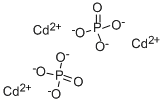
What is CADMIUM PHOSPHATE (ORTHO)?
Chemical properties
powder(s) [CRC10]
The Uses of CADMIUM PHOSPHATE (ORTHO)
Cadmium orthophosphate (CAS# 13847-17-1) is an inorganic salt and common soil pollutant.
Safety Profile
Confirmed human carcinogen. Poison by inhalation. When heated to decomposition it emits toxic fumes of Cd and PO,. See CADMIUM COMPOUNDS and PHOSPHATES.
Properties of CADMIUM PHOSPHATE (ORTHO)
| Melting point: | ~1500℃ [CRC10] |
| solubility | insoluble in H2O |
| form | powder |
| Water Solubility | insoluble H2O |
| Solubility Product Constant (Ksp) | pKsp: 32.6 |
| CAS DataBase Reference | 13477-17-3 |
| EPA Substance Registry System | Phosphoric acid, cadmium salt (2:3) (13477-17-3) |
Safety information for CADMIUM PHOSPHATE (ORTHO)
Computed Descriptors for CADMIUM PHOSPHATE (ORTHO)
New Products
2-(2-Chlorophenyl)glycine Propiolic Acid 1-(3-Hydroxy-4-methoxyphenyl)-2-nitroethene (±)-amino(2-fluorophenyl)acetic acid trans-3-Benzyloxy-4-methoxy-beta-nitrostyrene 1-Pentadecanol 4-(4-Αminophenyl)-3-Morpholinone 3-Morpholino-1-(4-(2-oxopiperidin-1-yl) phenyl)-5,6-dihyropyridin-2-(1H)-one 1-(4-Aminophenyl)-3-morpholino-5,6-dihydropyridin-2(1H)-one N-cyanoacetylurethane 1H-IndazoleRelated products of tetrahydrofuran



You may like
-
 CADMIUM PHOSPHATE 13477-17-3 99%View Details
13477-17-3 -
Cadmium phosphate CAS 13477-17-3View Details
13477-17-3 -
 White Crystal Cadmium Phosphate Case no:13477-17-3View Details
13477-17-3 -
471-25-0 Propiolic Acid 98+View Details
471-25-0 -
84145-28-8 98+View Details
84145-28-8 -
2-(2-Chlorophenyl)glycine 88744-36-9 98+View Details
88744-36-9 -
40216-83-9 trans-4-Hydroxy-L-proline methyl ester hydrochloride 98+View Details
40216-83-9 -
1-(3-Hydroxy-4-methoxyphenyl)-2-nitroethene 98+View Details
39816-35-8
Statement: All products displayed on this website are only used for non medical purposes such as industrial applications or scientific research, and cannot be used for clinical diagnosis or treatment of humans or animals. They are not medicinal or edible.